


INTRODUCTION
The global technology landscape has undergone a seismic metamorphosis in recent years. If the previous decade was marked by the rise of social media and cloud computing, the era that begins and culminates in 2026 will be defined by autonomy and embedded intelligence. Artificial Intelligence (AI) is the operating system of all future innovation.
2026 will be the year when companies stop asking “What can AI do?” and start asking “How can we manage what AI is already doing?”. The focus shifts from generative capability (text, image, code) to strategic execution capability and the urgent need for supporting infrastructure (security, computing and sustainability) to sustain this revolution.
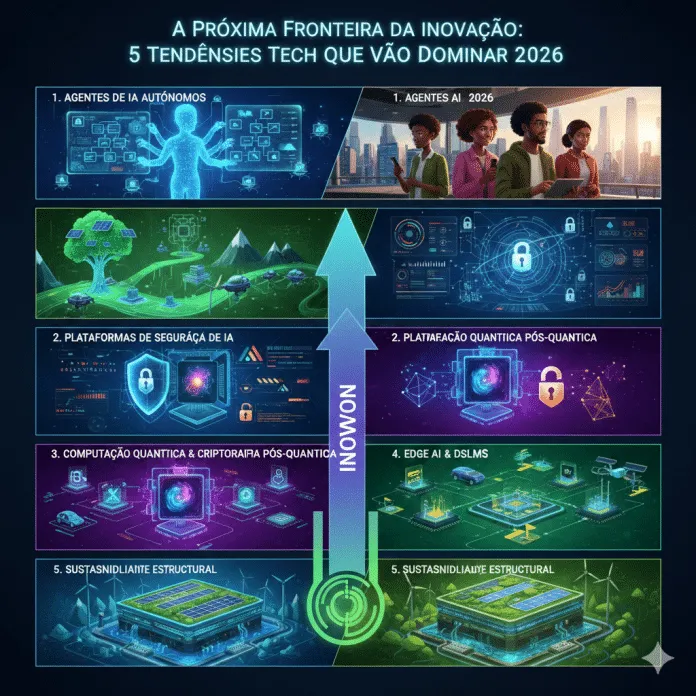
Below, we explore in depth the five most transformative technology trends that will redefine the global landscape in 2026.
1. Autonomous AI Agents (Agentic AI): The Transformation of Work
The most disruptive trend for 2026 is the consolidation of Autonomous AI Agents. Unlike generative AI models that only respond to prompts (direct commands), AI Agents are systems designed to:
-
Plan: Define a sequence of steps to achieve a complex objective.
-
Act: Execute these steps, interacting with software, APIs and external databases.
-
Learn: Receive feedback from the environment and adjust the plan to optimize results.
-
Manage: Oversee subtasks and delegate to other AIs or humans, when necessary.
The Leap from Tool to Collaborator
The impact of AI Agents is profound. They transform AI from a simple productivity tool (like a writing assistant) into a strategic digital collaborator capable of managing end-to-end projects.
Practical Examples in 2026:
-
Marketing: An AI Agent can monitor campaign performance, identify a drop in conversions in real time, generate new creative optimized for the target audience, update website code with new elements, and notify the manager only when the new cycle is running successfully.
-
Software Development: An Agent can receive a bug description, write correction code, generate unit tests, submit a pull request (PR), receive feedback from a human reviewer and make necessary adjustments, completing the development cycle almost autonomously.
-
Finance: Trading agents can monitor thousands of macroeconomic and microeconomic variables, execute complex operations across multiple exchanges and report consolidated risk at end of day.
The challenge lies in trust and explainability. As these agents gain autonomy, companies need robust tools to audit their decisions and ensure they operate within ethical and regulatory boundaries. Agent management will become a new IT specialty.
2. AI Security and Governance Platforms (AISP)
With the proliferation of Large Language Models (LLMs) and the rise of Autonomous Agents, the attack vector and compliance risk explode. In 2026, the demand for AI Security Platforms (AISP) will cease to be a niche and become an essential multi-billion dollar market.
The risk is no longer just from external hackers; it is internal, structural and ethical.
Risks Addressed by AISP in 2026:
-
Data Poisoning Attacks: Where malicious data is introduced into the training dataset, causing the model to behave in biased or unsafe ways in the future.
-
Prompt Injection: Attacks where malicious users manipulate the model with sophisticated commands to make it ignore its security rules or disclose confidential information.
-
Bias & Compliance Risk: Ensuring that the model is not perpetuating existing biases in the data (racial bias, gender bias, etc.) and that all its decisions are in strict compliance with laws such as GDPR (Europe) and other data privacy legislation in force.
AISP will provide layers of continuous monitoring, decision auditing, input/output data filtering and AI Explainability (XAI) tools. Without these platforms, AI adoption in regulated sectors (banking, healthcare, government) will be paralyzed by fear of legal and reputational risk.
3. Practical Quantum Computing and the Urgency of Post-Quantum Cryptography
Although general-purpose computers are still a few years away, 2026 will be an inflection point in the practical use of Quantum Computing systems and the security response to them.
The Impact on the Computing Side
The use of quantum computing will focus in 2026 on high-value spaces that require exponentially superior processing, such as:
-
Optimization: Solving optimization problems (such as the traveling salesman problem) at global scale, optimizing large delivery fleet traffic in real time.
-
Molecular Simulation: Accelerating the discovery of new materials and drugs by simulating atomic interaction of complex molecules in ways unreachable by classical systems.
-
Financial Modeling: Risk assessment and portfolio optimization, incorporating thousands of variables simultaneously to predict market failures.
The Cryptography Threat
The greatest concern in 2026 will be Shor’s algorithm, which in theory allows a quantum computer to break most current public encryption schemes (such as RSA and ECC), which protect everything from banking transactions to military communications.
The urgent trend is the adoption of Post-Quantum Cryptography (PQC). Organizations with “harvest data” – information that needs to remain secret for 10 or 20 years – will be under pressure to migrate their key systems and digital certificates to PQC standards (such as CRYSTALS-Dilithium and CRYSTALS-Kyber), standardized by bodies like NIST. Failing to start this transition now will leave governments and large corporations extremely vulnerable.
4. Edge AI, Specialization and DSLMs
The next major limitation of AI is latency. The need to send data to centralized cloud for processing and wait for a response is not viable for critical applications like robotic surgery, autonomous vehicles or real-time industrial monitoring. 2026 is the year when AI processing migrates massively to the “edge”, meaning the device itself.
Advantages of Edge AI:
-
Low Latency: Decisions made in milliseconds, crucial for safety.
-
Privacy: Sensitive data (such as internal surveillance cameras or health data) are processed and stored locally, never leaving the organization’s perimeter.
-
Reliability: Continuous operation even in locations with intermittent connectivity.
The Focus on DSLMs (Domain-Specific Language Models)
The concept of a single “Large Language Model” (LLM) that does everything will become inefficient. The trend will be toward creating Domain-Specific Language Models (DSLMs).
A DSLM is a smaller, faster, cheaper model to run locally, trained only on a very specific knowledge corpus.
-
A Legal DSLM will be trained exclusively on millions of pages of jurisprudence and legal codes.
-
An Industrial Maintenance DSLM will be trained only on equipment manuals and failure sensor data.
This specialization allows AI to achieve levels of precision and safety that would be impossible for generic models, accelerating adoption in highly technical and regulated industries. The combination of Edge AI with DSLMs democratizes access to cutting-edge intelligence outside of large data centers.
5. Structural Sustainability and Green IT
The AI revolution is an intense energy revolution. Training a state-of-the-art LLM can consume as much energy as dozens of homes in a year. 2026 marks the moment when sustainability ceases to be a marketing appendix and becomes a design and engineering imperative for IT infrastructure.
Companies will be under regulatory and market pressure to adopt the concept of “Sustainability by Design”.
Green IT Framework:
-
Hardware Optimization for AI: Development and adoption of chips and AI accelerators (such as GPUs and TPUs) that deliver more teraflops per watt, drastically reducing power consumption in inference processing.
-
Circular and Strategic Data Centers: The focus will shift to liquid cooling solutions (more efficient than air cooling) and locating new data centers in regions with renewable energy surplus (solar, wind). There is a growing trend of Data Centers “underwater” or in cold locations to optimize consumption.
Efficient Computing: Implementation of AI techniques to manage the data center’s own energy consumption, shutting down or hibernating non-essential resources in real time.
In 2026, sustainability will become a business metric comparable to cost and performance. Solutions that do not demonstrate a clear path to carbon neutrality will be overlooked.
Conclusion: The Interconnection of Trends
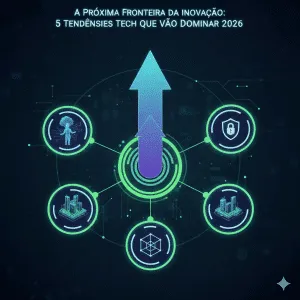
The five trends that will dominate 2026 do not exist in isolation; they interweave. The need for Security and Governance only grows due to the autonomy and complexity of AI Agents. The migration of AI to the Edge is driven both by the need for low latency and by Sustainability imperatives (smaller models consume less). And all this digital infrastructure must prepare for the imminent threat/opportunity of Quantum Computing.
In 2026, innovation will be about integrating this autonomous intelligence in a safe, efficient and ethical manner. Organizations that understand and invest in these five frontiers of innovation will get ahead, transforming risk into competitive advantage.