


Alexa Compatible Devices: Complete Guide
Home automation technology has evolved rapidly in recent years, and because of this, the search for devices compatible with Alexa is growing increasingly. While many people know only the basic functions of the assistant, much of its potential is revealed when various devices are connected to the intelligent ecosystem. Thus, this complete guide was created precisely to explain how these devices work, why they make a difference in daily life, and what are the best options for those who want to build or expand a smart home. Additionally, we’ll show you how to integrate them efficiently, so everything works smoothly.
Before exploring each category, it’s important to understand that Alexa acts as a command center capable of uniting different brands and technologies. Therefore, even if you own devices from different manufacturers, they can work together, as long as they follow compatible protocols. This is why so many people choose Alexa as their main hub, since it facilitates communication between different devices, allowing for more complete automations. Meanwhile, other assistants may require more closed ecosystems, which limits possibilities.
How do Alexa compatible devices work?
In general, devices compatible with Alexa are those that can be controlled by voice, routines, or automated commands through the Amazon Alexa application. For this to happen, manufacturers integrate their products into Amazon’s system, allowing users to configure and use additional features. Once the device is connected to Wi-Fi or via its own hub, it becomes accessible through Alexa, which begins to recognize its functions. That’s why the installation process is usually simple and quick.
Additionally, Alexa uses cloud connectivity, which means that commands sent by the user are interpreted and processed quickly, allowing for almost immediate responses. While many people believe that voice control is the main advantage, the truth is that automated routines make the use even more powerful. For example, you can make the lights turn on automatically at dusk, while the fan turns on only when the temperature rises. All of this happens because Alexa coordinates actions between devices, combining convenience and intelligence.
Categories of Alexa compatible devices

There are several categories of devices that work with Alexa, and each of them contributes to a specific type of automation. The following are the main ones:
1. Smart lights
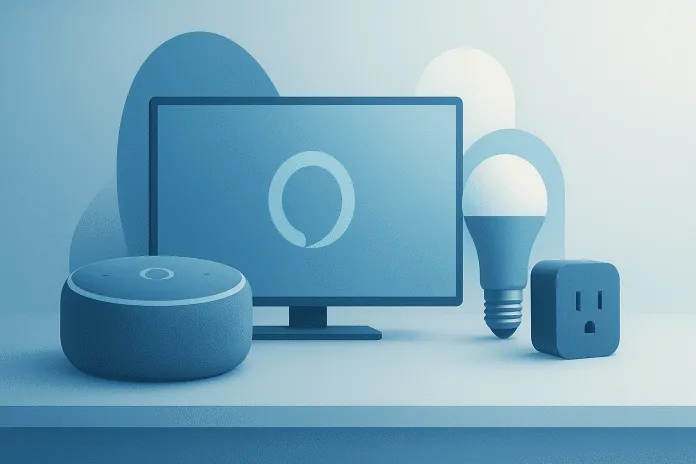
Smart lights are probably the most popular devices, as they allow you to control lighting by voice, app, or specific routines. They can change color, adjust intensity, and turn on or off automatically. Since they are simple to install, many people start building their smart home with them. Additionally, they are compatible with various protocols, which facilitates network expansion.
2. Smart outlets
Smart outlets turn any ordinary device into an Alexa-controlled device. Just connect them to the traditional outlet and synchronize them to the app. This is very useful for equipment like fans, coffee makers, chargers, lamps, and even older sound systems. While it may seem simple, this functionality allows you to create extremely practical routines, such as turning on the coffee maker in the morning or turning off all devices when leaving the house.
3. Locks and security devices
Security devices compatible with Alexa include cameras, locks, motion sensors, and alarms. Since they offer more control and protection, they are ideal for those who want to monitor their home, even when away. Thus, Alexa can send notifications, display camera images on smart screens, and even alert when a door is opened. In this case, the integration between security and automation provides more peace of mind to the user.
4. Smart assistants and displays
The Echo devices themselves, such as the Echo Dot or Echo Show, are compatible with Alexa by default and serve as smart home hubs. They allow you to perform voice commands, view camera images, make calls, control music, and interact with other devices. Additionally, since they are always connected, they function as a starting point for communication between various home devices.
5. Smart appliances
More and more manufacturers are launching appliances integrated with Alexa, such as refrigerators, microwaves, washing machines, robot vacuums, and air purifiers. Thus, they offer features like remote cycle start, usage reports, and completion notifications. Although these features vary by brand, the integration makes routines easier and makes the environment more practical.
6. Universal controls
Universal controls compatible with Alexa are devices capable of turning infrared devices into voice-controllable equipment. This includes televisions, air conditioners, decoders, and even projectors. Thus, even if the device is not originally smart, it will respond to automated commands. Meanwhile, the user gains more comfort and centralized control.
Advantages of using Alexa compatible devices:
There are several advantages to integrating these devices in your home, and one of the main ones is centralization. When everything is connected to Alexa, the user eliminates the need for multiple apps, since the assistant unifies control. Additionally, automation reduces repetitive tasks, increasing convenience in daily life. Even though some people imagine that this type of technology is complicated, the truth is that it becomes quite intuitive after the initial setup.
Another important point is energy savings, as many devices allow consumption monitoring, automatic shutdown, or on-demand operation. This contributes to more efficient device usage. Additionally, security also increases, as smart sensors, cameras, and locks help protect the residence, including when the user is away.
Another benefit worth highlighting is the ability to create personalized environments. For example, you can program routines like “cinema mode”, in which the lights dim, the TV turns on, and the air conditioner adjusts to the ideal temperature. Meanwhile, routines like “good night” can turn off all devices, lock smart doors, and activate automatic alarms.
How to choose the best Alexa compatible devices:

When choosing devices for your smart home, it’s ideal to check a few points. First, confirm that the product is officially compatible with Alexa, as this avoids integration issues. Then, consider connectivity: Wi-Fi devices are the most common, but some models use Zigbee, Matter, or Z-Wave. Since each protocol has specific advantages, it’s important to evaluate what best meets your needs.
Additionally, consider brand quality, support offered, and ease of configuration. While there are cheaper options, they don’t always guarantee stability. That’s why it’s recommended to choose recognized brands, especially when it comes to security and complex routines.
Another important point is automation planning. While you can start with few devices, it’s interesting to think about how the network can grow in the future. That way, compatibility between devices will be maintained, avoiding rework and unnecessary expenses later.
Conclusion:
Alexa compatible devices offer a practical and modern way to transform any environment into a smart home. With so many options available, it’s possible to build a complete ecosystem that includes lighting, security, entertainment, climate control, and appliances. Additionally, Alexa facilitates integration, allowing all devices to work harmoniously. Therefore, if you want more convenience, comfort, and automation in your daily life, exploring this universe is an excellent start.