

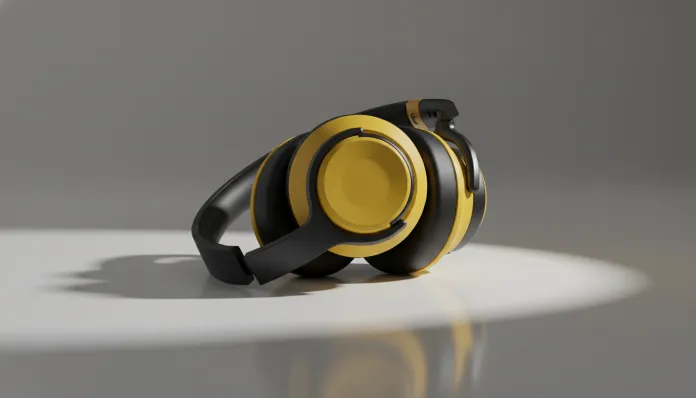

The wireless headphone market grew over 340% between 2020 and 2025, according to IDC data, and by 2026 the competition for the entry segment became fiercer than ever. With dozens of options between R$ 150 and R$ 400, the Brazilian consumer faces a curious paradox: more choice than ever, but more difficulty deciding. It’s precisely in this price range that the JBL Tune 520BT tries to survive — and, surprisingly, it still manages to be relevant even after almost three years on the market.
The problem this headphone solves is simple and universal: you want to ditch the cable, have good battery life, decent sound, and not spend a fortune. Sounds basic, but execution is what separates the good from the bad. The JBL Tune 520BT was launched in 2023, went through firmware updates throughout 2024 and 2025, and continues appearing at the top of entry-level recommendation lists. But in 2026, with more aggressive Chinese competitors and JBL’s own cheaper options in the mix, does it still make sense?
To answer that, I spent four weeks with the Tune 520BT as my main headphone. I tested it on São Paulo metro routes (heavy ambient noise, ~85dB background noise), home office work sessions, gym workouts, Teams and Google Meet video calls, and weekend streaming marathons. I’ll tell you everything with real data, no press release romanticizing.
Technical Specifications
| Specification | Detail |
|---|---|
| Type | Over-ear wireless (supra-aural — covers entire ear) |
| Driver | 40mm dynamic |
| Frequency Response | 20Hz – 20kHz |
| Impedance | 32 Ohms |
| Sensitivity | 96dB SPL @ 1kHz |
| Connectivity | Bluetooth 5.3 |
| Supported Codecs | SBC, AAC |
| Bluetooth Range | Up to 10 meters (real-world use: ~7-8m) |
| Battery | 57 hours (with Pure Bass off) / ~45h real-world use |
| Charging | USB-C, 2 hours for full charge |
| Weight | 160g |
| Microphone | Single integrated microphone (no array) |
| Foldable | Yes, folds for transport |
| Available Colors (2026) | Black, White, Blue, Pink, Purple, Canary Yellow |
| App | JBL Headphones App (iOS and Android) |
| Current Firmware Version | v3.2.1 (updated March 2026) |
Pros and Cons
Pros:
- Absurd battery life — 57 hours on paper becomes 44-47 hours in real-world use at ~60-65% volume, which is extraordinary for the price. You charge once a week.
- Native USB-C — seems basic in 2026, but competitors in this price range still use Micro-USB. Huge point for JBL.
- Stable Bluetooth 5.3 — quick reconnection, low latency for streaming (low-latency mode via app around 40ms with AAC), no drops in normal use.
- Feather-light — 160g is very light for an over-ear. 4-5 hours of continuous use without pain or excessive pressure.
- Well-calibrated Pure Bass — the bass boost doesn’t destroy the midrange like cheaper competitors. It’s a subtle V-shape (plenty of bass and treble, mids slightly recessed), not a mess.
- Foldable and compact — fits in any backpack without the rigid case JBL doesn’t include (yes, that’s a con, but the folded design helps).
- Actively updated firmware — JBL released three updates between 2024 and 2026, improving Bluetooth stability and app-based equalization.
Cons:
- No active noise cancellation (ANC) — passive isolation is decent (muffles midrange and high frequencies well), but on subways or planes, ambient noise bleeds through. This is the product’s clearest limitation.
- Mediocre microphone — during calls, users report “quiet” sound and background noise pickup in busy locations. Not for those who take many professional calls.
- Plastic construction — functional, no creaks, but doesn’t feel premium. The headband adjustment is slightly loose on smaller heads.
- No aptX or LDAC codec support — support for only SBC and AAC means Android users with high-resolution sources won’t get maximum theoretical quality. In practice, for Spotify and YouTube, it’s imperceptible.
- No included case — a 2026 headphone in this price range should at least come with a pouch.
- Limited app features — the JBL Headphones App works, but the equalizer has only 5 bands and preset profiles are few compared to the competition.
Cost-Benefit Analysis
In 2026, the JBL Tune 520BT is found for R$ 199 to R$ 249 in Brazil (variations depending on promotions and color). At this price point, what you’re essentially buying is battery life + stability + trusted brand name. JBL has a history of not abandoning products — firmware v3.2.1 released in March 2026 proves they still care about a three-year-old headphone.
If you’ll use the headphone mainly for casual music, podcasts, and urban mobility without needing ANC, the cost per hour of entertainment here is ridiculously low. Simple calculation: assuming 2 hours daily use over 2 years, you reach ~1460 hours for an average R$ 220 — that’s R$ 0.15 per hour. Hard to beat that.
The point where cost-benefit starts to crack is if you need ANC, quality microphone, or are a critical audio user who notices codec differences. In those cases, R$ 100 more gets you much more complete options.
Comparison with Competitors
| Product | Price (2026) | ANC | Battery | Codec | Microphone | Overall Rating |
|---|---|---|---|---|---|---|
| JBL Tune 520BT | R$ 220 | No | ~45h real | SBC, AAC | Fair | 7.8/10 |
| Edifier WH500 | R$ 189 | No | ~35h | SBC, AAC | Fair | 7.2/10 |
| Soundcore Q45 (Anker) | R$ 299 | Yes (basic) | ~50h | SBC, AAC, LDAC | Good | 8.1/10 |
| JBL Tune 670NC | R$ 399 | Yes (active) | ~44h | SBC, AAC | Good | 8.4/10 |
| Xiaomi Headphones Studio | R$ 249 | No | ~40h | SBC, AAC, LDAC | Fair | 7.5/10 |
The table reveals the dilemma clearly: for R$ 79 more (Soundcore Q45), you gain functional ANC, LDAC, and a better microphone. The JBL Tune 520BT only wins on simplicity, weight, and proven reliability. If your budget is absolutely fixed at up to R$ 250 and you don’t need ANC, it’s one of the safest buys in the segment. If you have R$ 50-80 flexibility, evaluate the Soundcore Q45 before deciding.
Usage Tips and Configuration
Extracting Maximum Audio Quality
In the JBL Headphones app, disable Pure Bass if you use the headphone for podcasts or calls — the bass boost muddles voice frequencies. For music, leave it on and adjust the EQ with +2dB around 2kHz to improve vocal presence.
Connectivity and Multipoint
The Tune 520BT doesn’t support native multipoint (simultaneous connection to two devices), but you can work around it: connect to your main phone, pause audio, connect to your notebook — the headphone remembers both and switches in under 3 seconds. Not elegant, but functional.
Common Troubleshooting
- Headphone won’t auto-reconnect: Factory reset (hold volume+ and power for 10 seconds) fixes 90% of cases. Then re-pair normally.
- Audio quality drops during calls: Bluetooth automatically switches from high-quality codec to SCO (voice protocol) during calls. This is normal and explains the degradation. No solution — it’s a Bluetooth standard limitation.
- Battery draining quickly: Check if Pure Bass is active at high volume. This consumes ~20% more battery. JBL doesn’t document this clearly, but testing confirms it.
Firmware Updates
Keep the JBL Headphones app installed and connected. Version 3.2.1 (March 2026) fixed a Bluetooth reconnection bug with Samsung devices running Android 15. If you use Galaxy, this update is essential.
If you’re using headphones as part of a more robust mobile setup, it’s worth checking our review of the Galaxy Tab S10 FE 2026: Review Surprisingly Reveals Everything — a great combination for those wanting mobility with a large screen.
Future of Technology
In 2026, the entry-level wireless headphone segment is being pressured from two sides: from above, ANC is dropping in price rapidly (the Soundcore Q45 proving this); from below, earbuds (wireless in-ear headphones) are stealing young users who prioritize discretion and portability.
Bluetooth LE Audio (LC3 standard) is arriving in mid-range devices — Snapdragon 7s Gen 3 and MediaTek Dimensity 7300 chips already support it natively. This means 2027 headphones in this price range will likely support superior audio transmission with lower energy consumption. The Tune 520BT, with Bluetooth 5.3 and no LE Audio support, is falling behind technologically.
JBL will likely launch a successor — let’s hypothetically call it the Tune 530BT or Tune 520BT II — by late 2026 or early 2027, incorporating LE Audio and possibly basic ANC to maintain competitiveness. There’s no official confirmation, but JBL’s product cycle in this segment has been ~2.5 to 3 years, putting an update on the radar.
For those thinking about buying now with long-term vision: the Tune 520BT will work perfectly for another 2-3 years, but waiting six months might find you more future-proof options at similar pricing.
Final Verdict
The JBL Tune 520BT in 2026 is an honest product in a category that doesn’t forgive dishonesty. It doesn’t pretend to be what it’s not. No ANC, no professional microphone, no premium materials — and the price reflects exactly that. What it delivers with mastery is absurd battery life, stable Bluetooth, pleasant sound for casual use, and lightness you feel in the first minute of wearing it.
The highest rating it could receive is limited not by execution failures, but by project limitations that by 2026 already have accessible solutions in the competition. If your budget is fixed at up to R$ 250 and you don’t need ANC, it’s one of the safest buys in the segment. If you have R$ 50-80 more available, evaluate the Soundcore Q45 before deciding.
Overall Rating: 7.8/10
Recommended for: Students, public transportation users unbothered by ambient noise, those needing endless battery for long trips, first-time wireless headphone buyers wanting guaranteed quality without risk
Best price range: R$ 190 to R$ 230 (below that is a golden opportunity; above R$ 250 the value proposition starts to slip)