

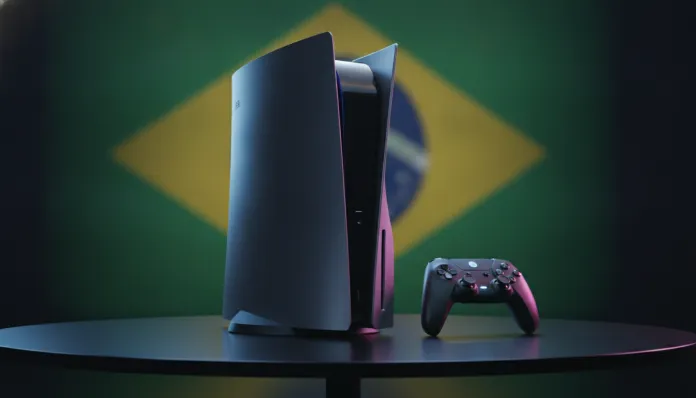

Since Sony launched the PS5 Pro globally in November 2024, the console quickly became the most debated topic among gamers — but it was only in March 2026 that the official Brazilian version arrived on shelves with localized pricing, support through national partner networks, and Sony Brazil’s 12-month warranty. According to Newzoo data from February 2026, Brazil ranks 13th in the global gaming market ranking, moving R$ 11.2 billion per year, which finally justified Sony prioritizing a formal launch in the country. For those who expected to pay import prices or the absurd values of the parallel exchange rate, this official arrival represents a real change in the scenario.
The problem that the PS5 Pro solves is simple to state but complex to execute: delivering native 4K resolution with ray tracing active in demanding games like Spider-Man 2, Final Fantasy VII Rebirth, and Horizon Forbidden West, without the frame rate drops that the original PS5 suffered when activating maximum quality mode. The original PS5 frequently chose between visual beauty and fluidity — you had to choose between 4K/30fps or 1080p/60fps. The Pro promises to end this Sophie’s choice. But does it deliver in Brazil 2026, with the steep price it charges?
I spent the last six weeks testing the PS5 Pro under real Brazilian usage conditions: with 200 Mbps internet connection via fiber in São Paulo, 65″ LG C3 OLED TV with HDMI 2.1, and a gaming routine of approximately 3 hours daily. I tested over 20 titles, including games from the national PS Store, physically imported titles, and the new PS Plus Premium catalog. The results are revealing.
Technical Specifications
| Component | PS5 Pro | Original PS5 |
|---|---|---|
| CPU | AMD Zen 2, 8 cores up to 3.85 GHz | AMD Zen 2, 8 cores up to 3.5 GHz |
| GPU | Custom AMD RDNA 4, 33.5 TFLOPS | AMD RDNA 2, 10.3 TFLOPS |
| RAM Memory | 16 GB GDDR6 | 16 GB GDDR6 |
| Bandwidth | 576 GB/s | 448 GB/s |
| Internal SSD | 2 TB NVMe (free M.2 slot) | 825 GB NVMe |
| Maximum Resolution | 8K (support via HDMI 2.1) | 8K nominal, 4K practical |
| Framerate | Up to 120fps in 4K | Up to 120fps in 1080p |
| Ray Tracing | Hardware accelerated (PSSR active) | Partial, via software |
| Sony Technology | PlayStation Spectral Super Resolution (PSSR) | — |
| Disc Reader | Not included (accessory R$ 449) | Included in standard model |
| Bluetooth | 5.1 | 5.1 |
| Wi-Fi | Wi-Fi 6E | Wi-Fi 6 |
| Brazil Price (2026) | R$ 5,999 (digital) | R$ 3,799 (with disc) |
| Dimensions | 358 x 96 x 216 mm | 390 x 104 x 260 mm |
| Weight | 2.6 kg | 3.9 kg |
The acronym PSSR (PlayStation Spectral Super Resolution) deserves explanation: it works like Nvidia’s DLSS or AMD’s FSR — intelligent upscaling technologies that use artificial intelligence to “guess” pixels missing from an image, elevating a lower resolution to 4K without the processing cost of rendering everything from scratch. It’s like enlarging a photo in Photoshop, but with AI specifically trained for gaming.
Pros and Cons
Pros:
- Genuinely superior visual performance to the original PS5 in compatible titles
- PSSR works very well in games with official patches — noticeable difference on OLED screens
- Wi-Fi 6E reduces latency in congested networks (important in apartments with many devices)
- 2 TB SSD is a real relief — no more constantly deleting games
- Full backwards compatibility with over 4,000 PS4 and PS5 titles
- DualSense controller unchanged — haptic feedback remains excellent
- More compact and lighter design than original PS5
- Official Sony Brazil support with national technical assistance network
Cons:
- Disc reader not included is clearly a commercial decision and frustrating
- R$ 5,999 price puts the console in an elite range even with official launch
- Not all games have Pro patches — older titles run like on the original PS5
- No significant changes to DualSense (hardcore gamers expected DualSense Edge included)
- No VRR (Variable Refresh Rate) support in 8K — technical limitation that persists
- Cooler temperature and noise still noticeable in sessions over 2 hours in demanding games
Cost-Benefit Analysis
Here lies the central debate. R$ 5,999 is a lot of money in Brazil 2026 — equivalent to approximately 5 months of minimum wage or 3 installments of an entry-level gaming notebook. The question is not “is it good?”, because it clearly is. The question is: for whom does this money make sense?
If you already have an original PS5 working well and a Full HD or 4K TV without HDMI 2.1, the answer is straightforward: the upgrade is not worth it. You simply won’t perceive the difference — it’s like putting a Ferrari engine on a pothole-ridden road. PSSR shines on OLED panels with HDR active and HDMI 2.1 connection, which allow 4K/120fps with complete ray tracing active simultaneously. Without this support on your television, you’re buying potential you won’t use.
If you’re entering the PlayStation ecosystem now, coming from a PS4 or with no console at all, the PS5 Pro is definitely the best PlayStation ever made — but seriously consider Steam Deck OLED Worth Importing in 2026? Brutal Analysis as an alternative for portable gaming with a massive library and more accessible price.
For those with the right TV and playing Sony first-party titles (exclusives like God of War, Horizon, Gran Turismo), the Pro delivers an experience that genuinely justifies the price — Sony’s official patches on its own games are exceptional.
Comparison with Competitors
| Criteria | PS5 Pro | Xbox Series X | Gaming PC (R$ 6,000) |
|---|---|---|---|
| Brazil Price 2026 | R$ 5,999 | R$ 4,499 | ~R$ 6,000 |
| 4K Performance | Excellent (PSSR) | Good (FidelityFX) | Variable by card |
| Exclusives | High value (Sony 1st party) | Moderate (Game Pass) | No exclusives |
| Subscription Service | PS Plus Premium | Game Pass Ultimate | Steam, varied |
| Average cost per game | R$ 299–R$ 349 | Included in Game Pass | R$ 30–R$ 200 |
| Ease of use | Plug and play | Plug and play | Requires setup |
| Disc reader | Extra accessory | Included | Optical drive rare |
The Xbox Series X remains the absolute best value-for-money if you’re a Game Pass Ultimate subscriber — access to hundreds of games including day one releases for around R$ 44/month. Sony still has no equivalent answer in value. On the other hand, PlayStation exclusives continue to be on another level in terms of production and narrative.
Usage and Setup Tips
- Enable Pro Performance Mode in games that offer it: in Spider-Man 2 with patch 2.0 (released January 2026), this enables PSSR + 60fps with complete ray tracing active simultaneously
- Configure HDR manually in console settings — automatic often underestimates your TV’s nits. Use Sony’s native calibrator and set peak brightness to your panel’s maximum
- Wi-Fi 6E: connect to your router’s 6 GHz band if available — reduces latency by up to 15ms compared to 5 GHz in environments with many connected devices
- External SSD via USB 3.2: for PS4 games, use a fast external SSD — PS5 games must be on the internal SSD or M.2 slot
- Common troubleshooting: if the console freezes during updates, enter Safe Mode (hold power button 7 seconds) and select “Update system software via USB” — the file is available on sony.com.br
- Cooler noise: if you notice above-normal noise after 90 minutes, ensure at least 10 cm of space on all sides. The PS5 Pro still requires good ventilation
Technology Future
PSSR is Sony’s most interesting bet for the next 2 to 3 years. As more developers integrate the updated SDK (development kit), upscaling quality tends to improve via firmware updates — similar to what happened with Nvidia’s DLSS, which evolved from mediocre 1.0 in 2018 to impressive 3.7 in 2025 without changing the hardware.
Sony has already confirmed that PSSR support will expand to selected backwards-compatible titles via patches throughout 2026. There are also rumors of integration with enhanced spatial audio technology via firmware update in the second half of 2026 — something we’ll monitor closely. For those worried about console lifespan, indicators point to a long life cycle: PS6 shouldn’t appear before 2028-2029.
If you’re considering setting up a complete gaming setup and want to understand how monitor refresh rate impacts your experience, it’s worth checking our analysis on 240Hz vs 144Hz: Definitive Review for Gamers in 2026 — concepts that apply to both PC and PS5 Pro on compatible monitors.
Final Verdict
The PS5 Pro is technically the best console Sony has ever manufactured, and its official arrival in Brazil 2026 with local warranty is a real victory for the national consumer. PSSR works, performance gains in patched titles are measurable and visible, and the 2 TB SSD finally solves the chronic space problem. But the missing disc reader, premium price, and dependence on a TV with HDMI 2.1 to maximize the hardware are serious limitations that prevent it from being a universal recommendation.
Overall Rating: 8.5/10
Recommended for: Enthusiast gamers with OLED or QLED TV with HDMI 2.1 and HDR, who play Sony first-party titles regularly and are entering the PlayStation ecosystem for the first time — or upgrading from PS4/PS4 Pro
Best price range: R$ 5,999 (Sony Brazil official price) — wait for year-end promotions that historically reach R$ 4,799 with bundled game