

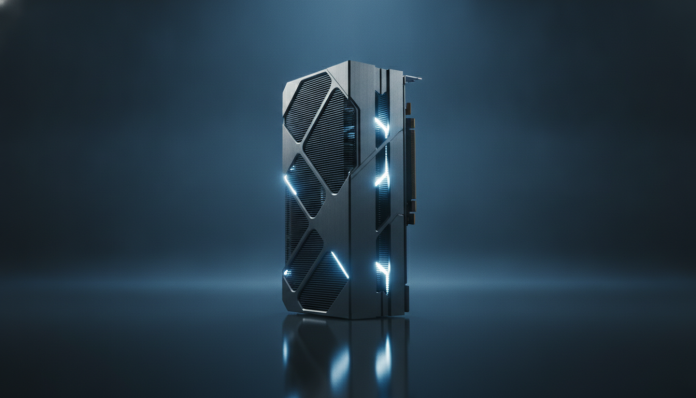

Is RTX 5070 worth it in Brazil in 2026?
The RTX 5070 is the mid-high GPU of Nvidia’s Blackwell generation, launched in early 2025 and arriving in the Brazilian market with the delays and surcharges we already know well. According to Nvidia, the card was designed to deliver performance close to the previous-generation RTX 4090 in 4K gaming, thanks to improvements in architecture and, mainly, advances in DLSS 4 with Multi Frame Generation (technology that generates multiple intermediate frames using artificial intelligence, increasing perceived fluidity without demanding as much from the GPU itself). It’s an ambitious promise, and the short answer is: for the right profile, yes, it’s worth it. But the Brazilian context changes this equation quite a bit.
In Brazil, the RTX 5070 ranges between R$ 5,500 and R$ 7,500 depending on the cooler manufacturer (heatsink and cooling system), the store, and availability at the time of purchase. The launch price in the US was $549 for the Founders Edition, which already raises a conversion factor that smells bad when you add import duties, ICMS, and the national retailer’s margin. If you import it yourself, you’re risking warranty and the Anatel homologation issue, which we’ll detail later.
RTX 5070 Technical Specifications
| Specification | RTX 5070 |
|---|---|
| Architecture | Blackwell (GB205) |
| CUDA Cores | 6,144 |
| VRAM | 12 GB GDDR7 |
| Memory Bus | 192-bit |
| Memory Bandwidth | 672 GB/s (per Nvidia specs) |
| TDP (Load Power) | 250 W |
| Ray Tracing Support | Yes, 4th Generation |
| DLSS | 4 (with Multi Frame Generation) |
| Power Connectors | 1x 16-pin (16 AWG recommended) |
| Video Outputs | 3x DisplayPort 2.1, 1x HDMI 2.1 |
| Recommended Resolution | 1440p and 4K |
| Launch Price (USA) | $549 (Founders Edition) |
| Price Range in Brazil (2026) | R$ 5,500 to R$ 7,500 |
What Blackwell Architecture Delivers in Practice
The major breakthrough of the Blackwell generation isn’t just in additional CUDA cores, but in the combination of GDDR7 memory with the new 5th-generation Tensor Cores, which power DLSS 4. For those who haven’t been following: Tensor Cores are specialized units within the GPU dedicated to AI calculations. They don’t render the game directly, but “guess” and reconstruct frames with impressive quality, relieving the raw workload from the card itself.
DLSS 4 with Multi Frame Generation can, according to Nvidia, generate up to three synthetic frames for every real rendered frame. In practice, this means that in compatible games, the FPS counter (frames per second, image smoothness) can appear much higher than what the GPU would deliver rendering everything from scratch. The point of attention here is that the list of compatible games grows gradually, and not all titles benefit from the feature equally. Before buying, it’s worth confirming whether the games you play most already have full DLSS 4 support on Nvidia’s official website.
The 12 GB of GDDR7 is sufficient for 1440p with all settings maxed out and for 4K on most current titles. There’s discussion in the community about whether 12 GB could become a bottleneck in the next two or three years as games become heavier in textures, but for now the speed of GDDR7 (practically double GDDR6X in bandwidth per pin) compensates for the 192-bit bus, which is narrower than the RTX 5070 Ti’s.
Gaming Performance: Where the RTX 5070 Stands
According to Nvidia and official spec sheet data, the RTX 5070 was positioned to deliver 1440p ultra-configured performance and 4K with DLSS 4 enabled at “Quality” or higher settings. In pure rasterization (traditional rendering, without AI), the card sits in performance close to the RTX 4080 Super from the previous generation, according to public statements from the manufacturer.
For games with heavy ray tracing (realistic physical light simulation, which demands heavy processing), the combination of 4th-generation RT Cores with DLSS 4 makes a noticeable difference in titles like Cyberpunk 2077 and Alan Wake 2. Practical recommendation: if you mainly play at 1440p with a high-refresh-rate monitor (144 Hz or higher), the RTX 5070 will deliver what it promises with room to spare. For native 4K without DLSS in demanding titles, there may be limitations depending on the game.
For creative work like 3D rendering, GPU-accelerated video editing, and local generative AI, the 12 GB of VRAM is the number you need to check before finalizing your purchase. Heavier AI workloads, like running language models locally (LLMs with parameters above 13B), typically demand more memory than that. Anyone using their computer for intensive professional creation should look at the RTX 5080 or the RTX Pro line.
RTX 5070 in Brazil: Taxes, Homologation & Warranty
This is the point that most changes the perception of value. The RTX 5070 sold in Brazil by stores like Kabum, Pichau, Terabyte, and similar ones comes with an invoice, national manufacturer warranty for the cooler (Asus, Gigabyte, MSI, Galax, among others), and Anatel homologation when required. Anatel homologation is mandatory for devices with wireless transmitters; video cards in general don’t fall into this requirement directly, but the point is that buying from an authorized Brazilian store guarantees local technical support without headaches.
If you’re thinking of importing from the US to save on exchange rates, the real risk is warranty. In case of a defect, you’d have to bear international shipping costs and possibly have no coverage, since GPU manufacturers’ warranties are usually regional. The price difference might look attractive on paper, but an international RMA (return and repair process) could cost more than you saved.
Another important detail: the RTX 5070 uses Nvidia’s 16-pin connector (also called 12VHPWR or 12V-2×6 in the revised version). Older Brazilian power supplies may need an adapter, and it’s not recommended to use questionable-quality adapters on this connector. If your PSU has less than 700 W or is from an unknown manufacturer, it’s worth planning a replacement along with the GPU.
Pros and Cons
Pros:
- Real performance jump with DLSS 4 and Multi Frame Generation in compatible games
- GDDR7 memory with high bandwidth, compensating for the 192-bit bus
- 250 W power consumption reasonable for the performance level offered
- DisplayPort 2.1 support, ready for high-resolution and high-refresh-rate monitors
- Growing availability in national retail with local warranty
Cons:
- Price in Brazil rises significantly compared to the US launch value in dollars
- 12 GB of VRAM can be limiting in AI workloads and heavy professional creation
- Maximum benefits depend on games with active DLSS 4 support
- 16-pin connector may require power supply replacement or extra attention
- AMD competition with competitive pricing deserves evaluation before committing
Competitors and Alternatives in Brazil
| Card | VRAM | Estimated Price in Brazil | For Whom |
|---|---|---|---|
| RTX 5070 | 12 GB GDDR7 | R$ 5,500 to R$ 7,500 | 1440p/4K with DLSS 4 |
| RTX 5070 Ti | 16 GB GDDR7 | R$ 8,000 to R$ 10,000 | More comfortable native 4K |
| RTX 4070 Super | 12 GB GDDR6X | R$ 3,500 to R$ 4,500 | 1440p with cost-benefit |
| AMD RX 9070 XT | 16 GB GDDR6 | R$ 5,000 to R$ 6,500 | Alternative without Nvidia ecosystem |
| RTX 4080 Super | 16 GB GDDR6X | R$ 7,000 to R$ 9,000 | Previous generation, larger VRAM |
The AMD RX 9070 XT deserves special attention. Also launched in early 2025, it arrived in Brazil with 16 GB of VRAM and a competitive price, making it a real alternative for those who don’t depend on the Nvidia ecosystem (DLSS, CUDA for creation, Nvidia Broadcast). Those who use creative tools that specifically depend on CUDA, like some versions of DaVinci Resolve or AI-based CUDA plugins, should stick with the Nvidia family.
If your budget is closer to R$ 3,500, the RTX 4070 Super still sells in national retail and delivers excellent 1440p performance. It’s not the newest generation, but for those who don’t need DLSS 4 or heavy ray tracing, the cost-benefit is hard to ignore. You can use AI assistants to quickly compare detailed specifications; if you want to know how to use ChatGPT Agent on your phone step by step, there’s already a guide available for that.
Frequently Asked Questions About the RTX 5070
Does the RTX 5070 run 4K consistently?
According to Nvidia, the card was designed for 4K with DLSS 4 enabled in Quality mode. In native 4K without upscaling, performance will vary significantly between titles. For 4K with all settings maxed out and ray tracing, the RTX 5070 Ti or RTX 5080 deliver more safety margin.
Is it worth waiting for a “Super” version of the RTX 5070?
Nvidia historically launches Super or Ti versions a few months after the main line launch. In 2026 we already have the RTX 5070 Ti available, but there’s no official confirmation of an RTX 5070 Super. If you need a GPU now, it doesn’t make sense to wait indefinitely for a product with no confirmed date.
What power supply is recommended for the RTX 5070?
Nvidia’s spec sheet points to a TDP of 250 W for the card. The general industry recommendation is to have a power supply with at least 650 W of total certified power, from a trusted manufacturer, and with a compatible 16-pin cable (or quality 12V-2×6 adapter). Check the specific recommendations of your GPU model’s manufacturer.
Does buying imported save money in Brazil?
Rarely. The savings on exchange rates tend to be consumed by import duties, international shipping, and mainly by the warranty risk. In case of a defect outside Brazil, the RMA process can be expensive and time-consuming. For most Brazilian buyers, national retail offers more security.
Is It Worth It?
The RTX 5070 is a competent GPU, well positioned technically for 1440p ultra-configured and 4K with DLSS 4. The real problem in Brazil isn’t the card itself, it’s the price. Paying between R$ 5,500 and R$ 7,500 for a GPU that sold for $549 in the US is a number that hurts, and you need to be honest with yourself about what you’re going to use it for.
Recommended for: gamers with a 1440p high-refresh-rate or 4K monitor playing DLSS 4-supported titles, creators using CUDA who need solid performance without spending on an RTX 5080, and anyone coming from an RTX 3070 or older who wants a real generational leap.
It doesn’t make sense for those who only play at 1080p, for those with an RTX 4080 or RTX 4080 Super running well, or for those who need more than 12 GB of VRAM in professional workloads. For that profile, either the RTX 5070 Ti or the AMD RX 9070 XT (depending on preferred ecosystem) is a more balanced choice.
Price range: R$ 5,500 to R$ 7,500 in national retail in 2026, with variation by manufacturer and store. Prices change frequently; confirm current values before finalizing your purchase.