

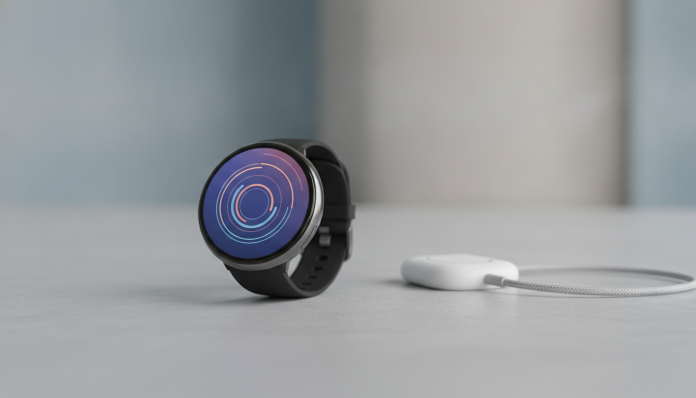

Galaxy Watch 8 in real life: what the battery delivers in everyday use
The Galaxy Watch 8 arrived as Samsung’s bid to consolidate Wear OS as a serious smartwatch platform in 2025, and in 2026 it remains the entry-level model of the Galaxy Watch line for those who want the Samsung ecosystem without paying for the Ultra price. The most recurring question in Brazilian comments and forums is always the same: does the battery last the day? The honest answer is yes, with caveats that depend heavily on how you use the watch.
According to Samsung, the promised autonomy is up to 40 hours in normal mode and up to 72 hours in power-saving mode. In practice, with GPS frequently activated, continuous heart rate monitoring, and notifications coming all the time, the number drops. This is neither a surprise nor a defect: it’s the expected behavior of any smartwatch with an always-on AMOLED screen and processor running Wear OS. What sets the Galaxy Watch 8 apart is that it delivers enough autonomy for most usage profiles without requiring mid-day recharges.
If you use the watch to check notifications, log workouts three or four times a week, and sleep with it on your wrist to monitor sleep, the Watch 8’s battery is good enough. If you’re an athlete who logs long runs with GPS active for hours and still wants ECG (electrocardiogram) and blood pressure measurement features on all the time, the Galaxy Watch Ultra is the way to go. This article is for those in the middle who want to understand what to expect.
Galaxy Watch 8 specs
| Specification | Galaxy Watch 8 (44 mm) | Galaxy Watch 8 (40 mm) |
|---|---|---|
| Display | Super AMOLED 1.5″ | Super AMOLED 1.3″ |
| Resolution | 480 x 480 px | 432 x 432 px |
| Processor | Exynos W1000 | Exynos W1000 |
| RAM / Storage | 2 GB / 16 GB | 2 GB / 16 GB |
| Battery | 425 mAh | 300 mAh |
| Declared Autonomy | Up to 40 h (normal) | Up to 30 h (normal) |
| Charging | 10 W wireless | 10 W wireless |
| System | Wear OS 5 / One UI Watch 6 | Wear OS 5 / One UI Watch 6 |
| Sensors | BioActive (HR, SpO2, ECG, pressure) | BioActive (HR, SpO2, ECG, pressure) |
| GPS | Yes (L1/L5 dual-band) | Yes (L1/L5 dual-band) |
| Resistance | 5 ATM + IP68 + MIL-STD-810H | 5 ATM + IP68 + MIL-STD-810H |
| Launch Price (USA) | US$ 299 | US$ 249 |
| Price Range in Brazil | From R$ 2,000 (varies) | From R$ 1,700 (varies) |
Brazilian prices subject to variation according to exchange rate, store, and promotions. Always check on Samsung Brazil’s official website or authorized retailers.
What the battery really delivers in daily use
Samsung uses the term “normal mode” to describe the scenario with always-on screen turned off, health monitoring at regular intervals, and Bluetooth connectivity active. This is the mode most people will use without noticing, because it’s the factory default.
With the always-on display (AOD) on, the declared autonomy drops to about 30 hours on the 44 mm model. For those who want to see the time without needing to rotate their wrist, this feature is very welcome, but requires a more frequent charging habit. Turning on the watch before bed and placing it on the base while you have morning coffee solves this for most people.
Continuous heart rate monitoring is one of the biggest battery consumers on any smartwatch. When activated in continuous mode (readings every second instead of 10-minute intervals), it can reduce autonomy by up to 20%, according to industry benchmarks released by publications like GSMArena. Those with a history of arrhythmia or using the watch for more rigorous health purposes will prefer to keep this mode on and accept the trade-off.
A 60-minute running session with dual-band GPS active consumes a considerable chunk of the charge, according to usage data shared in specialized forums like Reddit’s r/GalaxyWatch. The Watch 8’s L1/L5 GPS is more accurate than the single L1 GPS of previous versions, but also consumes more. For daily workouts of 45 to 90 minutes, the impact is manageable. Ultramarathoners and long-distance cyclists will need something with larger battery capacity.
Fast charging and Samsung’s ecosystem logic
The Galaxy Watch 8 charges at 10 W via Samsung’s proprietary wireless charging system. According to the manufacturer, a full charge takes approximately 65 minutes on the 44 mm model. This is relevant because you don’t need to leave the watch on the base overnight: thirty minutes of charging while you shower and have breakfast is enough to restore the charge lost from a night of sleep monitoring.
The problem is that the charger doesn’t come in the box in several markets, including Brazil. Samsung sells the charger separately, and the Galaxy Watch 7’s charging base is compatible with the Watch 8. If you’re upgrading from an earlier model, you likely already have the accessory. If you’re new to the ecosystem, add that cost to the watch’s price.
Reverse charging works with compatible Samsung smartphones: you can charge the watch by placing it on the back of your phone. It’s slow, but saves you in emergency situations when you forgot the base at home. It works with Galaxy S25, S24, and recent models from the A line that support the feature.
Health sensors: the differentiator that justifies the price
Samsung’s BioActive sensor integrates heart rate monitoring, pulse oximetry (SpO2), ECG, and blood pressure measurement in a single component. To use ECG and blood pressure in Brazil, the Samsung Health Monitor app needs to be available and approved by Anvisa for use in the country. Check Samsung Brazil’s website to see if the functionality is enabled for your model and region before buying based on these features.
Sleep monitoring with phase analysis (light, deep, REM) is one of the most praised features by Watch 8 users. Samsung uses algorithms developed in partnership with sleep research institutes, and the accuracy of phases improved in recent generations of hardware. It’s not a polysomnography exam, but it’s useful for identifying patterns over weeks.
For athletes, the dual-band L1/L5 GPS is a real quality leap compared to simple L1 GPS. It uses two satellite frequencies simultaneously, which reduces errors caused by tall buildings and trees. Those who run in urban centers or trails will notice the difference in tracking accuracy.
Software, compatibility, and situation in Brazil
The Galaxy Watch 8 runs Wear OS 5 with Samsung’s One UI Watch 6 interface. Unlike older versions, it’s compatible with Android smartphones from other brands, not just Samsung, as long as they run Android 11 or later. The integration is deeper with Samsung phones, which unlock features like ECG, blood pressure measurement, and health data sharing between devices.
In Brazil, the Galaxy Watch 8 has Anatel approval for models sold officially by Samsung Brazil. This guarantees that the watch can legally operate in the country and provides access to one year of official warranty. Buying via direct import or parallel websites may result in a device without local warranty and, in some cases, without support for LTE bands compatible with Brazilian carriers.
The LTE version (independent cellular connectivity) is available in Brazil for some carriers. It’s worth confirming with your carrier whether a smartwatch companion plan is available and what the monthly cost is before opting for this version, which typically costs R$ 200 to R$ 300 more than the Bluetooth version.
Competitors and alternatives available in Brazil
| Model | Declared Battery | System | Price Range BR |
|---|---|---|---|
| Galaxy Watch 8 (44 mm) | Up to 40 h | Wear OS 5 / One UI Watch 6 | From R$ 2,000 |
| Apple Watch Series 10 | Up to 18 h | watchOS 11 | From R$ 4,500 |
| Garmin Forerunner 265 | Up to 13 days | Garmin OS | From R$ 2,800 |
| Xiaomi Watch S4 | Up to 15 days | HyperOS Watch | From R$ 900 |
| Pixel Watch 3 (45 mm) | Up to 36 h | Wear OS 4 | From R$ 2,400 |
The Garmin Forerunner 265 is the strongest alternative for those who prioritize autonomy and sports accuracy above all else. The Xiaomi Watch S4 delivers weeks of battery at a much lower price, but loses on health sensors and app integration. The Pixel Watch 3 is in a similar position to the Watch 8, but with a smaller ecosystem in Brazil.
Frequently asked questions about Galaxy Watch 8 battery
Does the Galaxy Watch 8 battery last all day?
Yes, in the default configuration (always-on screen off, health monitoring at interval), the 44 mm model’s battery comfortably exceeds 24 hours of use. With always-on display on and GPS activated during workouts, consumption increases, but is still manageable with a quick morning charge.
Can you use the Galaxy Watch 8 to sleep without charging first?
It depends on how charged the watch was at the end of the day. With charge above 30%, it typically lasts through a night of sleep monitoring and still has residual charge in the morning. Samsung recommends placing it on the base while you get ready in the morning to restore what was consumed during the night.
Does the Galaxy Watch 8 work with iPhone?
No. The Galaxy Watch 8 requires an Android smartphone for setup and complete use of features. It is not compatible with iPhone. If you use iPhone, the Apple Watch Series 10 is the corresponding option in the Brazilian market.
How to ensure the best battery performance on a daily basis?
Turning off the always-on display when not essential, reducing automatic brightness, using GPS only during workouts, and configuring heart rate monitoring at intervals (instead of continuous) are the most effective adjustments. The One UI Watch 6 itself has a battery diagnostic panel that shows which functions consume the most.
Is the Galaxy Watch 8 worth it?
The Galaxy Watch 8 doesn’t have the longest battery life in the smartwatch market. But it has something that many competitors with durable batteries don’t offer: a complete set of health sensors, accurate GPS, deep Android integration, and a polished interface that consistently improved over recent generations. For those living in the Samsung ecosystem, the Watch 8 is the logical entry point of the line in 2026.
The comparison with other gadgets that balance cost and technology is inevitable: just as when choosing between mid-range smartphones competing in the same price range, the Galaxy Watch 8 wins by its set of features, not by a single isolated attribute.
Recommended for: users of the Samsung ecosystem who want a complete smartwatch for daily use, health monitoring, and moderate workouts, and who are willing to build the habit of a quick morning charge.
Not recommended for: endurance athletes who need days of autonomy with GPS on, iPhone users, and those looking for the lowest price above all.
Price range: starting from R$ 1,700 (40 mm) and R$ 2,000 (44 mm) in Brazil, with variation depending on store and period. Launch price in the USA was US$ 249 and US$ 299, respectively.