

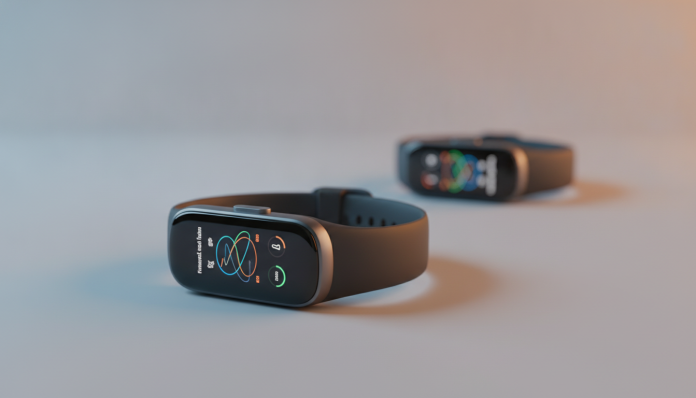

The short answer: yes, affordable smart bands still exist that deliver the essentials without the price tag of a full smartwatch
If you want to monitor your steps, track your sleep, receive phone notifications, and still have battery for days without charging every night, a smart band solves this with far less money than an Apple Watch or Galaxy Watch. The secret is knowing what you’re giving up and whether it matters for your daily routine.
In 2026, the budget fitness band market became even more competitive. Xiaomi, Huawei, and smaller brands like Amazfit and Honor continue fighting for this space with products ranging from R$ 150 to R$ 400. The right question isn’t “what’s the best band in the world,” but rather “which one delivers what I need and is officially available in Brazil with invoice and warranty.”
This article focuses especially on the Xiaomi Smart Band 9, launched in 2024 and still one of the best value-for-money options available in 2026 with Anatel certification and official sales in Brazil. It serves as a benchmark for anyone wanting an affordable band that actually works.
Xiaomi Smart Band 9 Specifications
| Specification | Details |
|---|---|
| Display | AMOLED 1.62 inches, 192 x 490 pixels |
| Battery | 233 mAh, up to 21 days typical use (manufacturer claim) |
| Sensors | Heart rate, SpO2, accelerometer, gyroscope |
| Water Resistance | 5 ATM (suitable for swimming) |
| Connectivity | Bluetooth 5.3 |
| GPS | Connected (uses smartphone GPS) |
| Exercise Modes | Over 150, according to manufacturer |
| Compatibility | Android 8.0+ and iOS 16+ |
| App | Mi Fitness |
| Anatel Certification | Yes (verify certification number on Anatel website for batch confirmation) |
| Launch Price (USA) | US$ 39.99 |
| Price Range in Brazil | R$ 200 to R$ 300 (varies by retailer and period) |
Display and Design: the standout feature at this price point
An AMOLED screen (active matrix organic light-emitting diode technology that produces true blacks and vibrant colors because each pixel emits its own light) at this price is a real differentiator. Most competing bands in this range use LCD displays with noticeably inferior brightness and contrast when tested side by side.
The Smart Band 9 has an elongated 1.62-inch display with resolution that delivers readable text and heart rate graphs in practice, without that feeling of reading an old calculator display. Peak brightness, according to Xiaomi, reaches 1,500 nits, which helps significantly in bright outdoor conditions.
The design follows the product line standard: thin body, removable silicone band, proprietary connector for replacement. Dozens of replacement bands are available on the market for R$ 20 to R$ 50. Weight is around 27 grams with the band, meaning you forget you’re wearing it within days of adaptation.
Battery and Autonomy: the most honest argument for choosing a band
Here’s why many people choose a band instead of a smartwatch: battery life. According to Xiaomi, the Smart Band 9 delivers up to 21 days with typical use and up to 14 days with continuous heart rate monitoring enabled. In practice, most users report using it for 10 to 15 days before needing to charge, which is still far superior to any popular smartwatch.
If you’ve grown tired of yet another device to charge overnight alongside your phone and earbuds, a band that goes almost two weeks without asking for a power outlet changes your relationship with the product. For those with intense routines and frequent travel, this weighs heavily in the decision.
The charger is magnetic, but the connector is proprietary to Xiaomi. This means if you lose the cable, you’ll need to buy a model-specific one. Keep it safe or buy a spare.
Health Monitoring: what works and what’s just a number on the screen
The optical heart rate sensor (which uses infrared light reflected from the wrist to estimate beats) is functional for daily use. According to specs, monitoring is continuous and the device alerts you to elevated or very low heart rate. For non-elite athletes, this is sufficient for a general sense of cardiovascular health.
SpO2 (pulse oximetry, which estimates blood oxygen percentage) is present, but like any wrist sensor on consumer devices, it lacks clinical precision. It serves as reference, not diagnosis. If you have a health condition requiring serious monitoring, a dedicated finger oximeter or medical consultation is the right path.
Sleep monitoring analyzes light, deep, and REM phases, and the Mi Fitness app presents data in quite readable format. It’s not the most sophisticated system on the market, but it fulfills the function for those wanting to understand basic sleep patterns. To deepen the use of your phone alongside these wellness data, check our practical guide to increase Android battery life, which brings tips that integrate well with habit monitoring via the band.
User Experience in Brazil: app, notifications, and connected GPS
The Mi Fitness app is available on Play Store and App Store in Portuguese. The interface is decent, Bluetooth synchronization works stably in most user reports, and data is presented in charts anyone can interpret without a manual.
Smartphone notifications reach the band, including WhatsApp, email, and calls. You can see message previews and reject or silence calls directly from your wrist. Replying to messages via the band isn’t possible, which is a common limitation in this product category.
Connected GPS means the band uses your phone’s location signal to trace running or walking routes. Works well while you have your smartphone in your pocket. If you want to train without your phone and record routes with precision, you’ll need a band with standalone GPS, which significantly raises the price.
Anatel certification is present in batches sold through Xiaomi’s official Brazil channel and authorized resellers. Before buying on marketplaces, verify the certification number directly on the Anatel website. Products imported without certification may be detained at customs and have no warranty under Brazilian consumer law.
Pros and Cons
Pros:
- AMOLED display with high brightness at a price point where LCD is the standard
- Battery autonomy far superior to any smartwatch in the same category
- 5 ATM resistance allows pool use without worry
- Compatible with Android and iOS, with Portuguese language app
- Available with Anatel certification in physical and official stores in Brazil
- Replaceable band with widely available accessories
Cons:
- Connected GPS, no standalone GPS
- Proprietary charger that’s easy to lose
- No ability to reply to messages from the wrist
- Small screen for those with vision difficulty or preferring larger reading space
- Health sensors lack clinical precision
Competitors and Alternatives Available in Brazil
| Model | Price Range in Brazil | Standalone GPS | Display | Estimated Battery |
|---|---|---|---|---|
| Xiaomi Smart Band 9 | R$ 200 to R$ 300 | No | AMOLED 1.62″ | Up to 21 days |
| Huawei Band 9 | R$ 250 to R$ 350 | No | AMOLED 1.47″ | Up to 14 days |
| Amazfit Band 7 | R$ 180 to R$ 280 | No | AMOLED 1.47″ | Up to 18 days |
| Honor Band 9 | R$ 200 to R$ 320 | No | AMOLED 1.47″ | Up to 14 days |
| Fitbit Inspire 3 | R$ 400 to R$ 550 | No | Color display | Up to 10 days |
None of these options offer standalone GPS at this price range. If integrated GPS is essential for you, the next tier starts around R$ 500 to R$ 700, with models like the Amazfit Band 9 Pro or entry-level Garmin options. If you’re thinking about complementing your band purchase with a new phone to use as a health hub, our article on the best phone up to R$ 1,500 to buy in 2026 can help you assemble a coherent setup without breaking the budget.
Frequently Asked Questions About Cheap Smart Bands
Does a cheap smart band work without a phone nearby?
Yes, partially. It records steps, heart rate, and sleep even without your phone. What doesn’t work without the smartphone is connected GPS and real-time notification display. Synchronization happens when you bring your phone back with Bluetooth active.
Is it worth importing a band without Anatel certification to pay less?
The risk isn’t worth it in most cases. Products without certification may be detained at customs, you have no legal warranty in Brazil, and if there’s a defect, you depend entirely on the foreign seller’s goodwill. The price difference rarely covers this risk.
Is a smart band suitable for weightlifting?
It works for general monitoring, like heart rate during training and basic movement counting. It doesn’t recognize strength exercises with the same accuracy as aerobic activities like running and walking. For this profile, the band’s manual exercise modes are more useful than automatic detection.
What’s the difference between a smart band and a cheap smartwatch?
The main difference is the balance between features and battery. A cheap smartwatch tends to have a larger screen, more apps, and sometimes GPS, but usually has autonomy of 1 to 3 days. The band sacrifices these extra features to deliver weeks of autonomy in a more discreet format.
Is it Worth Buying a Cheap Smart Band in 2026?
For most users wanting to take their first step into health and fitness monitoring without spending more than R$ 300, the answer is yes. The Xiaomi Smart Band 9 continues to be a solid reference in this range: good display, battery that truly lasts, and presence in Brazil’s official market.
It doesn’t work for those needing standalone GPS to train without their phone, those wanting to reply to messages from their wrist, or those wanting a large screen with independent apps. Those cases call for a smartwatch, and the budget needs to reflect that.
Recommended for: those starting to monitor health and fitness, those wanting to receive notifications on their wrist, those doing aerobic activities with their phone nearby, and those with irregular sleep patterns wanting to understand their patterns without spending much.
Price range: R$ 200 to R$ 300 in the Brazilian market, with variations by retailer and seasonal promotions. Check current prices at official Xiaomi stores and major marketplaces before deciding.