

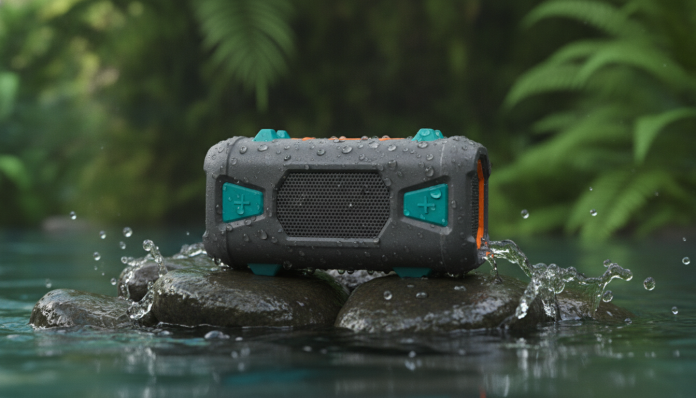

Waterproof Bluetooth Speaker Under R$ 300: Complete Buying Guide
Buying a water-resistant Bluetooth speaker without overspending seems simple, but the category is full of pitfalls. Some products promise IP67 on the packaging and leak on the first heavy rain, some brands lack Anatel certification and can be held at customs, and some models play loud but with sound so distorted you’ll prefer silence. The good news is that in 2026, the Brazilian market already offers decent options in this price range, and knowing what to look for in the technical specifications solves 80% of your doubts before you even open the shopping app.
This guide is for anyone who wants a speaker for the beach, pool, barbecue, or bathroom and doesn’t want to exceed R$ 300. It’s not for those seeking audiophile quality or advanced features like app-based EQ and solar charging, because those features truly appear only in products above this range. What you’ll find here are the criteria that really matter, the most cited models in Brazilian stores, and the attention points that people usually ignore until it’s too late.
What real water resistance means: understanding IP and IPX
The acronym IP stands for Ingress Protection and is followed by two numbers. The first indicates protection against dust (0 to 6) and the second indicates protection against liquids (0 to 9K). When you see IPX5, the X means dust protection wasn’t tested or certified; the 5 means the product withstands low-pressure water jets from any direction. IP67, meanwhile, guarantees complete dust protection and immersion up to 1 meter deep for 30 minutes, according to IEC 60529 standard.
In practice, think of it this way: IPX5 withstands rain and pool splashes, but shouldn’t be thrown into the water. IP67 can handle being dropped in a shallow pool, but wasn’t designed for diving. Models with IP68 go deeper, but rarely appear below R$ 300. For casual beach and pool use, IPX7 (equivalent to IP67 for water protection, without the dust digit) is already sufficient.
One point many people ignore: IP certification is tested with fresh water at room temperature. Salt water and pool chlorine degrade seals over time. Even in an IP67 product, the habit of rinsing with fresh water and drying the speaker well after use significantly increases its lifespan.
Criteria that determine purchase in this price range
Sound quality for your intended use
Speakers below R$ 300 generally work with 40 mm to 52 mm drivers and power between 5 W and 20 W RMS. RMS (Root Mean Square) is the real and continuous power, different from peak power, which appears larger on packaging to impress. Always compare RMS power.
In this range, don’t expect deep bass without distortion. Brands like JBL, Sony, and Anker typically prioritize balance between treble and midrange, while some lesser-known Chinese brands artificially push bass with factory equalizations that distort at high volume. If you’ll use it mainly for voice, podcasts, and pop music, any decent model works. If your focus is electronic and funk at maximum volume, test before buying or read specific reviews about distortion at high volume.
Battery: real autonomy versus manufacturer claims
Manufacturers declare autonomy under ideal conditions: volume between 50% and 70%, with no extra functions active. In real use, with high volume and summer temperatures, the number drops. A speaker that promises 12 hours usually delivers between 7 and 9 hours in intensive use.
Also check charging time and connector type. In 2026, speakers with USB-C are already the majority in this category, but there are still older models with micro-USB being sold on sale. USB-C charges faster and you probably already have the cable in your pocket.
Bluetooth connectivity and extra features
Bluetooth 5.0 and later versions offer greater range (theoretically up to 10 meters in line of sight) and more stable connection than earlier versions. In practice, walls and interference reduce this range. Check the technical specifications for which version the model uses; don’t rely on the box alone.
Some models come with features like TWS (True Wireless Stereo), which lets you pair two speakers of the same model to create a stereo effect. Others have FM radio mode and 3.5mm auxiliary input for those still using non-Bluetooth devices. These are useful bonus features, but don’t compensate for poor sound or weak sealing.
Anatel approval and warranty: what you need to know before importing
The Anatel (National Telecommunications Agency) requires any device that emits radio signals, including Bluetooth speakers, to be approved for legal sale in Brazil. The approval seal appears on the packaging and product body. Buying an unapproved model on sites like AliExpress may result in the product being held at customs, especially after new import rules in effect since 2024.
Models sold in major Brazilian retailers (Magazine Luiza, Americanas, Amazon BR, FastShop) already come with Anatel approval and minimum 90-day legal warranty, plus the manufacturer’s commercial warranty, which varies from 1 to 2 years depending on the brand. If you buy from a parallel importer on marketplaces, confirm the product has an invoice and seller warranty: without these, any issues are your cost.
If you’re researching other types of gadgets that go through similar cost-benefit evaluation processes before purchase, the article on Smartwatch vs. Fitness Tracker: Which One Is Worth It for You in 2026 uses the same usage-profile analysis logic that helps a lot when deciding.
Most common models in Brazil under R$ 300
The table below brings together models widely available in the Brazilian market in 2026. Prices are approximate and vary by store, promotion, and region. Always check the complete technical specifications before buying, as manufacturers update versions without changing the product name.
| Model | Water Resistance | Declared Power | Declared Battery Life | Bluetooth | Price Range (BR) |
|---|---|---|---|---|---|
| JBL Go 4 | IP67 | 4.2 W | 7 hours | 5.3 | R$ 180 to R$ 230 |
| JBL Clip 5 | IP67 | 7 W | 12 hours | 5.3 | R$ 250 to R$ 300 |
| Anker Soundcore Mini 3 | IPX7 | 12 W | 15 hours | 5.0 | R$ 200 to R$ 260 |
| Sony SRS-XB100 | IP67 | no official W data | 16 hours | 5.3 | R$ 230 to R$ 280 |
| Multilaser SP356 | IPX7 | 10 W | 8 hours | 5.0 | R$ 100 to R$ 150 |
Prices checked at Brazilian stores in the first half of 2026. Check availability and updated price at your preferred store.
The JBL Go 4 is the most affordable option among established brands and literally fits in your pocket. The JBL Clip 5 adds a carabiner to clip onto a backpack or beach chair, which makes a difference in outdoor use. The Anker Soundcore Mini 3 has a good balance between autonomy and price, according to Anker’s official specifications. The Sony SRS-XB100 is compact, lightweight (under 200 g, according to Sony) and has surprising bass reach for its size, according to the manufacturer’s specifications. The Multilaser SP356 is the cheapest national alternative with IPX7 and works well for those who need something simple without compromising too much on budget.
What to check before finalizing your purchase
- Confirm if the model has the Anatel Homologation Code listed in the product description
- Check if the announced power is RMS and not peak
- See if the charger is USB-C or micro-USB
- Read reviews from Brazilian buyers, especially about bass quality and water resistance in real use
- Verify if the seller offers an invoice and what the commercial warranty period is
- If it’s a gift, keep the original packaging: it greatly facilitates warranty claims
Frequently asked questions about waterproof Bluetooth speakers
Can I use the speaker inside the pool, throwing it in the water?
It depends on the certification. IP67 and IPX7 models support immersion up to 1 meter for up to 30 minutes in test conditions with fresh water. This means it survives being dropped in a shallow pool, but wasn’t designed to stay submerged while playing. Models that are only IPX5 should never be immersed under any circumstances.
Can a speaker without Anatel certification purchased abroad be used in Brazil?
Technically, personal use is not a crime, but the import may be blocked at customs. In 2026, enforcement of electronics imports by individuals is stricter. The risk of losing the product and your money is real, especially on purchases above the duty-free limit.
Do two speakers in TWS mode sound better than one larger speaker?
TWS mode creates separate left and right channels, which improves the perception of spatiality. But two small speakers rarely produce bass as full-bodied as a larger speaker with a bigger driver diameter. For open areas like beaches and parks, a single high-power speaker is usually more practical.
Is it worth paying more for a JBL or Sony than an unknown brand at the same price?
Generally, yes, within this range. Established brands have a product track record, a technical support network in Brazil, consumer support, and firmware updates. Unknown brands may offer equal specifications on paper, but quality control and seal durability over time are variables you only discover after months of use.
Which speaker makes the most sense for your profile
If your main use is beach and pool with real risks of immersion, don’t settle for less than IP67 minimum and prioritize brands with proven sealing history. The JBL Clip 5 and Sony SRS-XB100 are the most recommended in this scenario within budget.
For those who use it in the bathroom, on the balcony, or at barbecues without direct water contact, IPX5 or IPX7 from any decent brand already works, and you can save a bit and invest in an option with more power.
If your budget is very tight and you need something functional without high sound demands, the Multilaser SP356 does the job with national warranty and a price that fits any budget.
What’s not worth it, in any scenario, is buying on impulse based solely on wattage or packaging size. Read the technical specifications, check Anatel homologation, and compare real estimated autonomy from other buyers. With these three steps, the chances of regret drop significantly.