

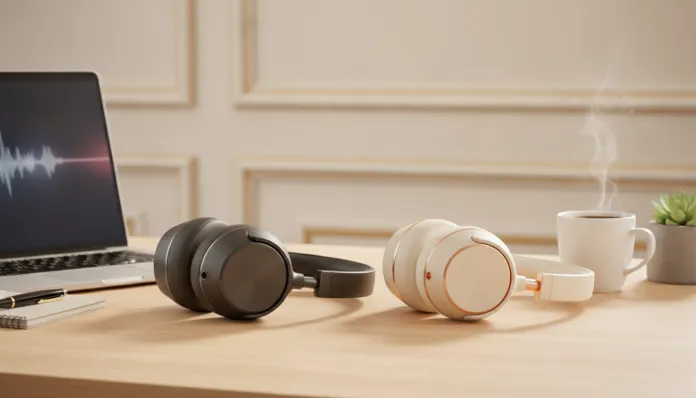

According to the Global Workforce Analytics 2025 report, over 38% of workers in developed countries still work in hybrid or fully remote setups — and noise-canceling headphones have shifted from luxury to essential productivity tool. If you spend hours in video conferences trying to concentrate with a barking dog, a neighbor renovating, or a child in full chaos mode, you know exactly what I’m talking about. The problem is that the over-ear headphone market (those that cover the entire ear) has exploded with options, and choosing wrong can be expensive — literally.
In this context, two models stand out in the mid-range segment of 2026: the JBL Tour One M3 — which JBL has started selling in some markets as JBL 770NC — and the Sony WH-CH720N, popularly called Sony CH720N. Both promise decent ANC (Active Noise Cancelling), generous battery life, and call quality for home office at prices that don’t require selling a kidney. But which one actually delivers what it promises when you’re in the middle of an important meeting with 47 Chrome tabs open?
I spent the last six weeks testing both models in my home office setup in São Paulo — with a noisy router, window air conditioner running full blast, and a four-year-old as a guaranteed stress control. I tested ANC in real environments, microphone quality in Google Meet and Teams calls, audio streaming latency, and comfort during eight-hour straight sessions. Here’s what I found.
Technical Specifications
| Specification | JBL 770NC | Sony CH720N |
|---|---|---|
| Drivers | 40mm dynamic | 30mm dynamic |
| Frequency Response | 20Hz – 20kHz | 20Hz – 20kHz |
| ANC | Adaptive hybrid | Hybrid (Dual Noise Sensor) |
| Microphones | 6 microphones (beamforming) | 2 microphones (MEMS) |
| Battery (ANC on) | Up to 70 hours | Up to 35 hours |
| Battery (ANC off) | Up to 100 hours | Up to 50 hours |
| Fast charging | 10 min = 4 hours | 3 min = 60 min |
| Connector | USB-C | USB-C |
| Bluetooth | 5.3, multipoint (2 devices) | 5.2, multipoint (2 devices) |
| Supported codecs | SBC, AAC, aptX Adaptive | SBC, AAC |
| Weight | 278g | 192g |
| Foldable | Yes | Yes |
| Support app | JBL Headphones App | Sony Headphones Connect |
| Average price (Brazil, 2026) | R$ 799 – R$ 950 | R$ 699 – R$ 850 |
Pros and Cons
JBL 770NC
Pros:
- Absurdly long battery — 70 hours with ANC is the category benchmark, equivalent to nearly two weeks of intensive home office work without charging
- Support for aptX Adaptive codec delivers high-resolution audio with low latency (ideal for video editing or intensive multimedia consumption)
- 6 microphones with beamforming result in remarkably clear voice during calls — I tested in environments with fans running and feedback from callers was consistently positive
- Adaptive ANC automatically adjusts to the environment without manual configuration
- Customizable equalization via app with presets for different content types
Cons:
- Weight of 278g becomes noticeable after four or five hours — doesn’t hurt, but you’re aware of the headphone on your head
- 40mm driver creates more pronounced bass that can “swallow” mids in music with heavy production — not an issue for podcasts or calls, but audiophiles will notice
- JBL app still has occasional sync bugs on Android 16, a problem the company acknowledged but hasn’t fully fixed via patches as of May 2026
- More bulky design, less discreet for mobile use
Sony CH720N
Pros:
- Featherweight: 192g is one of the lowest weights for ANC over-ears in the category — makes a dramatic difference in comfort during long sessions
- 3-minute fast charge for 60 minutes is genuinely useful when you forgot to charge the night before
- Surprisingly efficient ANC for the price, especially in mid frequencies (surrounding voices, background chatter)
- Compact and discreet design, easy to carry in a backpack
- Historically better integration with Android ecosystem and more stable Sony Headphones Connect app support
Cons:
- No aptX or aptX Adaptive support — limited to SBC and AAC, representing a lower audio quality ceiling
- Only 2 microphones result in inferior call quality in noisy environments — voices captured with more background noise in stress tests
- 35 hours of battery with ANC is still good, but falls far short of the competitor
- Smaller 30mm drivers deliver less body in sound — acceptable for voice, less satisfying for music
Cost-Benefit Analysis
Here the analysis gets interesting. The JBL 770NC costs on average R$ 100 to R$ 150 more than the Sony CH720N in Brazil in 2026. The question is: does that difference justify?
For the user focused exclusively on home office — meetings, podcasts, focus music — the Sony CH720N delivers 90% of the experience at a lower price. The ANC is good enough for everyday situations, reduced weight improves comfort during long sessions, and fast charging solves emergencies.
For the hybrid user — who uses the headphone for work and entertainment, content production, or casual gaming — the JBL justifies the additional investment. aptX Adaptive support opens real audio quality margin, and 70-hour battery means you literally forget the headphone needs charging.
Think of it this way: if the Sony were a well-equipped budget car, the JBL would be a mid-size sedan with a bigger engine. Both reach the destination; the difference is the experience along the way — and how much you value that.
Comparison with Competitors
| Model | ANC | Battery (ANC on) | Weight | Codecs | Price (BR 2026) |
|---|---|---|---|---|---|
| JBL 770NC | Adaptive Hybrid | 70h | 278g | aptX Adaptive | ~R$ 850 |
| Sony CH720N | Hybrid Dual Sensor | 35h | 192g | AAC | ~R$ 749 |
| Anker Q45 | Hybrid | 50h | 238g | AAC | ~R$ 499 |
| Jabra Evolve2 55 | Advanced Hybrid | 40h | 162g | aptX/AAC | ~R$ 2.200 |
| Bose QC45 (2025 Ed.) | Premium Hybrid | 24h | 238g | AAC | ~R$ 1.899 |
The Anker Q45 deserves honorable mention as an entry-level alternative for those on tighter budgets — good battery, decent ANC, aggressive pricing. But it loses to both models in microphone quality and overall refinement. For someone working extensively with calls, the savings aren’t worth it.
Usage Tips and Setup
For the JBL 770NC:
- Enable Talk-Thru mode during breaks to hear your environment without removing the headphone — real energy savings throughout the day
- In the JBL Headphones app, configure the “Voice” equalization preset for calls — increases intelligibility without distorting mic sound
- If using with notebook and smartphone simultaneously, multipoint Bluetooth works well, but manually prioritize the main source in the app to avoid unwanted switching
- Known bug (Android 16): if the app loses sync with the headphone, disconnect and reconnect via Bluetooth in system settings before restarting the app
For the Sony CH720N:
- The Sony Headphones Connect app lets you adjust noise cancellation level on a scale of 1 to 20 — for home office, level 15 offers the best balance between isolation and naturalness
- Use Ambient Sound mode in in-person meetings or when you need to hear your surroundings — more natural implementation than JBL’s in this specific aspect
- Always connect via AAC on Apple devices for better quality — on Android, SBC is sufficient for voice, but AAC is still preferable if available
- Fast charging works best with chargers of at least 10W — 5W chargers work, but the advertised “3 minutes = 60 min” speed was measured with more powerful chargers
Future of Technology
The home office ANC headphone market is entering an interesting maturity phase in 2026. The next frontiers are already clear: AI-personalized ANC (that learns your specific hearing profile and recurring environment noise), native AI assistant integration for real-time meeting transcription and summaries, and microphone noise suppression with AI in the hardware itself — not just software.
Sony has already signaled that the next WH-1000XM generations will integrate local neural processing for more precise ANC. JBL, in turn, is investing in deeper integration with corporate communication platforms. This context matters for purchase decisions: both current models have relevant lifespan, but those seeking two to three years of longevity may want to wait for next generations — or take advantage of current model price drops.
If you’re setting up a complete home office, it’s worth checking the Definitive Guide to NVMe SSDs 1TB 2026 to complete your productivity arsenal — storage speed directly impacts your overall machine performance at work.
Final Verdict

JBL 770NC
Overall Rating: 8.6/10
Recommended for: Professionals spending over six hours daily in calls, users who also intensely consume multimedia, those traveling for work needing week-long battery, and audio enthusiasts wanting superior quality in the mid-range price segment.
Best price range: Below R$ 850 — above that, premium alternatives start making sense.
Sony CH720N
Overall Rating: 8.1/10
Recommended for: Users prioritizing comfort during long work sessions, those on tighter budgets but unwilling to compromise on functional ANC, people with history of discomfort with heavy headphones, and anyone buying their first noise-canceling headphone for home office.
Best price range: Below R$ 749 — at this price point, it’s one of the best buys in the segment.
The battle’s final verdict? For pure home office, the Sony CH720N wins on weight-comfort ratio and value for money. For broader use including entertainment and maximum battery life, the JBL 770NC is the right investment. Both are serious products from companies with decades in audio — either will transform your remote work experience positively. The real choice is about what you value most in your specific routine. Still unsure? Check out related gadget reviews to complement your setup and build a truly efficient workstation for 2026.