

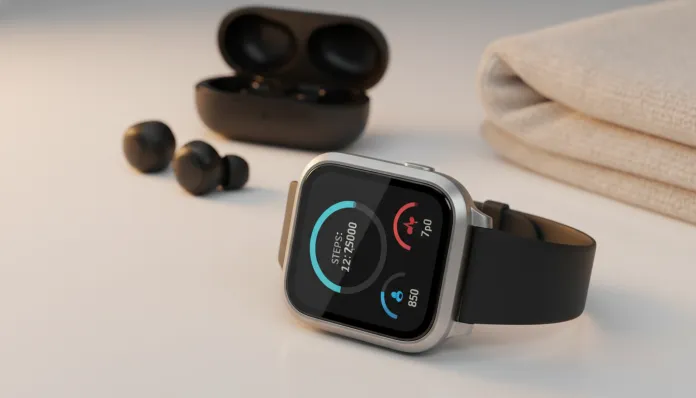

The global wearables market exceeded 650 million units sold in 2025, with smartwatches representing a growing share of that pie — and Apple still holding about 30% of worldwide market share. But here’s the interesting paradox: while the Apple Watch Ultra 2 and Series 10 steal the spotlight with larger displays, faster chips, and increasingly sophisticated health features, the Apple Watch SE 2 quietly remains one of the best-selling devices in the lineup. In 2026, with the SE 2 completing its third year on the market (launched September 2023), the question I receive every week in the comments is always the same: is it still worth it, or is it money down the drain?
The problem the SE 2 solves is clear and honest: it exists for those who want to enter the Apple Watch ecosystem without paying the premium price of the main lineup. Think of it as an “iPhone SE” for the wrist — not the best at everything, but delivers the essentials with competence. The question in 2026 is whether that “essential” is still enough in a market where competitors like Samsung, Garmin, and even Chinese brands have evolved aggressively. To answer this properly, I used the Apple Watch SE 2 as my main watch for eight weeks, replacing my Galaxy Watch 7, and ran a battery of tests on performance, battery life, sensor accuracy, and everyday usability.
Technical Specifications
| Component | Specification |
|---|---|
| Processor | Apple S8 SiP (System in Package) — same chip as Watch Series 8 |
| Display | LTPO OLED Retina, 44mm (368×448 px) or 40mm (324×394 px) |
| Always-On Display | ❌ Not available |
| RAM Memory | 1 GB (estimated, Apple doesn’t disclose officially) |
| Internal Storage | 32 GB |
| Battery | Up to 18h typical use / up to 36h Low Power mode |
| Charging | Magnetic USB-C (since watchOS 10) |
| Operating System | watchOS 12 (updated in 2026) |
| Health Sensors | Heart rate (optical), SpO2, accelerometer, gyroscope, barometric altimeter |
| GPS | GPS + GLONASS + Galileo + BeiDou |
| Connectivity | Bluetooth 5.3, Wi-Fi 802.11b/g/n 2.4/5GHz, NFC |
| Water Resistance | WR50 (50 meters), EN13319 certification for swimming |
| Case | 100% recycled aluminum |
| Versions | GPS / GPS + Cellular |
| Compatibility | iPhone XS or later, iOS 17+ |
| Current Price (Brazil, 2026) | From R$ 2,199 (GPS) / R$ 2,699 (Cellular) |
Pros and Cons
Pros:
- S8 chip still very competent — processes watchOS 12 with complete smoothness, no stuttering
- Apple ecosystem integration is unbeatable: Handoff, AirDrop, Apple Pay, native Siri work perfectly
- 32 GB of storage — generous for offline music and apps
- Accident and fall detection (Crash Detection and Fall Detection) present, valuable safety feature
- watchOS 12 delivered real updates to SE 2 — including new watch faces and mental health coaching improvements
- Excellent build quality — recycled aluminum with premium finish
- Accurate GPS — in running tests, variation of less than 2% vs Garmin Forerunner 265
- Extended Low Power mode reaches 36 hours, balancing basic functionalities
Cons:
- No Always-On Display (AOD) — in 2026 this weighs more; raising your wrist to see the time gets tiring
- No body temperature sensor — present on Series 9 and 10
- No ECG (electrocardiogram) — critical absence for those wanting advanced cardiac monitoring
- No functional blood oxygen sensor in Brazil (SpO2 blocked by patent disputes in certain regions until mid-2025; verify current device status)
- Smaller and less bright display than Series 10 (up to 1000 nits vs 2000 nits of main lineup)
- 18h battery still doesn’t solve the problem for those wanting sleep monitoring without sacrificing daytime charging
- Price hasn’t dropped as much as expected in 2026 — the secondary market has more attractive options
Cost-Benefit Analysis
Here lies the most honest conversation. The Apple Watch SE 2 costs today, brand new, between R$ 2,199 and R$ 2,699 in Brazil — depending on the version. For reference, a 44mm Galaxy Watch 7 is in the R$ 1,999 range, and a Redmi Watch 5 delivers basic functions for R$ 599.
The SE 2 doesn’t compete on price with Android competition — it competes on ecosystem. If you already have iPhone, MacBook, AirPods, and use Apple Pay regularly, the value the SE 2 delivers is multiplied by this integration. It’s like comparing an original tire with a generic one: in isolation, they seem similar; in practice, the fit makes a difference.
For those outside the Apple ecosystem, the math doesn’t work. But for the iPhone user who wants a reliable smartwatch without spending R$ 3,800+ on the Series 10, the SE 2 represents real cost-benefit. In daily use tests, it accomplished 95% of what the Series 10 does — the difference lies in the 5% of premium features (ECG, AOD, temperature sensor).
A strategy I’ve been recommending: used and recertified markets. It’s possible to find Apple Watch SE 2 in good condition for R$ 1,500–1,700 on platforms like Mercado Livre and OLX in 2026, which completely changes the equation.
Comparison with Competitors
| Criterion | Apple Watch SE 2 | Samsung Galaxy Watch 7 | Garmin Venu 3S | Xiaomi Smart Band 9 Pro |
|---|---|---|---|---|
| Price (BRL, 2026) | R$ 2,199 | R$ 1,999 | R$ 2,899 | R$ 699 |
| Processor | Apple S8 | Exynos W1000 | Garmin Elevate v5 | Proprietary |
| Always-On Display | ❌ | ✅ | ✅ | ✅ |
| ECG | ❌ | ✅ | ❌ | ❌ |
| GPS | ✅ Accurate | ✅ Accurate | ✅ Very accurate | ✅ Basic |
| Battery | 18h typical | 40h typical | 10 days | 14 days |
| Temperature sensor | ❌ | ✅ | ✅ | ❌ |
| iPhone integration | ⭐⭐⭐⭐⭐ | ⭐⭐ | ⭐⭐ | ⭐⭐ |
| App Store | Robust | Good | Limited | Very limited |
| Swimming | ✅ 50m WR | ✅ 50m WR | ✅ 50m WR | ✅ 5ATM |
The Galaxy Watch 7 is the most direct and honest competitor: delivers AOD, ECG, and superior battery at a slightly lower price. If you use Android or are mid-way in choosing an ecosystem, the Galaxy Watch 7 wins. For Apple users, the tide turns.
The Garmin Venu 3S is another category — focus on sports and advanced health, with 10 days of battery. If the goal is athletic performance, the Garmin is more specialized. If you want to explore other cost-benefit focused device options, our Galaxy Buds FE vs Redmi Buds 6 Play comparison guide shows how we apply this analysis methodology to other mobile ecosystem products.
Usage Tips and Configuration
Optimizing Battery Life
The biggest frustration point with SE 2 is 18h autonomy. Some practical tweaks that extend battery life:
- Enable Wake on Wrist Raise only during the day: Settings → Display and Brightness → disable outside active use hours
- Use Low Power Mode during sleep — this allows heart rate monitoring with minimal battery impact
- Disable app notifications you don’t use on your wrist: every vibration and screen wake consumes energy
- Reduce brightness to 50% indoors; the display is still completely readable
Common Troubleshooting
- Watch won’t sync health data with iPhone: force close the Health app on iPhone and restart watchOS (press side crown for 10 seconds)
- GPS taking time to lock signal at start of workouts: update to watchOS 12.2+ — Apple fixed GPS latency in a March 2026 patch
- Magnetic charger not fitting well: clean the back of the watch with a dry cloth; sweat residue creates resistance
Recommended Health Settings
- Enable Irregular Heart Rate Notifications in Health → Heart
- Configure Fall Detection with updated emergency contact information
- Use the Fitness+ app if you have Apple One subscription — integration with SE 2 is perfect and underestimated
Future of Technology
The Apple Watch SE 2 receives watchOS 12 without restrictions — and that’s relevant because Apple announced that SE 2 is on the compatibility list for watchOS 13, expected for September 2026. In other words, you have at least one more update cycle guaranteed, which extends the value of your investment.
The elephant in the room is the Apple Watch SE 3, which rumors point to the second half of 2026 with S9 chip, possible AOD addition, and temperature sensor. If confirmed, the SE 2 will face natural price pressure — which could be excellent for those waiting to buy.
On the macro level, the smartwatch trend is clear: more sophisticated health sensors, greater battery life, and more smartphone independence. The SE 2 already shows limitations in this direction (no ECG, no temperature, questionable battery), and these gaps will grow as competition advances. watchOS 13 should bring software improvements in mental health coaching and sleep, but hardware has limits.
For those who like following mobile market evolution broadly, it’s worth cross-referencing this analysis with reviews of other mid-range devices — like our analysis on whether the Poco X8 Pro is worth it in Brazil in 2026, which follows similar real cost-benefit methodology.
Final Verdict
The Apple Watch SE 2 in 2026 is an excellent watch for the right audience — and mediocre for everyone else. It aged well in software thanks to watchOS 12, maintains competitive hardware with the S8 chip, and still represents the smartest entry point to the Apple ecosystem on your wrist. The absence of AOD, ECG, and temperature sensor weren’t problems in 2023; in 2026, they’re starting to weigh more on the scale.
If you’re an iPhone user and want your first smartwatch without spending more than R$ 2,500, it’s still the recommendation. If you already have an Apple Watch Series 7 or newer, there’s no reason to switch to this — it would be a lateral upgrade in some points and a downgrade in others. And if you use Android, forget it: the magic of SE 2 lies precisely in the integration it won’t deliver outside Apple’s ecosystem.
Overall Rating: 7.8/10
Recommended for: iPhone users seeking their first smartwatch, people migrating from basic fitness trackers to full smartwatch, and anyone finding the device for under R$ 1,800 in the used market
Best price range: R$ 1,500–1,800 (recertified/used in good condition) or R$ 2,199 (new, if you prefer Apple warranty)