


INTRODUCTION
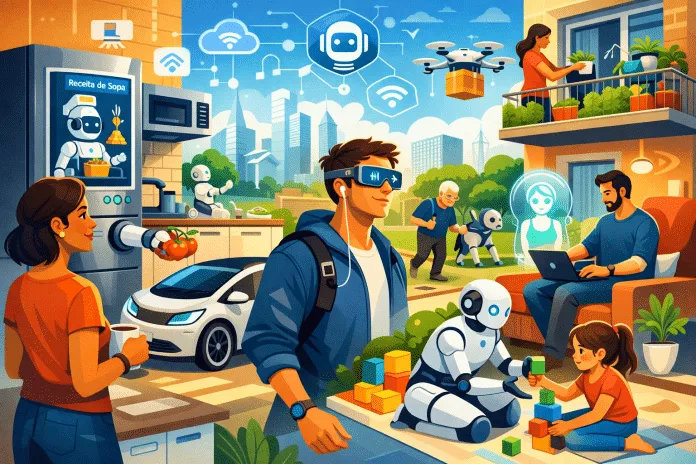
Artificial intelligence in daily life is no longer something distant or exclusive to large technology companies. Today, it is present in simple actions like choosing a route in traffic, receiving movie recommendations or even organizing work tasks.
Even so, many people still don’t realize how much AI is already part of their routine or have doubts about how it works, where it is used and what its real benefits are. Understanding this is important not only to keep up with technological evolution, but also to use these tools in a more conscious and efficient way.
In this article, you will learn about 7 practical uses of artificial intelligence in daily life, with clear examples, real applications and accessible explanations. The goal is to show how technology is already integrated into your routine, often without you noticing, and how it can optimize time, decisions and productivity.
Everything in a simple, current and real-world applied way.
What is Artificial Intelligence?
Artificial Intelligence (AI) is a branch of technology that develops systems capable of performing tasks that would normally require human intelligence, such as:
-
Voice recognition
-
Data analysis
-
Decision making
-
Learning from past experiences
According to IBM, AI is based on algorithms, machine learning and large volumes of data to simulate intelligent behaviors
https://www.ibm.com
Why Is Artificial Intelligence Everywhere?
The popularization of AI happened due to three main factors:
-
Advancement of computational power
-
Increase in the amount of available data
-
Evolution of machine learning algorithms
Today, companies use AI to automate processes, personalize services and improve user experience.
Artificial Intelligence in Daily Life: 7 Practical Uses
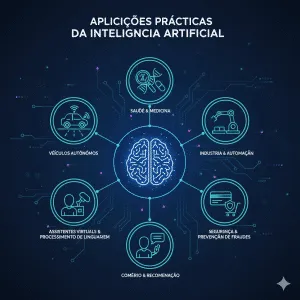
1. Virtual Assistants (Alexa, Google Assistant, Siri)
Virtual assistants use AI to understand voice commands and execute tasks.
Practical examples:
-
Create reminders
-
Play music
-
Control smart devices
Google AI
https://ai.google
2. Streaming and E-commerce Recommendations
Platforms like Netflix, Spotify and Amazon use AI to suggest content and products.
Benefits:
-
Personalized experience
-
Time savings
-
More relevant suggestions
3. Maps and Traffic Applications
Applications like Google Maps and Waze use AI to:
-
Analyze traffic in real-time
-
Suggest faster routes
-
Predict congestion
4. Cameras and Facial Recognition
AI is widely used in:
-
Unlocking smartphones
-
Security systems
-
Automatic photo organization
Microsoft highlights the use of computer vision in security and automation
https://www.microsoft.com/ai
5. Automated Customer Service (Chatbots)
AI-powered chatbots serve customers 24 hours a day.
Advantages:
-
Quick responses
-
Cost reduction
-
Customer service scalability
6. Writing, Translation and Content Creation
AI tools help to:
-
Correct texts
-
Translate languages
-
Generate drafts and ideas
According to MIT Technology Review, generative AI is changing the way we produce content
https://www.technologyreview.com
7. Digital Security and Fraud Detection
Banks and financial platforms use AI to:
-
Identify suspicious transactions
-
Prevent scams
-
Protect user data
World Bank – Financial Technology
https://www.worldbank.org
Advantages and Limitations of Artificial Intelligence
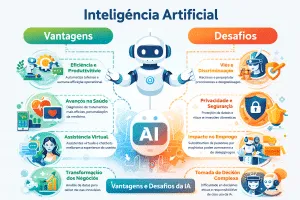
Main Advantages
-
Automation of repetitive tasks
-
Error reduction
-
Fast analysis of large data volumes
Important Limitations
-
Dependence on quality data
-
Risks of algorithmic bias
-
Ethical and privacy issues
Will Artificial Intelligence Replace People?
This is a common doubt. According to the World Economic Forum, AI tends to transform professions, not just eliminate them
https://www.weforum.org
New roles emerge as technology evolves, especially in areas such as:
-
Data analysis
-
Programming
-
Technology management
CONCLUSION
Artificial intelligence in daily life is already a reality present in applications, services and devices we use every day. It makes tasks easier, optimizes decisions and makes processes more efficient, often invisibly to the user.
Understanding how this technology works and where it is applied allows you to better take advantage of its benefits and make more conscious choices. AI is not just the future – it is already part of the present.
If this article was helpful, share it with someone who still thinks artificial intelligence is something from the movies.
Frequently Asked Questions
What is artificial intelligence in daily life?
It is the use of AI in common tasks, such as applications, online services and smart devices.
Is artificial intelligence safe?
When properly applied and regulated, yes, but it requires care with data and privacy.
Do I need to understand technology to use AI?
No. Most applications are intuitive for the end user.
Does AI work without internet?
Some functions yes, but most depend on connection for data analysis.