

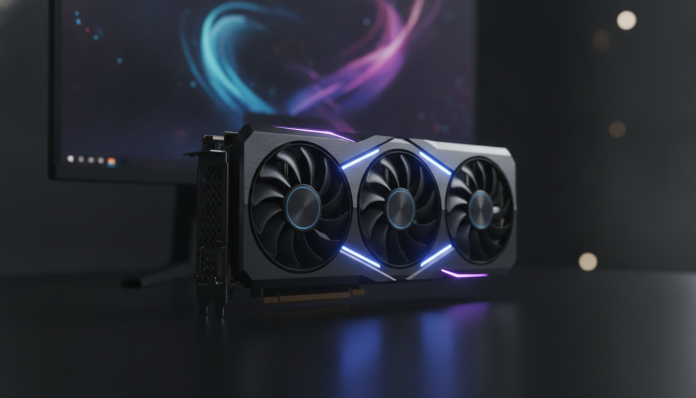

The best GPU under R$ 3,000 for 1080p gaming in 2026
If you want to build or upgrade a gaming PC without breaking the bank, the up-to-R$ 3,000 graphics card range is where most of the Brazilian market lives. This is where manufacturers like NVIDIA and AMD compete most fiercely, and where cost-to-performance ratios tend to be more honest than in top-of-the-line segments. The 1080p (1920×1080 pixels) resolution remains the dominant standard in Brazil in 2026, and a well-chosen GPU in this range delivers framerates high enough to compete in any current game.
The short answer is this: the RX 7600 XT from AMD and the RTX 4060 from NVIDIA are the most solid candidates in this price range in Brazil today. Depending on your profile, one may be worth more than the other, and we’ll break this down throughout the article. Also in the conversation is the Arc B580 from Intel, which hit the global market at the end of 2024 and gained more traction in 2025 and 2026 with mature drivers.
This comparison is for anyone who wants to game at 1080p with high or ultra quality without spending more than R$ 3,000, and wants to make an informed decision based on real specifications, national availability, and total cost of ownership.
Comparison of main GPUs up to R$ 3,000 for 1080p
| GPU | VRAM | Memory Bus | TDP (max consumption) | Launch Price (USA) | Approximate Range in Brazil (2026) |
|---|---|---|---|---|---|
| AMD RX 7600 XT | 16 GB GDDR6 | 128 bits | ~190 W | US$ 329 | R$ 2,000 to R$ 2,700 |
| NVIDIA RTX 4060 | 8 GB GDDR6 | 128 bits | ~115 W | US$ 299 | R$ 1,800 to R$ 2,500 |
| Intel Arc B580 | 12 GB GDDR6 | 192 bits | ~190 W | US$ 249 | R$ 1,600 to R$ 2,200 |
| AMD RX 7600 | 8 GB GDDR6 | 128 bits | ~165 W | US$ 269 | R$ 1,400 to R$ 1,900 |
Prices in Brazil vary by store, exchange rate, and state ICMS. Values above are reference for research, not fixed price.
VRAM: why 8 GB is already tight for 1080p
VRAM is the dedicated memory of the graphics card, the space where textures, current frame data, and graphics resources loaded by the game sit. Think of it as the game’s work table: the larger it is, more things can be at hand without needing to fetch from the cabinet (which would be system RAM, much slower for this purpose).
In 2025 and 2026, several AAA games with high-resolution textures, such as titles using heavier rendering technologies, already show VRAM consumption above 8 GB even at 1080p with ultra settings. This doesn’t mean the RTX 4060 with 8 GB becomes unusable, but in some specific scenarios it may force the driver to compress textures or present occasional stutters.
The RX 7600 XT comes with 16 GB of VRAM on a 128-bit bus, which is generous for the price range. The Intel Arc B580 offers 12 GB with a 192-bit bus, a combination that gives it more bandwidth per gigabyte than AMD in this specific configuration. For those wanting to game with everything maxed out and not worry about memory limitations in the next two or three years, the advantage of both over the RTX 4060 is real.
Performance at 1080p: what the spec sheets indicate
Without our own lab, we’re not inventing numbers here. What official specifications and publicly available data allow us to say is the following:
- The RTX 4060 has the best energy efficiency in the group, with a TDP of just 115 W according to NVIDIA’s spec sheet. For those with a more modest power supply or concerned about electricity bills, this is relevant.
- The RX 7600 XT has more compute cores than the original RX 7600 and more VRAM, which translates to better performance in games that scale well with memory.
- Intel’s Arc B580 was launched at US$ 249 in the USA and gained a reputation for delivering competitive performance in rasterization (the traditional way of rendering images in games), especially after Intel Arc drivers matured throughout 2025.
- In games with ray tracing support (a technique that simulates real light behavior, making reflections and shadows more realistic but requiring much more processing), NVIDIA typically has a structural advantage because of the Ada Lovelace architecture and dedicated hardware. AMD and Intel also support ray tracing, but generally with inferior performance in this price range.
For 1080p in competitive games like shooters and MOBAs running at 144 Hz or higher, any of the four GPUs in the table can deliver elevated framerates in the right settings. The bottleneck in these cases tends to be the processor, not the GPU.
Upscaling: DLSS, FSR, and XeSS change the equation
Upscaling is a technology that renders the game at a lower resolution and then reconstructs the image to the final resolution using intelligent algorithms. The practical result is performance gain with image quality loss that ranges from imperceptible to acceptable, depending on implementation.
- DLSS 3 / DLSS 4 (NVIDIA): available exclusively on RTX GPUs. The latest version uses artificial intelligence to generate intermediate frames, increasing perceived framerate considerably. It’s the most polished solution on the market according to widely publicized public evaluations.
- FSR 3 (AMD): works on any GPU, including NVIDIA and Intel. It doesn’t use dedicated AI in the same way, but quality has improved significantly in more recent versions. Because it’s open, it has support in more games.
- XeSS (Intel): Intel’s solution, works best on Arc GPUs by using dedicated hardware, but also runs on other cards with reduced quality.
If you play titles supporting DLSS and value this differentiator, the RTX 4060 gains points that don’t appear directly in crude spec comparisons. If you prefer an agnostic solution that works with any compatible game, FSR on the RX 7600 XT covers more titles.
Availability in Brazil, warranty, and importing
This is a critical point that many people ignore when buying a GPU. In Brazil, graphics cards are sold by AIBs, that is, partner manufacturers such as ASUS, Gigabyte, MSI, Galax, and Sapphire, and not directly by NVIDIA, AMD, or Intel. Each AIB has its own warranty policy in Brazil.
Buying from an authorized national reseller guarantees access to local warranty, usually one to three years depending on manufacturer and model. Importing via international order may seem cheaper at first glance, but warranty is tied to the country of origin, and you still pay IOF, import tax, and may have unforeseen customs clearance costs.
As for Anatel approval: GPUs don’t emit radio signals on their own, so Anatel’s regulation doesn’t apply to them in the same way it does to routers or smartphones. But connected monitors and peripherals may have this requirement. Always verify that the product has a national invoice and clear warranty coverage before finalizing the purchase.
The Intel Arc B580 had more irregular availability in Brazil throughout 2025, but has been gaining more distributors in 2026. Even so, the variety of available models is still smaller than AMD and NVIDIA. If you value ease of replacement or local technical support, RX 7600 XT and RTX 4060 have a clear logistical advantage.
Which to choose, by usage profile
If you want the best raw value for money at 1080p and don’t care about heavy ray tracing: the RX 7600 XT delivers the most VRAM in the range and has good performance in pure rasterization. It’s the choice for those who want to play with everything maxed out without worrying about the near future in terms of memory.
If you want energy efficiency and the NVIDIA ecosystem (DLSS, Nvidia Reflex, broad driver support): the RTX 4060 is the choice. The 115 W consumption is hard to beat, and DLSS 4 with frame generation is a real differentiator in supported games. The 8 GB VRAM limit is the main caveat.
If you have a tighter budget and want to stretch your money: the Intel Arc B580 around R$ 1,600 to R$ 2,200 with 12 GB and 192-bit bus is a pleasant surprise, especially with 2025 onward drivers. It’s not for those averse to risk or needing easy support, but delivers generous specs for the price.
If you want to save even more and play less demanding titles: the original RX 7600 for under R$ 2,000 still makes sense for 1080p at medium or high settings.
Choosing a GPU also involves thinking about the rest of the system. If you use the PC for video editing or AI rendering, for example, the 16 GB VRAM of the RX 7600 XT might be more useful than any gaming benchmark. In fact, if you use creative tools like the best free AIs for creating images without registration in 2026, extra VRAM can make a difference when running local models.
Frequently asked questions about GPUs for 1080p up to R$ 3,000
Is 8 GB of VRAM still sufficient for gaming at 1080p in 2026?
It depends on the game and settings. For most titles at high to ultra quality, 8 GB still works well. In some newer games with very heavy textures and maximum settings, there may be occasional stutters. If you have the habit of gaming at the graphics limit, 12 GB or 16 GB offer more headroom.
Is it worth paying more for the RTX 4060 just for DLSS?
If you play titles supporting DLSS 3 or DLSS 4 with frame generation, yes, the differentiator is real and perceptible. If your catalog consists mainly of games that don’t support DLSS, the advantage disappears and the comparison returns to crude specs, where the RX 7600 XT has the VRAM advantage.
Is the Intel Arc B580 reliable for daily use in 2026?
Arc drivers improved significantly throughout 2025, and Intel maintained a consistent update pace. There may still be occasional compatibility issues with older games using legacy APIs like DirectX 9. For modern games with DirectX 12 or Vulkan, the experience is much more stable than in the first months after launch.
Do I need a more powerful power supply to swap GPUs?
It depends on your current power supply and chosen GPU. The RTX 4060 with 115 W TDP is the least demanding in the group. The RX 7600 XT and Arc B580 reach up to 190 W. As a general rule, a 550 W to 650 W 80 Plus Bronze power supply is sufficient for systems with these GPUs, but always check the official recommendation from your chosen card’s manufacturer.
What you should do now

Before clicking to buy, check current prices at national stores like Kabum, Pichau, and Terabyte, which usually have good variety of models. Prices fluctuate with exchange rates and demand, so what costs R$ 2,200 today may be R$ 1,950 in two weeks or R$ 2,400 during high dollar periods.
Also confirm warranty in Brazil before finalizing the purchase: look for the authorized distributor’s name on the AIB manufacturer’s website. And remember that the GPU is half the equation: an outdated processor can waste all the potential of your new card, especially in competitive games at 144 Hz or higher.