


Gym earbuds in 2026 that won’t fall: what really matters before buying
Choosing earbuds for training seems simple until you drop the device on the floor for the third time during a squat, or take them off mid-run because they’re hurting your ear. The market in 2026 is saturated with options, and most manufacturers promise the perfect fit without delivering anything beyond marketing. This guide exists to cut through that noise.
The focus here isn’t on the cheapest or most expensive earbuds: it’s on the right earbuds for people who actually train. We’ll talk about the criteria that determine if earbuds stay in your ear during intense HIIT, which models have official specifications that support that promise, and how to navigate the available offerings in Brazil, including imports, Anatel homologation, and warranty.
The short answer: for most practitioners, in-ear earbuds with ear hooks (the loop that wraps around your ear) or sport shell design deliver the best balance between stability and comfort. Established true wireless sport earbuds like Jabra, Shokz, and JBL’s sport line remain reference points in 2026 for concrete technical reasons that you’ll understand throughout this text.
The criteria that really define if earbuds stay in place
Format and fit system
The fit is the first filter. There are three main sport formats on the market:
- In-ear with silicone tips (traditional earbuds): depend exclusively on the pressure of the tip in the ear canal. They work well for walking and moderate strength training, but tend to loosen with sudden movements.
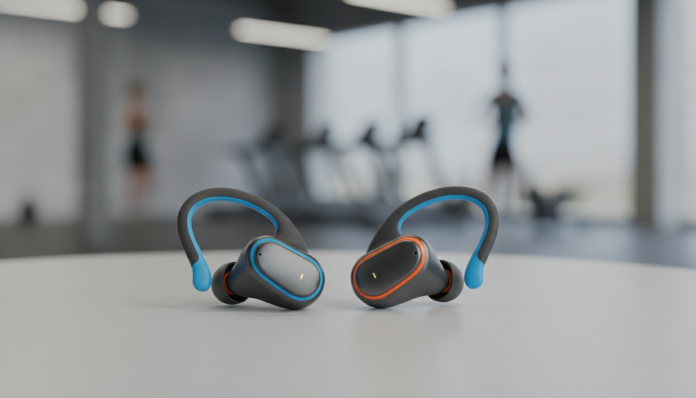
- In-ear with ear hook: the tip enters the canal and a flexible silicone or plastic loop rests on the upper part of the ear. This system distributes weight and drastically reduces the risk of falling. It’s the most recommended format for running and functional training.
- Bone conduction: transducers are supported on the bones of your cheekbones without blocking your ears. There’s no risk of falling from the ear canal because they simply don’t enter it. The trade-off is inferior sound quality and poor performance in noisy environments.
The IP rating (classification of resistance to water and dust, defined by IEC 60529 standard) also matters here. For the gym, the minimum recommended is IPX4, which protects against splashing from any direction. If you train outdoors or sweat a lot, IPX5 or IPX7 (submersion up to 1 meter for 30 minutes) is preferable. Always check the certificate in the technical specs, as some manufacturers use proprietary terminology that doesn’t match the IEC standard.
Battery and charging case
For training sessions up to 90 minutes, any earbuds with 6 hours of declared autonomy is sufficient. The point of attention is that manufacturers measure autonomy at low volume, without active ANC. In practice, expect 15% to 30% less than the advertised value if you train at high volume. Check if the technical specs inform the test volume (usually 50% or 70%) and whether ANC was active during measurement.
The charging case matters less for the gym than for travel, but a quick charge of 10 to 15 minutes that delivers 1 hour of use can save a workout. Look for this information explicitly in the manufacturer’s official materials.
Latency and audio quality
For training while listening to music, latency (the delay between the signal sent and the sound reproduced) isn’t a practical problem. It stays below human perception with any modern codec. Audio quality for sport has a specific characteristic: you’ll use it in a noisy environment, so the response of midrange and bass matters more than treble detail. Earbuds that sound good in a studio can sound dull on a treadmill.
ANC (Active Noise Cancellation) in sport earbuds is a controversial feature. It drains battery, can create uncomfortable pressure in the ear canal during long training, and eliminates important alert sounds if you run on the street. Many sport models offer disableable ANC or a transparency mode (which amplifies environmental sounds). For a closed gym, ANC is a useful bonus. For outdoor training, prefer transparency mode.
Models with specifications that support gym use
Below are models with presence in the Brazilian market in 2026 and publicly available official specifications. Prices in Brazilian reais vary depending on exchange rate and sales channel; the values cited are approximate reference for purchases in Brazil.
| Model | Format | IP | Declared autonomy (earbud) | ANC | Price range (BR) |
|---|---|---|---|---|---|
| Jabra Elite 8 Active (2nd generation) | In-ear with hook | IP68 | Up to 8 hours | Yes | R$ 900 to R$ 1.200 |
| JBL Endurance Peak 3 | In-ear with hook | IPX7 | Up to 10 hours | No | R$ 400 to R$ 600 |
| Shokz OpenRun Pro 2 | Bone conduction | IP55 | Up to 12 hours | No | R$ 800 to R$ 1.100 |
| QCY T13 ANC 2 | Traditional in-ear | IPX5 | Up to 6 hours | Yes | R$ 150 to R$ 250 |
| Beats Fit Pro | In-ear with flexible wing | IPX4 | Up to 6 hours | Yes | R$ 1.200 to R$ 1.600 |
The Jabra Elite 8 Active stands out for its IP68 (total dust protection and submersion), integrated ear hook system integrated into the earbud body, and adjustable equalization in the app. According to Jabra, the model was specifically designed for sudden movements. The Jabra Elite 8 Active is imported and not always found with Anatel homologation in physical stores; check the seal and documentation before buying.
The JBL Endurance Peak 3 is a more accessible option with IPX7 and JBL’s PowerHook system, which automatically pauses audio when you remove the earbuds. No ANC, but with declared autonomy of 10 hours, it’s the most direct candidate for those who train more than an hour per session without worrying about battery.
The Shokz OpenRun Pro 2 is the choice for those who won’t compromise on hearing the environment. Bone conduction doesn’t block your ear, so you hear both music and the instructor at the same time. Sound quality is notoriously inferior to in-ear earbuds, especially in bass. If that doesn’t bother you, stability is unbeatable: it literally can’t fall from the ear canal because it’s not in it.
The QCY T13 ANC 2 is the most aggressive value-for-money option in the segment. If you want to learn more about this model before deciding, check the complete review of the QCY T13 ANC 2 to understand the limitations and strengths in detail. It doesn’t have an ear hook, so the fit depends on the tip; switch to a memory foam silicone tip if the standard doesn’t stay firm.
Anatel homologation, import, and warranty in Brazil
This point is ignored by many people and becomes a headache later. Anatel (National Telecommunications Agency) requires that devices with Bluetooth connectivity sold in Brazil be homologated. Earbuds without homologation can be seized at customs and have no legal warranty backed by the Consumer Protection Code.
When buying through parallel importers or international marketplaces:
- Check if the product has the Anatel homologation number on the packaging or in the product specs on the website.
- Purchases over US$ 50 (CIF value, including freight and insurance) are subject to a 20% import tax for individuals via Remessa Conforme. For purchases over US$ 600, the rate rises to 60%.
- Warranty from a parallel importer does not replace manufacturer warranty; in case of defect, the process is usually more bureaucratic.
JBL, Jabra, and Beats models have official distributors in Brazil and are found in stores like Amazon.com.br, Magazine Luiza, and Americanas with invoice and 12-month warranty (legal minimum). Shokz also operates officially in the country. QCY has growing presence through importers, but homologation varies by batch; ask the seller for proof.
Tips and accessories that make a real difference
Earbuds that don’t fit well can become excellent earbuds with the right tip. Brands like Comply manufacture memory foam tips that adapt to the shape of your ear canal and increase passive isolation. They’re compatible with most earbuds that use 5mm or 6mm stems; check compatibility before buying.
For third-party ear hooks, there are universal silicone kits that fit earbuds without native hooks. They work reasonably well for walking and light strength training, but don’t offer the same security as a hook integrated into the earbud design. If fit is a priority, invest in a model that already has the hook from the factory.
Frequently asked questions about gym earbuds
Are noise-cancelling earbuds dangerous to wear while running on the street?
Yes, they can be. With active ANC, you significantly reduce environmental sounds, including car horns and alerts. Most modern sport earbuds offer a transparency mode that amplifies external sound via microphone; prefer that mode for outdoor training. In a closed gym, ANC is safe and useful for focusing on your workout.
What’s the difference between IPX4, IPX7, and IP68?
The number before the X (or in place of the X) indicates dust protection: absent in IPX, maximum in IP6. The number after indicates water protection: IPX4 protects against splashing, IPX7 against submersion up to 1 meter for 30 minutes, and IP68 indicates submersion under conditions defined by the manufacturer (usually deeper). For the gym, IPX4 is sufficient; for swimming, you need something specific for water sports, as IPX7 doesn’t cover diving pressure.
Is it worth paying more for earbuds with Bluetooth 5.3 or 5.4 instead of 5.2?
For gym use, the practical difference is minimal. Newer Bluetooth versions bring improvements in power consumption and connection stability in environments with a lot of interference. If the earbuds you want have 5.2 and meet all other criteria, don’t rule them out because of the Bluetooth version.
Do I need different earbuds for strength training and running?
Not necessarily. Good in-ear earbuds with an ear hook and IPX5 or higher address both scenarios. The relevant distinction is for swimming (you need earbuds certified for water use with internal music storage) or bone conduction for those who prioritize environmental awareness in street running.
What to consider when making your purchase
The best gym earbuds aren’t the most expensive or those with the most features on the technical sheet: they’re the ones that stay in your ear throughout your entire workout without irritating you. For most people doing strength training and functional workouts, in-ear with ear hook, IPX5 or higher, and at least 6 hours of autonomy works well, and you can find that in the R$ 400 to R$ 1.200 range with official warranty in Brazil.
If your budget is tight, the QCY T13 ANC 2 is honest about what it delivers for around R$ 200. If you run on the street and want maximum fit security with environmental awareness, the Shokz OpenRun Pro 2 is hard to beat. If you want the complete package without compromises and have the budget for it, the Jabra Elite 8 Active remains one of the most solid references in the segment in 2026.
Before finalizing any purchase, verify Anatel homologation, the seller’s warranty policy, and whether the tips that come with the earbuds are the right size for your ear canal. These details don’t appear in any unboxing, but they determine whether the earbuds will last a year or end up in a drawer in three months.