

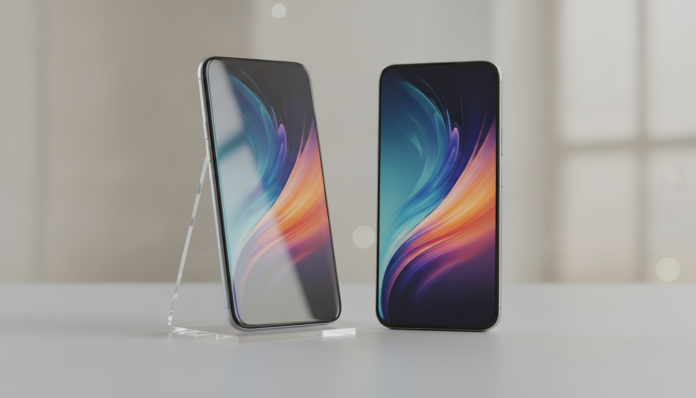

The best smartphones under R$ 2,000 in May 2026
Finding a good smartphone in this price range in Brazil has never been so challenging — not because there are few options, but because there are many good ones competing for attention. In 2026, the under R$ 2,000 range has left behind the era of “almost good” mid-range devices and entered firmly into the territory of phones that deliver premium experience in specific areas: fluid display, all-day battery life and cameras that don’t disappoint.
The criteria for this selection is simple: devices with Anatel homologation (that is, legally sold in Brazil with manufacturer warranty), available at major national retailers like Magazine Luiza, Amazon Brasil, Americanas and carriers, with list price up to R$ 2,000 in May 2026. Prices vary with promotions and dates like Black Friday, so consider the values here as reference.
The direct answer for those who just want a name: the Xiaomi Redmi Note 14 Pro and the Samsung Galaxy A56 compete for first place depending on what you prioritize. Below, you’ll understand why, and discover which one is right for your case.
Comparative table: specs side by side
| Feature | Xiaomi Redmi Note 14 Pro | Samsung Galaxy A56 | Motorola Edge 50 Neo | POCO X7 Pro |
|---|---|---|---|---|
| Processor | Snapdragon 7s Gen 3 | Exynos 1580 | Dimensity 7300 | Dimensity 8400 Ultra |
| RAM / Storage | 8 GB / 256 GB | 8 GB / 256 GB | 8 GB / 256 GB | 8 GB / 256 GB |
| Display | 6.67″ AMOLED, 120 Hz | 6.7″ Super AMOLED, 120 Hz | 6.4″ pOLED, 120 Hz | 6.67″ AMOLED, 120 Hz |
| Main Camera | 200 MP, f/1.65 | 50 MP, f/1.8 | 50 MP, f/1.8 | 50 MP, f/1.6 |
| Battery | 5,500 mAh | 5,000 mAh | 4,310 mAh | 6,000 mAh |
| Charging | 45 W | 45 W | 68 W | 90 W |
| Software (Launch) | Android 14, MIUI/HyperOS | Android 15, One UI 7 | Android 14, Hello UI | Android 14, HyperOS |
| Protection | IP68 | IP67 | IP68 | IP68 |
| Anatel | Yes | Yes | Yes | Check |
| Price Range (May/2026) | R$ 1,700 to R$ 1,900 | R$ 1,800 to R$ 2,000 | R$ 1,400 to R$ 1,700 | R$ 1,600 to R$ 1,900 |
> Prices collected from national retailers in May 2026. Values change with promotions.
Daily performance: who goes the farthest without lag
The Snapdragon 7s Gen 3 in the Redmi Note 14 Pro and the Exynos 1580 in the Galaxy A56 are recent-generation chips that handle any user’s daily routine well. Multitasking, social media, 4K streaming, camera, it all runs smoothly. The difference appears when you step it up: demanding games like Genshin Impact on high settings or 4K video editing require more from the processors.
The POCO X7 Pro has an advantage here with the Dimensity 8400 Ultra, a chip that sits between advanced mid-range and entry-level flagship, according to Mediatek itself. For those who game a lot, this processor delivers more stable frame rates in demanding titles. The trade-off is that POCO has less software polish and Anatel homologation should be checked at purchase time, since availability can vary between resellers.
The Motorola Edge 50 Neo falls a step below in raw processing power with the Dimensity 7300, but makes up for it with faster charging (68 W) and cleaner software. For conventional use, the chip difference won’t appear in daily use.
Display and visual experience: where the price range surprises
All four models use AMOLED panels with 120 Hz refresh rate, which is the display technology where pixels emit their own light, delivering true black and more vibrant colors than LCD. If you’ve never had a smartphone with AMOLED, you’ll notice the difference in the first five minutes.
The Galaxy A56 has what Samsung calls Super AMOLED, with adaptive brightness adjustment and Gorilla Glass Victus Plus support, which puts the display among the most protected in the price range. One UI 7 also brings well-calibrated visual comfort features. For those who use their phone a lot in bright environments, the A56’s maximum brightness is a real differentiator, as noted in Samsung’s technical sheet.
The Motorola Edge 50 Neo uses pOLED (a variation of OLED on plastic screen, more curved at the edges), with FHD+ resolution and a slightly smaller 6.4-inch display. For those who prefer a more compact device that’s easier to hold with one hand, this is the only one on the list with this profile.
Camera: large numbers don’t always mean better photos
The 200 MP sensor in the Redmi Note 14 Pro draws attention, but it’s important to understand what that number represents in practice. Cameras with very high megapixels typically use pixel binning, a technique that groups smaller pixels to generate a photo with more light information. According to Xiaomi’s technical sheet, the camera captures at 12.5 MP by default and only uses the 200 MP when manually activated. The result is a large sensor that performs well with light and reasonably in difficult conditions.
The Galaxy A56 relies on 50 MP with f/1.8 aperture and image processing enhanced by Samsung’s software, which has years of refinement in the market. According to the official sheet, the A56 brings AI night mode and 3x optical zoom, placing it ahead in photographic versatility for daily use. For those who want good photos without needing to configure anything, the A56 is more consistent.
The POCO X7 Pro brings f/1.6 aperture, which theoretically captures more light, but check real samples on specialized channels before deciding, as Xiaomi image processing in the POCO segment tends to vary between models.
Battery and autonomy: who lasts all day without charging
| Model | Capacity | Charging | Estimated Autonomy |
|---|---|---|---|
| Redmi Note 14 Pro | 5,500 mAh | 45 W | Heavy use: 1.5 days |
| Galaxy A56 | 5,000 mAh | 45 W | Heavy use: 1 day |
| Motorola Edge 50 Neo | 4,310 mAh | 68 W | Heavy use: 8 to 10 h |
| POCO X7 Pro | 6,000 mAh | 90 W | Heavy use: 1.5 to 2 days |
The autonomy estimate above is qualitative and based on battery capacity, processor and screen size. Actual results vary with usage habits, screen brightness and connectivity. For more precise data, check tests published by channels like TudoCelular and Canaltech.
The POCO X7 Pro has the largest battery on the list and the fastest charging. For those who travel a lot or aren’t in the habit of regularly charging their phone, this point can be decisive. Motorola compensates for the smaller battery with charging speed, going from zero to one hundred in around 50 minutes, according to the manufacturer’s technical sheet.
Software and support: how long the phone will last
This is a criterion that few people consider when purchasing, but it makes a difference in two or three years. Samsung guarantees four years of Android updates for the Galaxy A56 and five years of security patches, which puts the device ahead in the price range in terms of software longevity.
Motorola guarantees two years of OS updates and three of security for the Edge 50 Neo, which is still reasonable. Xiaomi promises three years of updates for the Redmi Note 14 line, but the actual delivery history deserves monitoring. It’s worth checking forums like XDA Developers to see how the brand has fulfilled this commitment in Brazil.
For those who want to keep their phone for longer without worrying about support, the Galaxy A56 is the safest choice on the list.
Import and Anatel homologation: what to consider
Buying an imported phone without Anatel homologation may seem tempting for the price, but it carries concrete risks: without the Anatel seal (National Telecommunications Agency), the device may not work on all frequency bands of Brazilian carriers, which affects 4G and 5G signal quality. The warranty, when it exists, is typically from the seller and not the manufacturer.
All models on this list, with the exception of the POCO X7 Pro (verify the SKU before buying), have homologated versions available at national retailers. When buying on sites like Amazon Brasil or at carrier physical stores, you guarantee an invoice, one-year warranty by law and access to authorized technical support.
Which to choose according to your profile
If you want the best overall value for money: the Redmi Note 14 Pro delivers a large display, ample battery and 200 MP camera for R$ 1,700 to R$ 1,900. It’s the most balanced on the list for those without a specific priority.
If you want the most reliable long-term: the Galaxy A56 has the best software support, the brand with the largest technical support network in Brazil and a camera that delivers consistency in daily use. The higher price, close to R$ 2,000, is justified by the complete experience.
If you game a lot or want the largest battery: the POCO X7 Pro is the most powerful on the list. Just confirm Anatel homologation before closing the purchase.
If you prefer a smaller phone and fast charging: the Motorola Edge 50 Neo is the only compact on the list, with the quickest charging and lightweight software. The smaller battery is the only point of attention.
Frequently asked questions about phones under R$ 2,000
Is it worth waiting for the next release or buying now?
In May 2026, the models on this list represent the best available in the range. New releases in the second half may bring updates, but initial prices are usually higher. If you need a phone now, buying one of the models on this list is a safe decision.
Does the Galaxy A56 have 5G in Brazil?
Yes, according to Samsung’s technical sheet, the Galaxy A56 brings 5G support on bands compatible with Brazilian carriers. Check with your carrier which bands are available in your city before considering this as a decision factor.
Is the Redmi Note 14 Pro the same as the Xiaomi Note 14 Pro?
They are names from the same line, sold by Xiaomi under different sub-brands in some markets. In Brazil, check the exact model in the box and product technical sheet at the store, as specifications may vary between regional and global versions.
Does it make sense to spend R$ 2,000 on a phone when there are cheaper options?
It depends on usage. Phones like the Motorola Moto G85, which falls below R$ 1,500, serve well for basic use. The R$ 2,000 range makes a real difference if you use the camera frequently, game, or want to keep the device for more than two years without feeling slowness.
What to bring to the store or website when buying

Before finalizing the purchase, check three things: the Anatel homologation number on the box or product page, the storage version (some models have 128 GB version for the same price on imported sites), and the seller’s exchange policy. If you use wired earphones a lot, note that none of the models on this list have a 3.5mm jack, so a USB-C to 3.5mm adapter may be necessary.
If you’re setting up a complete setup with headphones and a watch, it’s worth looking at what comes with each ecosystem: Samsung devices, for example, integrate better with the Galaxy Watch 8, whose battery we reviewed in detail here. And if working from home is part of your routine, a good noise-canceling headphone like those evaluated in the JBL Tune 770NC vs Sony WH-CH720N comparison for home office can complete the package without busting the budget.