

 revolutionizes education, healthcare, retail, and business. Discover how VR, AR, and MR are reshaping industries beyond gaming.)
Extended Reality (XR): How VR, AR and MR Are Transforming the World Far Beyond Games
Extended Reality (XR), which brings together Virtual Reality (VR), Augmented Reality (AR) and Mixed Reality (MR), is consolidating itself as one of the most revolutionary technologies of the digital age. Although for a long time it was associated mainly with the gaming universe, today it occupies a much larger and more complex space, influencing areas such as education, health, architecture, tourism, retail, security and even the corporate market. Furthermore, its accelerated expansion demonstrates that we are facing a structural change in the way we live, learn and work.
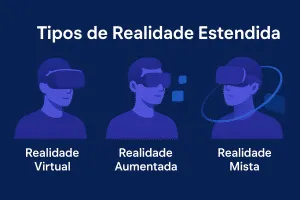
To begin with, it is essential to understand that XR transforms the way people interact with information and environments. While Virtual Reality creates completely digital worlds, Augmented Reality inserts virtual elements into the real world. Mixed Reality, on the other hand, combines both, allowing deep interaction between physical and digital objects. In this way, XR not only expands possibilities, but also brings individuals closer to experiences that were previously impossible or extremely limited.
Education: when learning is no longer just theory
Education is one of the sectors most impacted by XR. This is because traditional methods often face limitations, especially when involving complex content. On the other hand, XR offers immersive experiences that facilitate the understanding of abstract concepts. For example, a student can visualize the solar system at enlarged size, observe planets in motion or explore the interior of the human body in 3D.
Furthermore, XR promotes greater engagement. Many students report that they learn better when they interact with the content, rather than just reading or listening to it. This combination of practice with visualization facilitates memorization and makes learning more enjoyable. Consequently, it is expected that schools, universities and educational platforms will increasingly adopt these resources.
Healthcare: training and precision as pillars
The healthcare field has also benefited greatly from Extended Reality. Doctors and medical students can train complex procedures in simulated environments, reducing risks and increasing precision. For example, surgeons use VR models to train interventions before performing them on real patients. This allows them to become familiar with anatomical particularities and identify potential challenges in advance.
At the same time, hospitals have adopted AR to assist in examinations and procedures. With smart glasses, professionals can see digital information about the patient while performing tasks, making care more efficient. Thus, XR not only improves the quality of services, but also saves lives by reducing errors and expanding the knowledge of specialists.
Architecture and engineering: design before building
Architects and engineers have found in XR a powerful tool for visualization and decision-making. Previously, clients needed to interpret blueprints and physical models, which often generated doubts or communication failures. Now, with XR, it is possible to walk through an environment even before its construction, observe textures, test colors, reorganize furniture and visualize lighting in real time.
In this way, errors are detected earlier, avoiding waste and rework. Furthermore, clients feel more secure when approving projects, as they clearly understand how the final result will be. This transparency strengthens the relationship between design teams and consumers, making the process more efficient and reliable.
Retail: elevated personalization and experience
The retail sector is also experiencing significant transformation driven by XR. Clothing stores, for example, use smart mirrors that allow consumers to virtually try on pieces. Meanwhile, furniture companies allow customers to visualize how a product would look in their own home environment using just a mobile phone.
As a result, consumers make more assertive choices and have a more pleasant shopping experience. Additionally, brands can create interactive campaigns, approaching the public in an innovative way. Therefore, XR has become a powerful strategy to increase sales and improve customer satisfaction.
Tourism and culture: traveling without leaving home
Another field that has been deeply transformed is tourism. With XR, it is possible to explore museums, historic cities and tourist attractions from anywhere in the world without leaving home. For example, visitors can observe works of art, listen to guided explanations and explore scenarios in 360 degrees. Thus, XR democratizes access to culture, allowing more people to experience enriching experiences.
Corporate world: training and expanded productivity
Companies are also adopting XR for employee training, remote meetings and workplace environment simulation. In this way, teams can practice risky tasks without danger, improve skills and reduce training costs. Furthermore, VR meeting environments provide more natural and immersive communication than traditional videoconferences.
The future impact of XR on daily life
Given all these transformations, it becomes evident that Extended Reality (XR) is ceasing to be a technology restricted to entertainment to become one of the main forces shaping the future of society. Its impact transcends borders and redefines the way we learn, work, consume and relate to the world around us. Furthermore, XR expands human capacity to experience, understand and create, offering new perspectives that were previously unimaginable.
As more advanced devices emerge and software becomes more accessible, XR tends to integrate naturally into people’s routines. Therefore, those who understand and adopt this technology early will be better prepared to keep up with rapid changes in the digital landscape. Companies, schools, professionals and consumers who use XR strategically will not only gain competitive advantage, but also contribute to building richer, safer and more efficient experiences.
Therefore, Extended Reality represents not just a technological advance it symbolizes a new chapter in the evolution of human interaction with the digital. After all, by combining immersion, innovation and infinite possibilities, XR is not only transforming the present, but also paving the way for a more connected, intuitive and extraordinarily expanded future.