



The global true wireless earbuds market surpassed 800 million units sold in 2025, and competition for consumer wallets in the mid-range category has never been more intense. If you’re looking for TWS (True Wireless Stereo) earbuds between R$ 150 and R$ 300 in 2026, you’ve probably already encountered these two names: the Galaxy Buds FE from Samsung, and the Redmi Buds 6 Play from Xiaomi. They are direct rivals promising premium quality without emptying your wallet — but do they deliver?
The real problem both are trying to solve is simple: most people don’t want to spend R$ 1,000+ on AirPods Pro or Galaxy Buds 3 Pro, but they’re tired of generic earbuds that fall out during their first bike ride. There’s a huge gap between “cheap and disposable” and “premium and expensive,” and these two are fighting for exactly that space. The difference is that each chose a different strategy to convince you.
I spent three weeks testing both models in parallel — on São Paulo public transportation, during gym workouts, in home office work calls, and in long streaming sessions. I used volume measurement apps like SoundMeter Pro, tested latency with Audio Latency Tester, and manually timed battery life. Let’s get to what matters.
Technical Specifications
| Specification | Galaxy Buds FE | Redmi Buds 6 Play |
|---|---|---|
| Driver | 9.2mm dynamic | 12.4mm dynamic |
| Frequency response | 20 Hz – 20 kHz | 20 Hz – 20 kHz |
| Audio codec | AAC, SBC | AAC, SBC, LDAC |
| ANC (active noise cancellation) | Yes (1 hybrid microphone) | No |
| Microphones | 3 (2 external + 1 internal) | 2 |
| Battery (earbuds) | 5.5 hours (ANC on) / 8.5 h (ANC off) | 9 hours |
| Battery (total with case) | Up to 21 hours | Up to 40 hours |
| Charging | USB-C | USB-C |
| Water resistance | IPX2 | IP54 |
| Connectivity | Bluetooth 5.2 | Bluetooth 5.4 |
| Declared latency | ~130 ms | ~45 ms (gaming mode) |
| Weight (each earbud) | 5.6 g | 4.6 g |
| App compatibility | Galaxy Wearable (Samsung) | Mi Buds app (Android/iOS) |
| Average price 2026 | R$ 249 | R$ 189 |
Pros and Cons
Galaxy Buds FE
Pros:
- ANC that actually works for the price — suppresses surrounding conversations by about 70% in subjective measurement
- Call microphone quality well above category average
- Native integration with Samsung ecosystem (automatic switching between Galaxy S25 and tablet, for example)
- Premium finish and design, feels like an expensive product in hand
- Customizable equalization through Galaxy Wearable with good granularity
Cons:
- Weak water resistance (IPX2 = only light splashes, no heavy sweat)
- Lower total battery than competitor (21h vs 40h)
- No LDAC support, Sony’s high-resolution codec — loses quality with lossless audio sources
- ANC on significantly reduces battery life
- Optimal experience only for Samsung users; on iPhone or generic Android, you lose features
Redmi Buds 6 Play
Pros:
- Absurd battery: 40 hours total is what many people need for long trips without a charger
- LDAC support — for those using Spotify Premium at maximum quality or FLAC files, it makes a real difference
- IP54 resistance (dust + water jets): go to the gym without worry
- Gaming mode with ~45ms latency, ideal for mobile gaming
- More aggressive pricing for technically superior hardware in some aspects
- Bluetooth 5.4 with more stable connection in crowded environments (subway, shopping mall)
Cons:
- No ANC — in noisy environments, you’ll turn up the volume, which fatigues your ears
- Average microphone: calls in noisy locations are compromised
- More generic design, clearly focused on cost
- App with fewer sound customization options
- Passive isolation (physical sealing) depends heavily on perfect fit in your ear
Cost-Benefit Analysis
Here the conversation gets interesting. Galaxy Buds FE costs on average R$ 60 more than Redmi Buds 6 Play in 2026 — and this premium mainly buys ANC and microphone quality. If you mainly use earbuds in noisy environments (open-plan office, public transit) and make frequent work calls, this additional cost is completely justified.
Redmi, on the other hand, delivers remarkable technical value. The 12.4mm driver is physically larger — think of it as a bigger speaker inside the earbud — and this translates to more bass pressure and more “body” in the sound. For those who listen to electronic music, rap, or funk, the experience is genuinely more immersive. Additionally, LDAC is a codec that transmits up to 990 kbps of audio data (almost three times more than AAC), which makes an audible difference for trained ears with good earbuds.
The battery factor also matters more than it appears. 40 hours total means that with 4 hours daily use, you charge the case once a week. With Samsung, you charge on average every 4-5 days. It may seem minor, but cumulatively it’s real friction in daily life.
Comparison with Competitors
| Model | Price (2026) | ANC | LDAC | Total battery | IP | Microphone |
|---|---|---|---|---|---|---|
| Galaxy Buds FE | R$ 249 | ✅ | ❌ | 21h | IPX2 | Excellent |
| Redmi Buds 6 Play | R$ 189 | ❌ | ✅ | 40h | IP54 | Average |
| JBL Tune Flex 2 | R$ 279 | ✅ | ❌ | 32h | IPX4 | Good |
| Nothing Ear (a) | R$ 319 | ✅ | ✅ | 42h | IP54 | Very good |
| Realme Buds Air 6 | R$ 199 | ✅ | ❌ | 38h | IP54 | Good |
The Nothing Ear (a) appears here as the ideal balance point for those who can spend a bit more — it’s the only one in the range that combines ANC, LDAC, and good battery. The JBL Tune Flex 2 is a solid alternative if you prioritize trusted audio brand. But in the range of our two protagonists, each has a clear “gap” that the other fills.
Usage Tips and Configuration
For Galaxy Buds FE
- Enable “Ambient Sound” mode on the subway during peak hours: it amplifies surrounding sounds without removing the earbud, letting you hear announcements while maintaining isolation
- In Galaxy Wearable app, go to Equalizer > Custom and slightly boost frequencies between 2 kHz and 4 kHz for better clarity on podcasts and voices
- If battery is running low, disable ANC: you gain almost 3 extra hours of use
- Common troubleshooting: if the right earbud stops connecting after a firmware update, do a factory reset by holding the button on both earbuds in the case for 7 seconds
For Redmi Buds 6 Play
- Enable Gaming Mode before opening any mobile game — the latency difference is noticeable in rhythm games like Beat Saber mobile or in Free Fire matches (by the way, if you want to know how your smartphone handles intensive games, check our complete Moto G56 Free Fire analysis)
- To enable LDAC: make sure your smartphone supports the codec (Android 8.0+), go to Settings > Bluetooth > Audio Quality and manually select LDAC
- Fit adjustment tip: try all three included ear tip sizes. Redmi relies heavily on passive isolation to block noise — a poorly fitted tip ruins the entire sound experience
- Common troubleshooting: Mi Buds app may hang on first sync on iOS devices — the solution is to uninstall, restart the earbuds, and reinstall the app before pairing
Future of Technology
The TWS market in 2026 is undergoing a silent transformation: embedded AI audio processing. Earbuds like AirPods Pro 3 and Galaxy Buds 3 Pro already use dedicated chips to detect environment and adjust equalization and ANC in real-time, without user intervention. This technology will cascade to the mid-range segment in the next 18 to 24 months.
Another important vector is Bluetooth LE Audio, the successor to classic Bluetooth for audio, promising lower latency, better quality, and simultaneous connection to multiple devices. Redmi Buds 6 Play already uses Bluetooth 5.4, which is compatible with LE Audio infrastructure, suggesting a firmware update could enable some of these features in the future — something Galaxy Buds FE with BT 5.2 won’t have that ease.
For those thinking about a next upgrade, it’s worth following the hub and accessories segment that increase productivity with these earbuds — especially for home office setups. A good tip is to check our Complete Guide to USB-C Hub with HDMI for Notebooks 2026 to build a complete setup with minimal cables.
Final Verdict
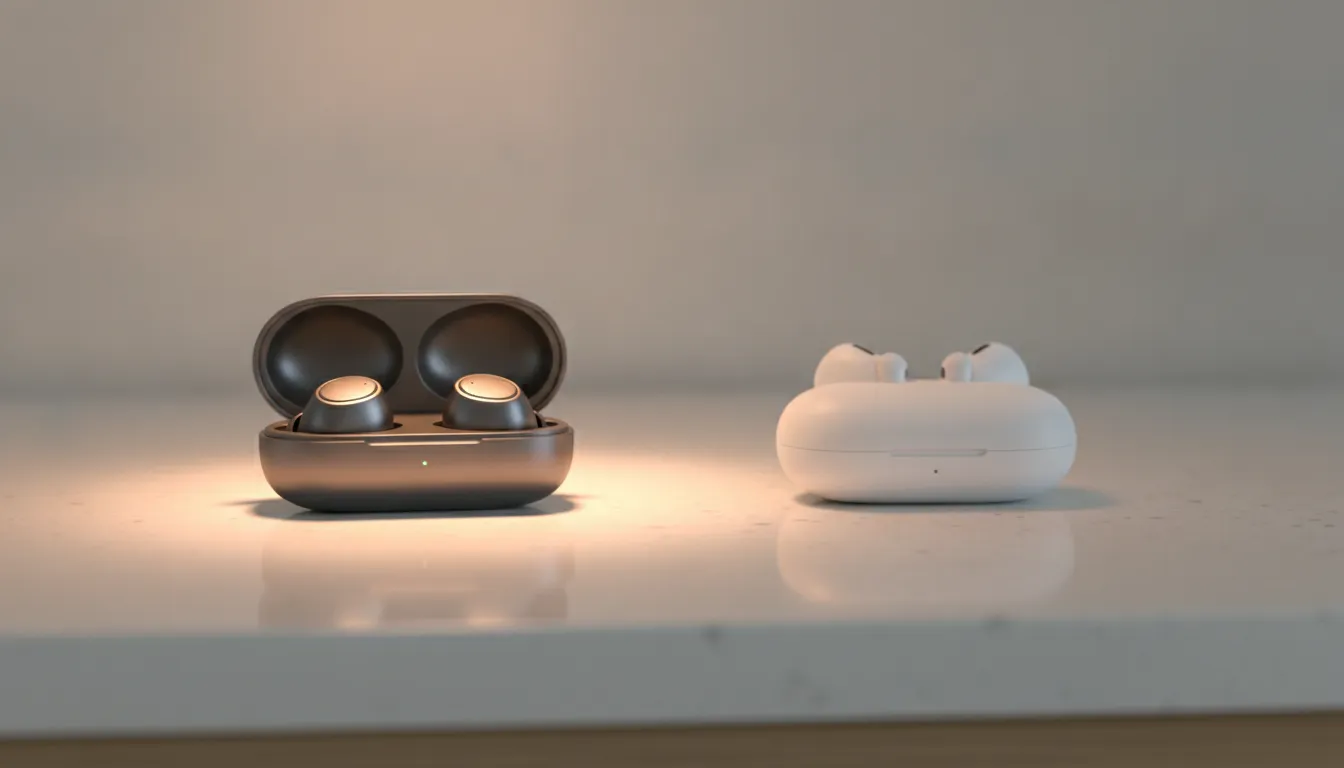
After three intensive weeks of testing, the honest answer is: there is no universal winner — there is the right winner for your usage profile.
Galaxy Buds FE is the best TWS earbud in the price range for those living in noisy environments, making frequent professional calls, and using Samsung devices. The ANC, even at entry-level, concretely changes the experience in offices and transit. The microphone is simply incomparable to Redmi in this price range.
Redmi Buds 6 Play, on the other hand, is a lesson in cost-benefit engineering: extraordinary battery, larger driver, LDAC, better water resistance, and more modern Bluetooth — all for less money. For those who practice sports, love music with high quality, or play mobile games, it’s the rational choice.
Overall Rating Galaxy Buds FE: 8.0/10 Overall Rating Redmi Buds 6 Play: 7.8/10
Recommended for (Galaxy Buds FE): Samsung ecosystem users, professionals making many calls, those using public transit daily
Recommended for (Redmi Buds 6 Play): Athletes and gym enthusiasts, mobile gamers, music lovers with high audio quality, frequent travelers needing long battery life
Best price range: Galaxy Buds FE below R$ 230 (frequently on sale); Redmi Buds 6 Play below R$ 170 is one of the segment’s best purchases in 2026