

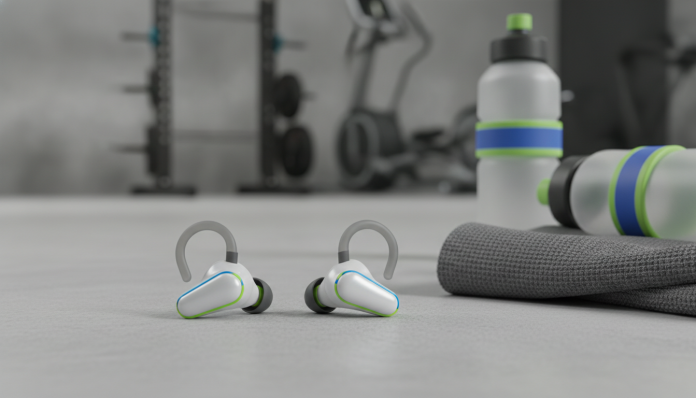

Gym Earbuds in 2026 That Don’t Fall During Workouts: Complete Guide to Choosing the Right Ones
Anyone who’s lost an earbud in the middle of a squat knows how it ruins your rhythm. The earbud falls, you stop, put it back in, lose the music at the wrong moment, and your workout goes downhill. In 2026, the market for sports earbuds has evolved considerably, but there’s still a lot of confusion between models that promise to “stay in place” and models that actually deliver on that promise in practice.
This guide is a comparison focused on one specific criterion: earbuds that don’t fall during high-intensity workouts, whether weightlifting, running, functional training, or HIIT. We’ll analyze the main models available in Brazil, what differentiates each one on paper, and who should buy what.
What Makes an Earbud Actually Stay in Place
Before diving into the models, it’s important to understand why some earbuds escape your ear and others don’t. The answer lies in three factors: attachment design, weight, and anatomical fit.
Earbuds with ear hooks (also called wings) wrap around the outer contour of your ear, creating a second support point beyond the ear canal. This design is the most effective for sudden movements. Pure in-ear earbuds depend exclusively on the pressure of silicone tips inside the ear canal, which works well for walking but can fail during intense running or rapid head movements.
The weight also matters a lot. Lighter earbuds (generally below 6g per unit) exert less force to come loose. And anatomical fit varies from person to person, which explains why a model considered “excellent” by one athlete can be a nightmare for another. Whenever possible, testing before buying is the safest approach.
Comparison of Main Models Available in Brazil in 2026
The table below brings together the main competitors in different price ranges. Prices in reais are market estimates and may vary by store and exchange rate.
| Model | Attachment Type | Water Rating | Battery Life (Earbud) | Noise Cancellation | Price Range (BR) | Launch (USA) |
|---|---|---|---|---|---|---|
| Jabra Elite 8 Active (2nd gen) | In-ear + hook | IP68 | Up to 8h | Active (ANC) | R$ 1,100 to R$ 1,400 | ~US$ 199 |
| Beats Fit Pro | In-ear + flexible wing | IPX4 | Up to 6h | Active (ANC) | R$ 1,300 to R$ 1,600 | ~US$ 199 |
| Shokz OpenRun Pro 2 | Bone conduction | IP55 | Up to 12h | None | R$ 900 to R$ 1,200 | ~US$ 179 |
| Anker Soundcore Sport X20 | In-ear + hook | IPX7 | Up to 9h | Passive | R$ 300 to R$ 450 | ~US$ 59 |
| Samsung Galaxy Buds3 Pro | In-ear (wing) | IP57 | Up to 6h | Active (ANC) | R$ 1,400 to R$ 1,700 | ~US$ 249 |
| JBL Endurance Peak 4 | In-ear + hook | IP68 | Up to 10h | Passive | R$ 400 to R$ 600 | ~US$ 79 |
Prices collected from Brazilian stores in the first half of 2026. Check availability and promotions at retailers.
Jabra Elite 8 Active and Beats Fit Pro: Favorites for Those Who Won’t Compromise on Sound Quality
The Jabra Elite 8 Active (second generation) maintains what the line has always done best: reliable fixation even without a visible external hook, thanks to a silicone design that locks inside the ear canal more efficiently than most. According to Jabra, the model was developed specifically for contact sports and has IP68 certification, which means protection against water immersion up to 1.5 meters for 30 minutes, according to the IEC 60529 standard. For gym sessions with intense sweating, this is more than enough.
Active noise cancellation (ANC, which uses microphones to capture external sounds and generate inverse sound waves to neutralize them) works well in enclosed spaces like gyms. The battery life stated by the manufacturer is up to 8 hours on the earbud, with additional charges via case.
The Beats Fit Pro relies on flexible silicone wings that wrap around the tragus, that small protrusion at the base of your ear. It’s a different design from the traditional hook and works better for smaller ears. Apple, which owns Beats, integrated the H2 chip into the model, the same as the AirPods Pro 2, which delivers good ANC quality and Bluetooth connection stability with iPhones. For Android users, the experience is functional but without the extra features of the Apple ecosystem. IPX4 certification covers splashes and sweat, but not immersion.
Shokz OpenRun Pro 2: For Those Who Need to Hear Their Surroundings
The Shokz OpenRun Pro 2 is a special case. It uses bone conduction, technology that transmits sound through vibrations in the skull bones, without blocking the ear. This means you hear the music and can still hear what’s happening around you: someone calling, traffic, instructors giving commands in the room. For outdoor runners or martial arts practitioners who need spatial awareness, this design is hard to beat.
Attachment is made by a band that wraps around the back of the head and rests the transducers (the vibrating elements) in front of the ear. According to Shokz, the model doesn’t fall regardless of the activity type, which makes sense given the design itself. Sound quality is lower than in-ears when it comes to bass reproduction, which is an inherent limitation of the technology. If you can’t live without punchy bass in your music, the OpenRun Pro 2 will disappoint.
JBL Endurance Peak 4 and Anker Soundcore Sport X20: Real Value for Money
For those who don’t want to spend more than R$ 600, the two most balanced models in the Brazilian market in 2026 are the JBL Endurance Peak 4 and the Anker Soundcore Sport X20.
The JBL Endurance Peak 4 has a robust ear hook and IP68, which puts the protection at the same level as the Jabra Elite 8 Active for less than half the price. Sound quality is good for the segment, no ANC, but with reasonable passive isolation. The battery life stated by JBL is 10 hours on the earbud, a competitive number in this range.
The Anker Soundcore Sport X20 is even cheaper and impresses with technical specifications for the price. It also has a hook and IPX7, which guarantees protection against water immersion up to 1 meter for 30 minutes, according to the IEC 60529 standard. No ANC, but it delivers stable connection and up to 9 hours of battery life according to the brand’s specifications. It’s the most honest choice for those starting to train and don’t want to invest heavily.
Brazilian Context: Homologation, Warranty, and Where to Buy
Before buying any earbud, especially from importers or international sites, check if the model has Anatel homologation (National Telecommunications Agency). Devices without this certification can be seized at customs and have no legal warranty in Brazil. Models like Jabra, Beats, Samsung, JBL, and Shokz have an official presence in the country and usually have active homologation, but confirm on the Anatel website before finalizing your purchase.
When buying through direct import, especially via sites like Amazon US or AliExpress, remember that purchases over US$ 50 are subject to taxation, and the product will have no authorized technical assistance in Brazil in case of defect. Brazilian legal warranty (minimum 12 months under the Consumer Protection Code) only applies to products sold by retailers with a Brazilian business registration. For those who like to solve tech issues without headaches afterward, as happens with other gadgets that go through this process, buying in Brazil tends to be safer in the long run.
Frequently Asked Questions About Gym Earbuds
Are in-ear earbuds with hooks better than without hooks for intense training?
Generally, yes. The hook creates a second support point that significantly reduces the risk of falling during sudden movements. The exception is models with very well-executed anatomical wing designs, like the Beats Fit Pro, which can be equally effective depending on your ear anatomy.
IPX4, IPX7, or IP68: Which Water Rating Do I Need for the Gym?
For sweat and water splashes, IPX4 is already sufficient. IPX7 and IP68 are more robust and cover accidental immersion, which is useful if you train in water sports or have a habit of rinsing your earbuds under the tap. The difference between IPX7 and IP68 is that IP68 also has dust protection, while IPX7 doesn’t specify this criterion.
Is It Worth Buying Earbuds with ANC for the Gym?
It depends on the environment. In noisy gyms, ANC helps isolate the sound and maintain focus. The problem is that when training outdoors or in group classes where you need to hear the instructor, ANC can get in the way. Some models allow you to easily disable the feature through the app.
Do Bone Conduction Earbuds Damage Hearing?
According to manufacturers like Shokz, bone conduction at moderate volumes is no more harmful than conventional earbuds. The risk of hearing damage is always associated with high volume for long periods, regardless of the technology used.
Which Earbud to Choose Based on Training Profile and Budget
The right choice depends more on your training style than on the brand.
Recommended for weightlifting and HIIT in a closed gym: Jabra Elite 8 Active or JBL Endurance Peak 4. The first delivers more sound quality and ANC; the second offers equivalent protection for much less.
Recommended for outdoor running: Shokz OpenRun Pro 2, especially if safety and environmental awareness matter. If you prefer immersive music and run in safe areas, the Jabra or Beats Fit Pro work well.
Recommended for those with limited budget: Anker Soundcore Sport X20. For the price, the specifications are hard to beat in Brazil in 2026.
Recommended for Apple ecosystem users: Beats Fit Pro, for native integration with iPhone and Apple Watch.
Not recommended for those expecting powerful bass: Shokz OpenRun Pro 2. Bone conduction has physical limitations that no equalization can overcome.
Price range: from R$ 300 (Anker Sport X20) to R$ 1,700 (Samsung Galaxy Buds3 Pro), with the most balanced models between R$ 400 and R$ 1,200. Check updated prices directly at retailers, as exchange rates and seasonal promotions significantly impact values.