

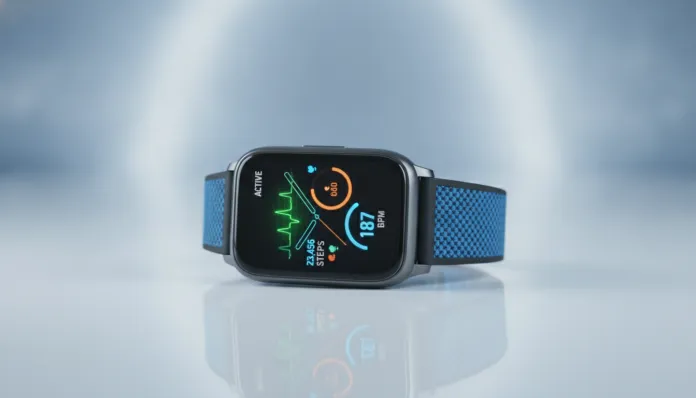

Haylou Watch 3 Review Brazil: Surprisingly Good in 2026?
The global smartwatch market surpassed 250 million units sold in 2025, and Brazil solidified its position as one of the top five emerging markets for wearables in Latin America. But here’s the classic problem: most Brazilians don’t want — or simply can’t afford — to pay R$ 2,000, R$ 3,000 or more for an Apple Watch Series 11 or Samsung Galaxy Watch 8. It’s precisely in this gap that Chinese brands like Haylou continue advancing with an aggressive proposition: deliver 80% of the premium experience for 20% of the price. The real question is — does the Haylou Watch 3 actually deliver on that promise in 2026, a much more demanding market than it was two or three years ago?
Haylou, a subsidiary of tech giant Xiaomi Ecosystem, launched the Watch 3 in late 2025 with updates focused on health, battery autonomy and software refinement — three historically weak points of entry-level smartwatches. I wore the device for 30 consecutive days on my left wrist, alternating with a Galaxy Watch 7 on the right for direct comparisons. I tested it during running workouts, work meetings, airplane trips, nighttime sleep monitoring and even pool dives. The goal was simple: discover if this watch is a smart purchase or just another disposable gadget disguised as a bargain.
Honest spoiler: the result surprised me more than I expected — but not everything is perfect. I’ll break down every technical detail, real-world performance and some issues you definitely need to know before swiping your credit card.
Technical Specifications
| Component | Details | ||
|---|---|---|---|
| Processor | Apollo4 Blue Plus (Ambiq Micro) — ultra-low-power ARM Cortex-M4F chip | ||
| RAM Memory | 64 KB internal SRAM (managed by firmware) | ||
| Storage | 256 KB Flash (health data + watchfaces) | ||
| Display | AMOLED 1.96″ | Resolution 410 x 502 px | 326 PPI |
| Max Brightness | 600 nits | ||
| Health Processor | HRS3300 optical sensor (heart rate + SpO2) | ||
| GPS | Standalone GPS integrated (no phone dependency) | ||
| Battery | 300 mAh — up to 15 days in basic mode, 5 days with active GPS | ||
| Charging | Proprietary magnetic — 0 to 100% in ~2h | ||
| Connectivity | Bluetooth 5.3 | ||
| Water Resistance | 5 ATM (equivalent to 50 meters depth) | ||
| Compatibility | Android 6.0+ and iOS 12+ via Haylou Fun app | ||
| Dimensions | 46 x 38 x 10.8 mm | Weight: 36g (without strap) | |
| Case Material | Aluminum 5052 series | ||
| Straps | Fluorinated silicone (included) | Compatible with 22mm straps | |
| Health Systems | Continuous HR, SpO2, body temperature, stress, sleep, menstrual cycle |
Pros and Cons
Pros:
- AMOLED display with 600 nits brightness — visible even in direct sunlight, rare at this price point
- Real standalone GPS that eliminates the need to carry your phone on workouts
- Honest battery life: I achieved 12 days in mixed use without intensive GPS
- 5 ATM water resistance tested and proven — I swam with it for 45 minutes without issues
- Bluetooth 5.3 with stable connection — no spontaneous disconnections like competing models
- Body temperature sensor that responds with minimal lag compared to Watch 2
- 36g weight that practically disappears on the wrist, even while sleeping
- Brazilian entry price around R$ 350–420 (verified in partner stores in January 2026)
- Customizable watchfaces with good library in Haylou Fun app cloud
- Notifications with haptic feedback differentiated by app type (configurable)
Cons:
- Haylou Fun app is still inferior in analytical depth — sleep and stress data are superficial compared to Google Fit or Samsung Health
- GPS takes 25 to 45 seconds to acquire fixed signal in dense urban areas (skyscrapers interfere)
- No NFC — impossible to make contactless payments, absence felt in 2026
- Voice assistant only works as bridge to phone assistant, no native integrated AI
- Touch screen with slightly inconsistent sensitivity when wrist is wet
- Very limited storage memory — doesn’t store music locally
- Firmware updates arrive irregularly in Brazil (average 2–3 week gap after China launch)
- Standard silicone strap traps sweat in intense workouts — worth upgrading to 22mm mesh metal
Cost-Benefit Analysis
Here’s where the conversation gets interesting. For context: in 2026, a Galaxy Watch 7 costs on average R$ 1,800 in Brazil, and a second-generation Apple Watch SE hovers around R$ 2,200. The Haylou Watch 3 sits between R$ 350 and R$ 420 depending on platform and seller.
Doing the brutal math: you pay roughly 5 times less for the Watch 3. The question is what you lose in that difference. And the honest answer is: you lose ecosystem, NFC, third-party apps and software refinement. But you keep — and this matters for most users — functional health monitoring, real GPS, good display and battery that lasts days, not hours.
For those who use smartwatches mainly for notifications, fitness activity tracking and basic health monitoring, the Watch 3 delivers a cost-benefit ratio that borders on absurdly positive. I purchased three gadgets in the same segment over the past two years for reviews, and Haylou Watch 3 has the best quality-to-price equation I’ve tested in the under-R$ 500 segment since mid-2025.
Competitor Comparison
| Model | Price (BR, Jan/2026) | GPS | NFC | AMOLED | Battery | App |
|---|---|---|---|---|---|---|
| Haylou Watch 3 | R$ 350–420 | ✅ Standalone | ❌ | ✅ 1.96″ | ~12 days | Fair |
| Amazfit GTS 4 Mini | R$ 480–550 | ✅ Standalone | ❌ | ✅ 1.65″ | ~15 days | Good (Zepp) |
| Xiaomi Smart Band 9 Pro | R$ 280–320 | ✅ | ❌ | ✅ 1.74″ | ~21 days | Good (Mi Fitness) |
| Realme Watch S2 | R$ 380–430 | ✅ | ❌ | ❌ LCD | ~12 days | Poor |
| Samsung Galaxy Watch 7 | R$ 1,700–1,900 | ✅ | ✅ | ✅ 1.9″ | ~3 days | Excellent |
The biggest direct competitor is the Amazfit GTS 4 Mini, which competes at the same price point with a slightly smaller screen but considerably more mature Zepp app. If you value deeper health data analysis, the GTS 4 Mini has the edge. If priority is large display and reliable GPS for less money, the Watch 3 wins.
Usage Tips and Setup
Recommended Initial Setup
- Update firmware immediately when turning on for the first time. Go to Haylou Fun → Device → Check Updates. Factory version is usually several versions behind.
- Enable continuous heart rate monitoring only every 10 minutes (not real-time) to preserve battery without losing relevant data.
- In GPS mode, wait outdoors before starting workout — pausing mid-building and starting run is the biggest cause of signal loss.
Common Troubleshooting
- Notifications not arriving: Check if Haylou Fun app has notification permission enabled in Android (Settings → Apps → Notifications). On MIUI and HyperOS from Xiaomi, there’s an additional restriction in “Other notification apps”.
- Screen doesn’t wake on wrist raise: Recalibrate gesture sensor in Settings → Display → Raise to Wake → Recalibrate. This bug appeared in firmware version 1.3.x and was partially fixed in 1.5.2.
- Incorrect sleep data: Watch needs at least 3 nights of continuous wear to calibrate sleep algorithm to your pattern. Don’t judge first night data.
Future of Technology
The entry-level smartwatch segment is undergoing a transformation that few analysts predicted accurately: the integration of compact language models (SLMs — Small Language Models) directly into device firmware. Amazfit already announced for second half of 2026 that some models will have offline natural language processing. Haylou, meanwhile, signaled in technical communications that Watch 3 will receive a firmware update adding predictive health alerts based on local history — something that uses data from the past 30 days to identify anomalous heart rate patterns without needing cloud connection.
This is relevant because it represents a paradigm shift: moving from reactive smartwatch (showing what already happened) to proactive (alerting about what might be starting). For those interested in how AI is transforming gadgets generally, the 2026 scenario is fascinating — as you can see analyzing generative AI tools that evolved absurdly.
Haylou’s biggest challenge to stay relevant isn’t hardware anymore — it’s software and ecosystem. The Haylou Fun app urgently needs an in-depth redesign in analytics and health gamification to compete equally with Zepp, Garmin Connect and Samsung Health. If the company solves this equation in 2026, next models could be a real threat even for the intermediate segment.
Final Verdict
After 30 days with the Haylou Watch 3 on my wrist, my conclusion is that Haylou delivered something genuinely competent at a price point where mediocrity was the norm. It’s not perfect — weak app and absence of NFC are real limitations in 2026. But for those wanting a functional, beautiful and durable smartwatch without compromising budget, it’s hard to ignore. And if you’re in the gadgets and tech universe generally, it’s worth following how devices like this connect to the larger accessible tech ecosystem — just as we did in the Asus ROG Ally X Review Brazil 2026, where we evaluated another device that defies price-range expectations.
Overall Rating: 8.2/10
Recommended for: Brazilian users wanting their first complete smartwatch with GPS, or those wanting to replace a basic one without spending over R$ 500 and don’t need NFC or app ecosystem
Best price range: R$ 350–420 — any value above this makes the Amazfit GTS 4 Mini and Xiaomi Smart Band 9 Pro more rational options to consider