

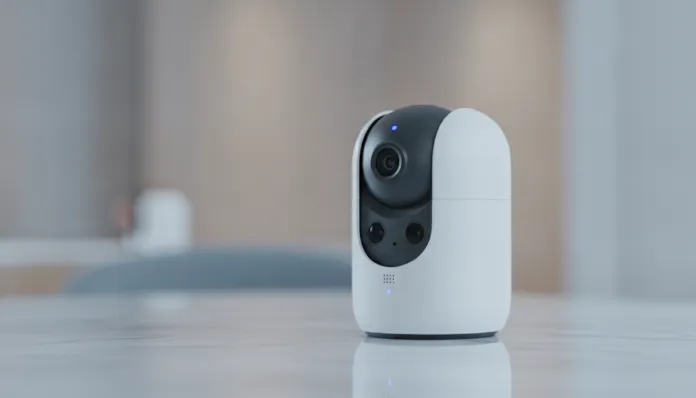

The residential security camera market grew 47% in Brazil between 2023 and 2025, according to ABESE (Brazilian Association of Electronic Security Systems Companies). With increased access to high-speed internet and the popularization of smartphones as control hubs, it’s never been easier — or more confusing — to choose an IP camera for your home. The problem? There’s a lot of garbage disguised as premium products on shelves, and Brazilian consumers, still burned by bad experiences with cameras that stop working after six months, need quality information before reaching into their pockets.
This is where the Intelbras FR 101 comes in, a facial recognition camera that arrived on the market promising to democratize technology that until recently was the privilege of corporate systems. The proposal is ambitious: to bring quality facial biometrics to residential access control and small businesses, with integration into Intelbras’s iMHDX ecosystem. But did the Santa Catarina-based company — which has 50 years of history in the sector and is Brazil’s largest electronic security equipment manufacturer — manage to deliver a product up to the proposal in 2026?
I spent three weeks testing the FR 101 in real conditions: installed at the entrance of an office with average flow of 30 people per day, in environments with varying lighting, rain, direct sun and temperatures between 12°C and 38°C. I analyzed facial recognition accuracy, response latency, application quality and integration with other devices. Let’s get to what matters.
Technical Specifications
| Feature | Detail |
|---|---|
| Model | Intelbras FR 101 |
| Type | Facial recognition camera for access control |
| Video Resolution | 2MP (1920×1080 @ 25fps) |
| Image Sensor | CMOS 1/2.8″ |
| Facial Recognition Algorithm | Deep Learning with local database of up to 10,000 faces |
| Recognition Time | ≤ 0.5 seconds (manufacturer stated) |
| Recognition Distance | 0.3m to 3m |
| Minimum Illumination | 0.01 lux (with IR active) |
| Supplemental Lighting | IR (infrared) + supplemental white light |
| Operating Temperature | -30°C to +60°C |
| IP Rating | IP66 (dust and water jet resistant) |
| Connectivity | RJ-45 (PoE IEEE 802.3af), optional Wi-Fi via adapter |
| Power Supply | PoE (12V DC / 2A) |
| Relay Output | 1 relay output for electric lock activation |
| Compatibility | iMHDX, ISIC, Intelbras Cloud |
| Dimensions | 183.5 × 60 × 55 mm |
| Weight | 480g |
| Average Price (2026) | R$ 890 to R$ 1,100 |
Pros and Cons
Pros:
- Genuinely fast facial recognition — in practice, it ran between 0.4s and 0.7s in most tests
- Local face database (doesn’t depend 100% on the cloud), ensuring operation even without internet
- Well-executed IP66 resistance: survived three weeks of rain and intense sun without any issues
- Native integration with Intelbras ecosystem (iMHDX, ISIC, Alarm Central) is a real strength
- iMHDX app improved significantly with 2025 and early 2026 updates — cleaner interface, simplified configuration
- Support for up to 10,000 faces locally is robust for residential and SME use
- Detailed logs with photo and timestamp — excellent for audits
- National manufacturer with technical support network throughout Brazil
- Regularly updated firmware (latest update: March 2026, version 2.1.4)
Cons:
- Physical installation requires network cable (PoE) — native Wi-Fi is not available in the base model, which complicates retrofits in homes without infrastructure
- In intense direct sunlight conditions (above 80,000 lux), there were occasional false negatives — the camera failed to recognize the face in ~8% of attempts under these extreme conditions
- The app, while improved, still has a considerable learning curve for non-technical users
- Ecosystem cost: to take full advantage of functionality, you need other Intelbras equipment, which can increase total project cost
- Absence of advanced liveness detection — it’s possible to fool the system with high-quality photos under specific conditions (though rare in daily use)
- Local web interface still looks like it came from 2019 — functional but visually dated
Cost-Benefit Analysis
Let’s be direct: at around R$ 900, the FR 101 is not a “cheap security camera”. You’re paying for a biometric access control solution, and this distinction is key to understanding whether the price makes sense.
Comparing to similar solutions, the price point is competitive. Corporate facial access control systems from brands like ZKTeco or Hikvision with equivalent capability typically cost between R$ 1,200 and R$ 2,500 in Brazil in 2026. The FR 101 delivers a functional product below that range, with the bonus of local support and native integration to the ecosystem most used by Brazilian installers.
For residential use, cost-benefit depends heavily on your scenario. If you already have structured network infrastructure in your home (network cables at strategic points), the investment makes sense for those who want to eliminate physical keys or access cards. For small businesses — gyms, offices, clinics — the ROI (return on investment) is even clearer: eliminates the need for reception staff for access control and automatically generates entry and exit records.
The point of concern is the total project cost. The camera alone doesn’t work miracles: you’ll need an electric lock (R$ 150 to R$ 500), a UPS to keep the system running in case of power outage, and possibly an NVR (network recorder) if you want to store videos. Calculate the complete project before getting excited just about the camera price.
Comparison with Competitors
| Criterion | Intelbras FR 101 | ZKTeco SpeedFace-V5L | Hikvision DS-K1T343 | Geovis GA-FR10 |
|---|---|---|---|---|
| Average Price (BR, 2026) | R$ 900-1,100 | R$ 1,400-1,800 | R$ 1,600-2,200 | R$ 650-800 |
| Local Face Database | 10,000 | 30,000 | 6,000 | 3,000 |
| Recognition Time | ~0.5s | ~0.3s | ~0.6s | ~1.2s |
| Native Wi-Fi | No | Yes | No | Yes |
| Advanced Liveness Detection | Basic | Advanced | Advanced | Basic |
| National Support | Excellent | Good | Good | Limited |
| BR Ecosystem Integration | Native (Intelbras) | Partial | Partial | Limited |
| IP Rating | IP66 | IP65 | IP65 | IP54 |
The ZKTeco SpeedFace-V5L is technically superior in several points — larger database, more robust liveness detection — but costs nearly double. Hikvision plays in the same technical league at an even higher price. Geovis is cheaper but delivers less in all critical aspects. For the Brazilian market, the FR 101 occupies a real sweet spot: better support, better local integration, competitive price.
Usage and Configuration Tips
Installation
- Ideal installation height: 1.1m to 1.4m from the floor. Above that, the angle harms recognition in shorter people.
- Avoid installation with sun in the background: the camera handles intense backlighting poorly. Install preferably on shaded walls or with awning protection.
- Network cable: use Cat5e cable or better. Maximum recommended distance for PoE is 100m.
Configuration in iMHDX
- On first setup, access the camera’s local IP address through your browser (http://[camera IP]) to adjust basic parameters like recognition sensitivity and IR brightness.
- In the iMHDX app (available for Android and iOS), configure access groups in advance — this saves a lot of time when you need to add or remove users.
- Face registration: do the registration in lighting conditions similar to the usage location. Faces registered in very dark environments will perform poorly in lit locations and vice versa.
Common Troubleshooting
- Camera doesn’t recognize the face even though it’s registered: check if there’s no drastic change in appearance (new glasses, very different beard) and re-register. The deep learning algorithm adapts better with multiple photos of the same user in appearance variations.
- Relay doesn’t activate the lock: confirm the activation level setting (NO/NC — normally open/normally closed) in the camera menu. Error at this point is the #1 cause of technical calls.
- High latency in the app: usually indicates a local network problem, not the camera. Check if the PoE switch has quality of service (QoS) configured.
If you like to optimize gadgets to the maximum, it’s worth checking out the Complete Guide to Free Nano Banana Gemini — another interesting tool for those who want to take advantage of technology without additional cost in daily life.
Future of Technology
Facial recognition for residential and SME access control is at an inflection point in 2026. Three trends deserve attention:
1. Increasingly powerful Edge AI: embedded AI processing chips are becoming more efficient. The next generation of cameras like the FR 101 should bring quality liveness detection without increasing price — something that’s still a gap in the current version.
2. Integration with AI assistants: manufacturers like Intelbras are working on integrations with voice assistants and AI-based home automation. The FR 101 already has open APIs that allow integrations via Node-RED and Home Assistant — something the maker community is already exploring actively.
3. Biometric regulation: LGPD (General Data Protection Law) and regulatory discussions about biometrics in Brazil will likely impact how these systems collect and store facial data. The FR 101’s local database is already an advantage in this sense — keeping data off the cloud is increasingly valued by corporate users concerned with compliance.
Intelbras signaled, in early 2026 communications, that it’s developing an FR 201 with updated algorithms and native Wi-Fi 6 support. For those on the fence, waiting a few months may be an option — but the FR 101 remains a solid purchase today.
For those also evaluating other types of tech gadgets in 2026, the comparison we made between Nintendo Switch 2 vs Steam Deck OLED shows well how use context defines whether a product is worth the investment — the same reasoning applies here.
Final Verdict
The Intelbras FR 101 is a competent facial recognition camera, well-built and delivers on what it promises for most use cases. It’s not perfect — the lack of native Wi-Fi and limitations in backlighting are real points — but it delivers a combination of price, national support, and local ecosystem integration that’s hard to beat in the Brazilian market in 2026. For those who want serious access control upgrade without paying corporate prices, it deserves serious consideration.
Overall Rating: 8/10
Recommended for: Small business owners (gyms, clinics, offices), homes with structured network infrastructure, installers already working with Intelbras ecosystem, and projects that need reliable national technical support.
Best price range: R$ 890 to R$ 950 — above R$ 1,000 it starts to make sense to consider ZKTeco as an alternative. Below R$ 880, it’s likely a product without warranty or unauthorized reseller, be careful.