

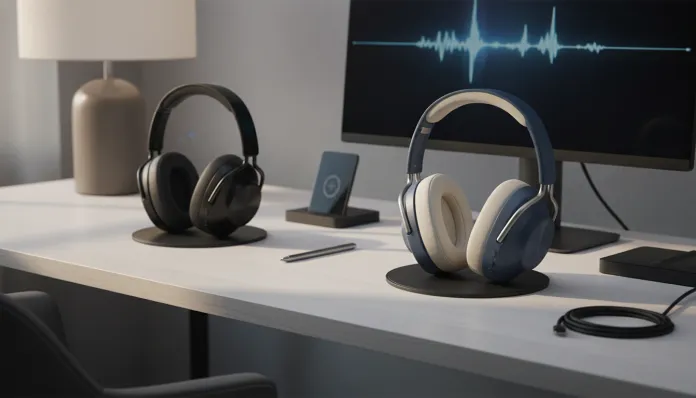

JBL Tune 770NC vs Sony WH-CH720N: Ultimate Home Office Comparison in 2026
According to Global Workplace Analytics consulting data, more than 58% of knowledge workers in developed economies operate in hybrid or fully remote arrangements in 2026 — a number that solidified the market for active noise cancellation headphones (ANC) as one of the fastest-growing segments in consumer electronics. In this scenario, choosing the wrong headphones is not just a matter of comfort: it’s productivity and mental well-being at stake when your neighbor decides to renovate the apartment at 10 AM on an important Monday meeting.
The problem is real and has a name: auditory fatigue combined with environmental distraction. Two over-ear headphones (those that encompass the entire ear) stand out in the R$600 to R$900 price range to solve exactly that — the JBL Tune 770NC and the Sony WH-CH720N. Both promise decent ANC, absurd lightness, and all-day battery life, but deliver quite different experiences depending on your usage profile.
I spent the last six weeks alternating between the two models in real home office conditions: Google Meet and Microsoft Teams meetings, deep focus sessions with music, long calls, and even a subway trip to test ANC outside the home. I added testing with the Sony Headphones Connect app and JBL Headphones App, measured audio latency with benchmarking tools, and consulted official spec sheets from both manufacturers. Here’s the complete verdict.
Technical Specifications
| Specification | JBL Tune 770NC | Sony WH-CH720N |
|---|---|---|
| Type | Over-ear, closed | Over-ear, closed |
| Driver | 40mm dynamic | 30mm dynamic |
| Frequency Response | 20Hz – 20kHz | 20Hz – 20kHz |
| Impedance | 32 Ohms | 16 Ohms |
| Sensitivity | 100 dB SPL/mW | 98 dB SPL/mW |
| Bluetooth | 5.3 | 5.2 |
| Supported Codecs | SBC, AAC | SBC, AAC, LDAC |
| Multipoint | Yes (2 devices) | Yes (2 devices) |
| ANC | Yes (adaptive) | Yes (adaptive) |
| Transparency Mode | Yes | Yes (Ambient Sound) |
| Battery (ANC on) | 44h | 35h |
| Battery (ANC off) | 70h | 50h |
| Quick Charge | 5 min = 3h of use | 3 min = 60 min of use |
| Physical Connection | USB-C + 3.5mm jack | USB-C + 3.5mm jack |
| Weight | 213g | 192g |
| Foldable | Yes | Yes |
| Average Price (2026) | R$ 649 | R$ 849 |
Pros and Cons
JBL Tune 770NC
Pros:
- Exceptional 44-hour battery with ANC active — literally a full work week without recharging
- Generous quick charge: 5 minutes deliver 3 hours of use
- Sound with substantial bass presence, great for those who like music while working
- Most accessible price on the Brazilian market in 2026
- Stable multipoint — switches between notebook and phone without drama
- Comfortable ear cushions for sessions up to 4-5 hours
Cons:
- No LDAC support (Sony’s high-resolution codec), limiting maximum audio quality
- ANC less efficient at mid frequencies (background voices pass through more)
- JBL Headphones App has limited EQ compared to competitor
- Microphone with mediocre quality in noisy environments
- Plastic structure conveys entry-level product feel
Sony WH-CH720N
Pros:
- Support for LDAC — transmits up to 990kbps of audio, three times more data than standard AAC
- ANC with notably superior performance, especially on voices and mid-range sounds
- Sony Headphones Connect app with 5-band EQ, sound adaptation modes, and granular ANC settings
- Weight of 192g: one of the lightest over-ears in the category in 2026
- Microphone with better voice capture for calls
- Discreet, professional design
Cons:
- 35-hour battery with ANC active is good, but loses to JBL
- Higher price may be hard to justify depending on usage
- Less prominent bass — may disappoint those using music as “sound shield”
- Relatively thin ear cushions, comfort drops after 3-4 hours of continuous use
Cost-Benefit Analysis
Here lies the most interesting decision point in the comparison. The JBL Tune 770NC costs on average R$200 less than the Sony, and in terms of “hours of use per real spent,” it wins easily. If you use the headphone mainly for music and need battery to not worry about charging during the week, the JBL delivers exceptional value.
The Sony WH-CH720N is a case of paying more for specific features that make real difference. LDAC is a clear example: think of it as the difference between watching a video in 1080p versus 4K — on mediocre speakers you won’t notice, but in a controlled environment or with quality DAC (digital-to-analog converter), the difference is perceptible. More important for home office: the Sony’s ANC is genuinely superior at filtering voices, which is exactly what bothers most in home offices.
For those doing more than 3 hours of video call per day, the Sony’s microphone and refined ANC justify the additional investment. For those using the headphone mainly for music and occasional meetings, the JBL is a great buy.
Comparison with Competitors
| Model | ANC | Battery (ANC on) | LDAC | Weight | Average Price BR |
|---|---|---|---|---|---|
| JBL Tune 770NC | ★★★☆☆ | 44h | No | 213g | R$ 649 |
| Sony WH-CH720N | ★★★★☆ | 35h | Yes | 192g | R$ 849 |
| Anker Soundcore Q45 | ★★★☆☆ | 50h | No | 238g | R$ 499 |
| Edifier W820NB Plus | ★★★☆☆ | 49h | Yes | 225g | R$ 699 |
| Sony WH-1000XM6 | ★★★★★ | 30h | Yes | 250g | R$ 2.199 |
The Edifier W820NB Plus deserves special mention as an intermediate alternative — it offers LDAC and long battery at R$699, but ANC and microphone fall below the Sony CH720N. For those wanting the absolute best ANC on the market, the Sony WH-1000XM6 is unbeatable, but costs almost three times more.
If you’re building a complete home office setup and want to understand how the headphone fits into a modern smartphone ecosystem, check out our analysis of the Poco X8 Pro Tested: Worth R$3,499 in 2026? — the combination of LDAC on the phone and Sony headphones is a real differentiator.
Usage and Configuration Tips
For JBL Tune 770NC
- Enable adaptive ANC: in the JBL Headphones app, set “Adaptive ANC” mode for variable environments — it automatically adjusts cancellation level as external noise changes.
- EQ for calls: slightly reduce frequencies between 200-400Hz and increase 2-3dB between 2kHz-4kHz to make your own voice clearer when monitoring the microphone.
- Multipoint: connect notebook and phone simultaneously. JBL automatically prioritizes whichever source is playing active audio — works without additional setup in most cases.
- Common troubleshooting: if ANC creates a “pressure” effect on ears (plugged ear feeling), reduce ANC level to medium in the app. This is a known issue in very quiet environments.
For Sony WH-CH720N
- Configure LDAC: in the Sony Headphones Connect app, go to “Sound Quality Mode” and select “Sound Quality Priority” to maximize LDAC. Note: this increases battery drain and requires the source device to also support LDAC.
- Ambient Sound mode for meetings: when you need to hear the environment without removing the headphone, use the configurable quick-action button — can be programmed to toggle between ANC and Ambient Sound with a single touch.
- Speak-to-Chat (if available via firmware update in 2025): automatically pauses audio when you start speaking — extremely useful for home office.
- Common troubleshooting: the Sony CH720N may experience microlag with LDAC if the transmitting device has congested Bluetooth. Solution: turn off other Bluetooth devices from the notebook or switch to AAC temporarily.
Future of Technology
The remote work headphone segment is evolving in three clear directions through 2026 and beyond. First, real-time AI-powered ANC — both JBL and Sony have publicly signaled the use of on-device neural processing for adaptive noise cancellation that learns your specific environment’s sound patterns. The Sony WH-1000XM6 already partially implements this; expect this feature to trickle down to the CH line by 2027.
Second, generative AI assistant integration — headphones that transcribe meetings in real time, suggest responses, and even simultaneously translate are leaving the experimental phase. The chip used in the CH720N (not disclosed by Sony, but speculated as derived from the V1 with less power) has limited computational headroom for these functions, but a hardware update in 2027-2028 will likely address this.
Third, active hearing health — automatic volume limiting, cumulative exposure monitoring, and auditory fatigue alerts. Apple already implemented this in AirPods Pro; JBL and Sony should follow in the next mid-range generation. For those spending 8+ hours daily with headphones in home office, this feature will be as important as ANC.
Final Verdict
After six weeks of intensive use, the choice between the two fundamentally depends on your usage profile — and neither is a bad choice.
For those prioritizing battery, cost, and robust bass: the JBL Tune 770NC is a hard purchase to contest in its price range. You’ll rarely run out of battery during the work week, and the sound is gratifying for long music sessions.
For those making many calls, demanding the best ANC in category, and using LDAC-enabled devices: the Sony WH-CH720N justifies every extra real. The superior ANC for voices concretely changes the remote work experience, and LDAC support is a differentiator you can feel — provided your setup supports the codec.
If you’re looking for headphones in more dynamic situations like exercise, also check our guide on Gym Earbuds That Don’t Fall: Review 2026 to understand how categories differ in terms of technology and ergonomics.
Overall Rating JBL Tune 770NC: 8.2/10 Overall Rating Sony WH-CH720N: 8.6/10 Recommended for (JBL): home office professionals prioritizing battery autonomy, mixed use (work + entertainment), and direct value-for-money Recommended for (Sony): professionals with many daily video calls, Android users with LDAC, those needing the best voice-filtering ANC in mid-range category Best price range (JBL): up to R$ 680 — above that, evaluate the Sony Best price range (Sony): up to R$ 899 — above that, consider saving more for the WH-1000XM6