

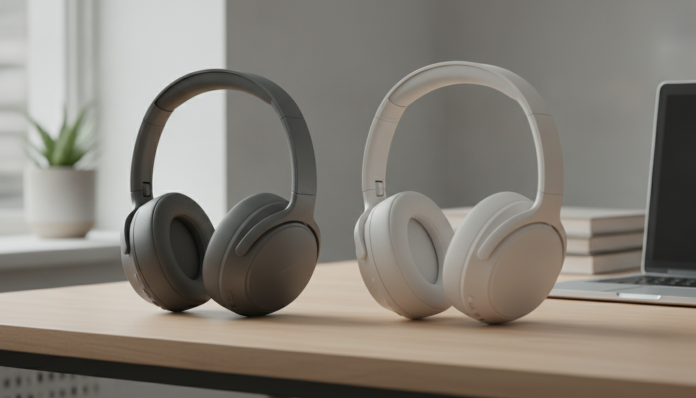

JBL Tune 770NC vs Sony WH-CH720N: Which is Better for Home Office
Choosing noise-cancelling headphones for working from home seems simple until you realize it’s hours of daily use, back-to-back meetings, and often kids or neighbors in the background. The JBL Tune 770NC and Sony WH-CH720N compete in exactly this space: both are over-ear (covering the entire ear), feature active noise cancellation, and come at a price that doesn’t require financial approval. The real question is which one handles remote work routines better without charging too much for it.
The short answer: the Sony WH-CH720N tends to be the right choice for those prioritizing lightweight design and microphone quality on calls. The JBL Tune 770NC has an advantage in declared battery life and raw value for money. But the devil is in the details, and those details make a difference when you have headphones on your head for six hours.
Comparative Specifications
| Specification | JBL Tune 770NC | Sony WH-CH720N |
|---|---|---|
| Type | Over-ear, closed-back | Over-ear, closed-back |
| Driver | 40 mm | 30 mm |
| Frequency Response | 20 Hz – 20 kHz | 20 Hz – 20 kHz |
| Noise Cancellation | Active ANC (Adaptive) | Active ANC |
| Ambient Mode (Sound Pass-through) | Yes | Yes |
| Bluetooth Codecs | SBC, AAC | SBC, AAC, LDAC |
| Bluetooth | 5.3 | 5.2 |
| Battery Life (with ANC) | Up to 44 hours | Up to 35 hours |
| Battery Life (without ANC) | Up to 70 hours | Up to 50 hours |
| Quick Charge | 10 min = 2 hours | 3 min = 60 min |
| Charging Connector | USB-C | USB-C |
| Microphone | Yes, built-in | Yes, with beam-forming |
| Weight | Approximately 220 g | Approximately 192 g |
| Foldable | Yes | Yes |
| App | JBL Headphones | Sony Headphones Connect |
| Regional Certification | Verify before purchase | Verify before purchase |
| Average Price (USD equivalent) | $110–$140 | $130–$170 |
Prices subject to variation by retailer and exchange rate. Data based on official manufacturer technical specifications.
Noise Cancellation: Who Blocks Out Home Office Chaos Better
Active noise cancellation, or ANC, works like “anti-sound”: microphones capture surrounding noise, the headphone creates an inverse sound wave, and the two cancel each other out. It’s like using an eraser on ambient sound. The practical result is that you can concentrate or hear your meeting without cranking the volume to maximum.
The JBL Tune 770NC uses what the manufacturer calls adaptive ANC, which automatically adjusts the cancellation level based on the environment. According to JBL, the system was designed to block continuous low-frequency sounds, like air conditioning and subway rumble. High-pitched and intermittent noises, like distant voices, pass through more easily.
The Sony WH-CH720N uses two external microphones to capture ambient sound before it reaches your ear. Sony doesn’t publicly detail the exact dB reduction performance, but positions the CH720N as a more affordable version of the WH-1000XM5, using similar software technology. For home office use, passive isolation (how much the ear cup blocks through physical contact) also matters, and here the 40 mm drivers on the JBL bring slightly larger cushions.
If your biggest enemy is constant air conditioning or refrigerator noise, both solve that well. If you live with young children or have a TV on in the background, expect that neither will work miracles: ANC at this price point reduces but doesn’t completely eliminate that type of noise.
Microphone Quality and Call Performance
This is the criterion most people ignore when shopping, but it determines your reputation in meetings. A poor microphone makes you sound like you’re calling from inside an aquarium.
The Sony WH-CH720N uses a beam-forming microphone system, a technique where multiple microphones work together to focus on your voice direction and reject side sounds. Sony states the system was optimized for calls, reducing background noise picked up during use in dynamic environments. For those doing many meetings on Google Meet, Teams, or Zoom, this difference shows up in how clearly your voice comes through on the other end.
The JBL Tune 770NC has a built-in microphone, but JBL doesn’t detail in the technical specs the number of microphones or the technology used for directional capture. This doesn’t mean the microphone is bad, but rather that engineering priorities here leaned more toward audio playback and battery life than voice capture.
If calls are your primary activity throughout the day, the Sony has a clear advantage here. If you use the headphone mainly to listen to music while working and meetings are occasional, this difference weighs less.
Battery, Weight, and Comfort on Long Work Days
Battery on paper is easy to win: the JBL Tune 770NC claims up to 44 hours with ANC on, versus 35 hours for the Sony. In reality, neither will die during a normal workday, so this number only matters if you travel frequently or leave the headphone uncharged over the weekend.
What matters more for home office use is weight and prolonged comfort. At approximately 192 g claimed by Sony versus roughly 220 g for the JBL, a 28 g difference seems small on paper, but after six hours of continuous use you feel it on your neck and ears. The CH720N was designed with thin headbands and lighter ear cushions, contributing to lower pressure at contact points.
The Sony’s quick charge is impressive on paper: 3 minutes of charging for 60 minutes of use, according to the manufacturer. The JBL offers 10 minutes for 2 hours. For anyone who forgets to charge before an important meeting, either one recovers quickly.
Both fold for transport, which matters even in home office setups: storing the headphone in a bag for a coworking day or trip is easier. For those curious how battery autonomy behaves in actual portable device use, like with the Galaxy Watch 8 battery life in real-world usage, the standard practice is always testing with active use, not just manufacturer specifications.
Audio Quality and LDAC Codec
For listening to music between meetings, audio quality matters. The JBL Tune 770NC uses 40 mm drivers, which tend to produce fuller sound in midrange and bass frequencies. JBL’s sonic signature historically favors bass, appealing to those who like “fuller” sound.
The Sony WH-CH720N has 30 mm drivers but includes the LDAC codec, a Bluetooth transmission protocol developed by Sony capable of transmitting up to 990 kbps, far above standard SBC (328 kbps). In simple terms, LDAC allows more audio information to be sent via Bluetooth, bringing wireless transmission quality closer to wired connection. The benefit shows up with high-quality streaming services like Tidal or Amazon Music Ultra HD on a compatible Sony or Android smartphone.
If you subscribe to any high-quality lossless streaming service and use Android, the Sony’s LDAC makes a real difference. If you use iPhone or listen to standard-quality audio, the practical difference shrinks significantly.
App and Extra Features
The JBL Headphones app lets you adjust the equalizer, configure ANC levels, and switch usage modes. The interface is functional, but the equalizer has few adjustment bands. The app is available for Android and iOS.
The Sony Headphones Connect app is more complete: it allows fine-tuning ANC levels in steps, configuring ambient mode (to hear surroundings without removing the headphone), accessing a multi-band equalizer, and customizing the function button. For those who like precise control over sound and headphone behavior, Sony’s app delivers more options.
Availability and Import Considerations
Both models have official distribution in major markets, sold by retailers like Amazon, authorized third-party sellers, and electronics chains. Before purchasing, check that the box bears the proper regional regulatory certification (required for wireless transmission devices sold legally in your country). Products lacking this certification from parallel importers lack official consumer protection guarantees.
Standard manufacturer warranty in most markets is 12 months. Sony and JBL both maintain authorized service networks in major cities. Buying from retailers providing official invoices is the safest path to warranty claims without hassle.
Which to Choose Based on Your Profile
These two headphones serve distinct profiles within the same price segment:
Choose the Sony WH-CH720N if:
- You take many calls and need your voice to come through clearly on the other end
- You use Android with high-quality streaming and want to leverage LDAC
- Comfort on long work sessions is a priority and you prefer lighter-weight headphones
- You want more control over settings through the app
Choose the JBL Tune 770NC if:
- Maximum battery life is your priority and you go days without easy charger access
- You prefer fuller bass sound without fine-tuning
- The price is noticeably lower than the Sony at your retailer
- You don’t make many calls with the headphone
For typical home office use, with daily meetings and six to eight hour workdays, the Sony WH-CH720N comes out ahead with better microphone capability, lighter weight, and more complete app controls. The JBL is a legitimate alternative, especially if priced significantly lower at your favorite retailer.
Frequently Asked Questions About JBL Tune 770NC and Sony WH-CH720N

Do both work as a headset for Teams and Zoom meetings?
Yes, both can function as Bluetooth headsets in meetings. The Sony WH-CH720N has an advantage in its beam-forming microphone system, which tends to capture your voice more clearly. The JBL works fine for casual use but may pick up more background noise in loud environments.
Are both compatible with iPhone and iPad?
Yes. Both are compatible with iOS via standard Bluetooth using the AAC codec. The Sony’s LDAC is not available on Apple devices, so part of the CH720N’s audio advantage is limited to Android-compatible use.
Which handles glasses better during long use?
The Sony WH-CH720N has thinner, lighter ear cushions, typically causing less pressure on glasses frames during extended use. The JBL has larger cushions, which may apply more pressure depending on frame style. If you wear glasses daily, try-on before purchase is worth it if possible.
Is it safe to import either of these from the US to save money?
Technically possible, but risky: the product may lack regional regulatory certification, making legal sale technically impossible in your country. Plus, manufacturer warranty typically doesn’t cover other regions, leaving you responsible for support issues. Exchange rate and import fees can eat into any price savings.
The decision between the two doesn’t have to be complicated. If you want the best value for working from home with frequent calls, the Sony WH-CH720N delivers more where it counts most. If maximum battery life and pronounced bass are your criteria, the JBL Tune 770NC delivers in spades. Either represents a major step up from non-ANC headphones for anyone working in noisy environments. Just as device comparisons in the same price range demand attention to actual use case, like we showed in Galaxy A36 or A56: Which Samsung Mid-Range to Choose in 2026, the best product is always the one that fits your real-world routine.