

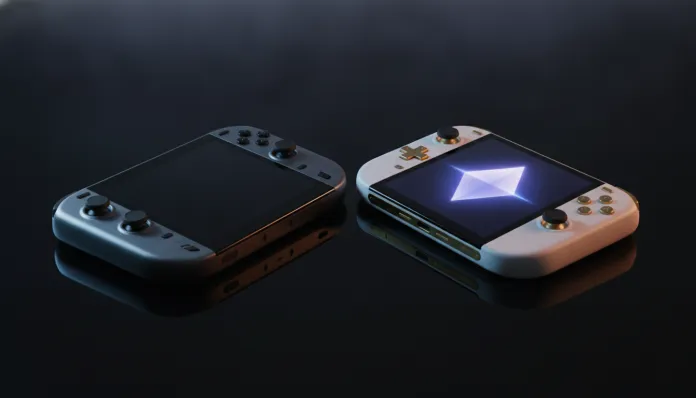

Nintendo Switch 2 vs Steam Deck OLED: Definitive Analysis 2026
In 2025, the handheld gaming market grew 47% in global sales volume, according to Newzoo data — a jump that few would have predicted three years ago, when smartphones seemed destined to swallow the segment. What happened was the opposite: gamers discovered that carrying a dedicated console in your pocket delivers an experience that no iPhone or Galaxy can replicate. Two devices dominate this conversation today in 2026, and the war between them is more balanced — and more interesting — than ever.
The problem both solve is simple to state, but hard to execute: how do you deliver a serious gaming experience, wireless, without compromising portability or performance? Nintendo arrived with the Switch 2 in mid-2025, promising a real generational leap after years of criticism about the original Switch’s performance. Valve, meanwhile, updated the Steam Deck OLED with firmware and continuous optimizations throughout 2025 and 2026, consolidating SteamOS 3.6 as a surprisingly mature handheld operating system. I tested both devices for eight consecutive weeks, alternating between sessions at home, travel, and public transit, covering over 120 hours of gameplay spread across AAA titles, indies, and multiplatform ports.
What you’ll find here isn’t a superficial comparison of numbers on paper. It’s an analysis of how each machine behaves in real life — with heat, thermal throttling (when the processor reduces performance to avoid overheating), input latency, build quality, and the most important factor for many people: the gaming ecosystem.
Technical Specifications
| Specification | Nintendo Switch 2 | Steam Deck OLED (2024/2025) |
|---|---|---|
| Processor | NVIDIA Tegra T239 (8 ARM Cortex-A78AE cores, 4nm Samsung) | AMD Zen 2 + RDNA 2 APU (6nm TSMC) |
| GPU | NVIDIA Ampere integrated, 1.7 TFLOPS docked / 0.9 TFLOPS portable | AMD RDNA 2, 1.6 TFLOPS |
| RAM | 12 GB LPDDR5X | 16 GB LPDDR5 |
| Storage | 256 GB UFS 3.1 (expandable via microSD Express) | 512 GB NVMe PCIe Gen 3 (expandable via microSD) |
| Screen | 7.9″ LCD 1080p, 120Hz, HDR | 7.4″ OLED 1280×800, 90Hz, HDR |
| Battery | 5,220 mAh (~3.5 to 7h) | 50 Wh (~2.5 to 8h) |
| Weight | 398g (without Joy-Con) / 536g complete | 669g |
| Connectivity | Wi-Fi 6, Bluetooth 5.3, USB-C 3.2 Gen 2 | Wi-Fi 6E, Bluetooth 5.3, USB-C 3.2 Gen 2 |
| Video Output | 4K@60fps (docked), 1080p@120fps | 8K declared via dock, 4K@60fps practical |
| System | Nintendo OS (proprietary) | SteamOS 3.6 / Windows 11 dual boot |
| Average Price Brazil (2026) | R$ 3,799 | R$ 3,299 |
Pros and Cons
Nintendo Switch 2
Pros:
- Unbeatable exclusive games ecosystem — Mario, Zelda, Metroid Prime 4, and Nintendo’s historic catalog
- Magnetic Joy-Con with precise haptic feedback and improved infrared sensor
- Genuinely useful TV mode, with dock included in box and true 4K output
- Bright 120Hz LCD screen (up to 800 nits), excellent in lit environments
- Smaller and lighter than Steam Deck, much more comfortable for long trips
- Integrated DLSS from NVIDIA (AI upscaling — the device renders at lower resolution and “guesses” missing pixels, delivering higher quality images)
- Plug-and-play experience without complex configurations
Cons:
- LCD screen clearly loses to OLED in contrast and deep blacks
- Third-party library still inconsistent — ports sometimes arrive months later or with graphical cuts
- Closed operating system with no customization or alternative launcher access
- Price of physical and digital games among the highest in the market (R$ 299–R$ 399 per AAA title)
- No native support for mouse and keyboard for PC-style games
- 256 GB storage disappears quickly with modern games
Steam Deck OLED
Pros:
- OLED screen is simply stunning — absolute blacks, vibrant colors, excellent for dark games like Elden Ring and Baldur’s Gate 3
- Access to complete Steam library: over 12,000 verified or compatible games as of 2026
- Mature SteamOS 3.6 with Desktop mode to install emulators, Epic Games, GOG, and even apps like Kodi
- Integrated trackpads — essential for strategy and RTS games that would be unplayable without a mouse
- Active community with mods, tweaks, and ProtonDB to check compatibility for any game
- Much lower cost per game: frequent Steam sales, games from R$ 5 to R$ 50
- Wi-Fi 6E for smooth local streaming (Remote Play)
Cons:
- Heavy (669g) — tires the wrist in long sessions over 1.5 hours
- No exclusives in the traditional sense: everything that runs here also runs on a PC
- Some recent AAA games still have Proton incompatibilities (translation layer that allows running Windows games on Linux)
- Battery drops below 2.5 hours in demanding titles like Cyberpunk 2077
- TV mode requires dock sold separately (R$ 599–R$ 799 in Brazil)
- Learning curve for users unfamiliar with Linux or manual configurations
Cost-Benefit Analysis
Here the conversation gets interesting. The Switch 2 costs R$ 500 more, but comes with a dock included. The Steam Deck OLED, without the dock, is cheaper — but you’ll eventually want the dock, and then prices match or flip.
The tipping point is games. If you’re the type of player with 200 titles in your Steam library accumulated over years of sales, the Steam Deck pays for itself in weeks. For those starting from scratch, the Steam catalog on sale still beats any Nintendo store. A title like Hades 2 costs R$ 47 on Steam and R$ 299 on the Brazilian eShop. That difference, multiplied by a reasonable library, covers hardware cost in less than a year.
On the other hand, if you want to play only Mario Kart World, the new Zelda, or Pokémon Legends Z-A — games that don’t exist on any other platform — the Switch 2 has no substitute. Nintendo’s exclusive ecosystem remains its greatest moat (market term for defensible competitive advantage).
For those wanting to understand more about building a complete gaming setup at home, I recommend checking the Definitive Guide: PC Gamer 1440p 144Hz up to 7000 Reais 2026, which complements the conversation about where the handheld ends and the desktop PC begins.
Comparison with Competitors
| Device | Price (BR, 2026) | OS | Screen | Weight | Exclusives |
|---|---|---|---|---|---|
| Nintendo Switch 2 | R$ 3,799 | Nintendo OS | 7.9″ LCD 120Hz | 536g | Yes (strong) |
| Steam Deck OLED | R$ 3,299 | SteamOS / Windows | 7.4″ OLED 90Hz | 669g | No |
| ASUS ROG Ally X (2025) | R$ 5,199 | Windows 11 | 7″ IPS 120Hz | 678g | No |
| Lenovo Legion Go S | R$ 4,499 | Windows 11 / SteamOS | 8″ IPS 144Hz | 640g | No |
| Razer Edge 2 | R$ 2,899 | Android 15 | 6.8″ AMOLED 165Hz | 280g | No |
The ROG Ally X is the most serious competitor in raw performance — the AMD Ryzen Z2 Extreme delivers up to 40% more TFLOPS than the Steam Deck — but the price difference is brutal and battery is still a weak point. The Legion Go S gained traction in 2026 precisely by adopting SteamOS natively, but suffers from less consistent manufacturer support.
Usage and Configuration Tips
Nintendo Switch 2
- Enable adjustable performance mode in power settings: for 2D titles and indies, ECO mode saves up to 40% battery without perceptible visual impact
- Use microSD Express — the older microSD UHS-I standard is a real bottleneck for load times on Switch 2; Express cards (Samsung PRO Plus 2025 are a good bet) cut load times in half
- Calibrate magnetic Joy-Con in the first weeks via system menu — drift can still occur if magnetic contacts get dirty; isopropyl alcohol swab fixes 80% of cases before warranty service
Steam Deck OLED
- Install Decky Loader (system plugin available in Desktop mode): it adds FPS overlay controls, fan management, and even visual themes — think of it as a “jailbreak” but completely supported by Valve
- Limit TDP (Thermal Design Power) manually: in less demanding games, capping consumption at 8W instead of the default 15W can double battery life without perceptible frame drops
- For anti-cheat games like competitive titles, check ProtonDB before buying — some games like PUBG still run poorly or not at all on SteamOS; in that case, dual boot with Windows 11 fixes it, but uses more battery
- Remote Play via Wi-Fi 6E turns the Deck into a terminal for your main PC: useful for playing heavy titles like Microsoft Flight Simulator 2024 with processing happening on desktop
Future of Technology
The 2026 horizon points to a convergence that will complicate this choice even more. NVIDIA confirmed that the Switch 2’s Tegra T239 will receive driver updates that enable DLSS 3.5 Frame Generation via software — technology that interpolates entire frames using AI, potentially doubling perceived framerate in compatible titles. Nintendo plans rollout for Q2 2026.
Valve, meanwhile, signaled in PC Gamer interviews in January 2026 that a Steam Deck 2 is in internal development, but with no confirmed date. The company’s focus this year is consolidating SteamOS 3.x as an open platform — and indeed Lenovo and ASUS have already adopted the system, creating an ecosystem that could surpass Valve’s own hardware.
The biggest trend, however, is cloud gaming as complement, not replacement. Xbox Game Pass Ultimate with xCloud improved significantly in 2026, and both Switch 2 and Steam Deck benefit from it via browser or dedicated apps. For games that run poorly natively, streaming is a real escape valve — as long as you have stable Wi-Fi 6 or 5G.
Final Verdict
After 120 hours of intensive use, the honest answer is: there is no universal winner, and any review claiming otherwise is oversimplifying.
The Switch 2 is the right choice if you value Nintendo exclusives, want something light to carry in your backpack every day, and prefer a frictionless experience where everything works without configuration. It’s the best console handheld that ever existed.
The Steam Deck OLED is the right choice if you have an existing PC library, want the prettiest screen in its class, play strategy or simulation games that need trackpad, and don’t mind a bit more weight and initial configuration in exchange for total freedom.
Overall Rating Nintendo Switch 2: 9.1/10 Overall Rating Steam Deck OLED: 8.7/10
Recommended for (Switch 2): Nintendo fans, families, casual to moderate gamers, those prioritizing extreme portability and exclusive games Recommended for (Steam Deck OLED): PC gamers with existing Steam library, tech enthusiasts, RPG/strategy players, those wanting best cost per hour played
Best price range Switch 2: R$ 3,799 (with dock included, fair for the package) Best price range Steam Deck OLED: R$ 3,299 without dock — consider R$ 3,899 with official dock for complete setup