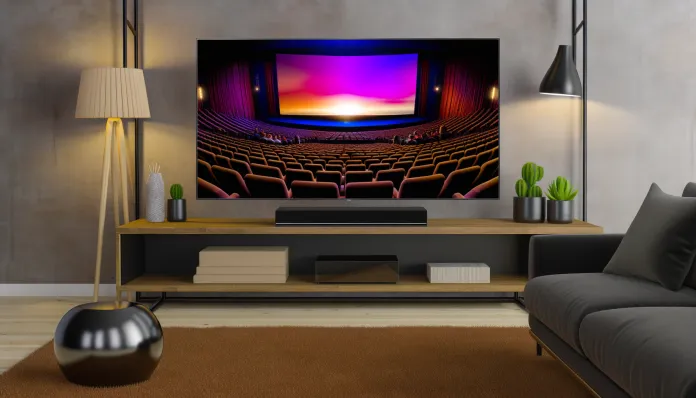
The question of whether an OLED TV is worth it in 2026 has become more complex with the evolution of QLED technologies and the significant reduction in prices. However, improvements in the durability of OLED panels and the maturity of the technology create a scenario where the decision fundamentally depends on the consumer’s usage profile and budget.
Firstly, the Brazilian market offers OLED options starting at R$ 3,500 for 55-inch screens, while equivalent QLED models cost around R$ 2,800. Thus, the price difference has drastically reduced compared to previous years when OLED cost twice as much as similar alternatives.
OLED in 2026: Is the Technology Finally Worth It?
OLED technology presents undeniable technical advantages that justify the investment in specific scenarios. Additionally, manufacturers have resolved the main durability issues that affected previous generations.
OLED pixels turn off completely to produce perfect blacks, eliminating the bleeding common in TVs with backlight. Consequently, the contrast becomes infinite, creating superior visual quality for cinematic and HDR content.
On the other hand, the 1ms response time of OLED panels surpasses any LCD/QLED technology available on the market. Therefore, gamers using PS5 or Xbox Series X at 120Hz find the best possible experience in OLED, without ghosting or motion blur.
In this context, the wide viewing angles maintain image quality even off the central axis, unlike the limitations found in QLED panels. In fact, this feature benefits rooms where not all viewers are positioned directly in front of the screen.
The ultra-thin design of OLED models saves significant space compared to the larger volume required to accommodate the backlight system of QLED TVs. Still, this aesthetic advantage may not justify the additional investment for all consumers.
Pros and Cons: Which Scenario Justifies the Investment
The decision between OLED and QLED should consider the usage environment, type of content consumed, and available budget. However, each technology excels in specific situations that determine which offers better cost-benefit.
When OLED is Non-Negotiable
Firstly, environments with lighting control directly benefit from OLED’s ability to produce absolute blacks. Additionally, home theaters and residential cinema rooms find in OLED technology the most faithful reproduction of cinematic content.
Gaming enthusiasts who prioritize instant response and fluidity at native 120Hz should consider OLED as the only viable option. Thus, competitive titles and single-player games with premium graphics gain superior visual quality.
Consumers who primarily watch movies, dramatic series, and documentaries benefit from precise color reproduction and infinite contrast. Consequently, platforms like Netflix, Prime Video, and Disney+ deliver the visual experience intended by content creators.
When QLED Makes More Sense
Rooms with a lot of natural light or intense artificial lighting favor QLED technology due to superior brightness. On the other hand, environments that do not allow full lighting control may make OLED less efficient during the day.
Limited budgets that prioritize screen size find better cost-benefit in QLED. Still, the savings may allow an upgrade from 55 to 65 inches while maintaining the same total investment.
Users who mainly consume content with static logos, such as news channels, sports with fixed scores, or online game interfaces, should consider QLED to avoid burn-in risks. However, the automatic protections of the 2025-2026 models have significantly reduced this concern.
OLED vs QLED: Practical Decision Table
The direct comparison between the technologies facilitates the decision based on objective criteria. In this context, each technical aspect directly influences the user experience in different usage scenarios.
Aspect
OLED
QLED
Best For
Contrast
Infinite (perfect blacks)
High, but limited
Movies and HDR: OLED
Maximum Brightness
800-1000 nits
1500-4000 nits
Bright rooms: QLED
Response Time
1ms
5-20ms
Competitive gaming: OLED
Viewing Angle
Wide without loss
Limited to 30°
Large rooms: OLED
Price 55″
R$ 3,500-5,500
R$ 2,800-4,200
Limited budget: QLED
Durability
60,000h with protection
80,000h+
Intensive use: QLED
Indeed, the table demonstrates that no technology is superior in all aspects. Consequently, the decision should prioritize the most relevant criteria for each user’s specific profile.
Durability and Burn-in Risk in Real Use
The fear of burn-in still influences many purchase decisions, although technological advances have drastically reduced this risk. However, understanding automatic protections and real limitations helps make more informed decisions.
The 2025-2026 OLED models implement pixel compensation algorithms that automatically redistribute wear. Additionally, static content detection systems reduce brightness or imperceptibly move the image when necessary.
Laboratory tests indicate that modern OLED TVs support 60,000 hours of use before visible brightness degradation. Thus, watching 8 hours daily, the lifespan reaches approximately 20 years, a period comparable to other display technologies.
On the other hand, intensive use of game interfaces with fixed elements, 24-hour news channels, or commercial applications still presents a high risk. Therefore, users with this profile should consider QLED as a safer alternative.
In contrast, varied content consumption – movies, series, documentaries, and different games – practically eliminates any concern with burn-in. Thus, most residential users can enjoy OLED without significant limitations.
The final decision should consider specific scenarios where OLED offers irreplaceable advantages that justify the additional investment. Consequently, identifying the ideal usage profile facilitates the choice between the available technologies.
Consumers who prioritize absolute visual quality for movies, cinematic series, and HDR content find in OLED the best experience available on the market. Additionally, precise color reproduction and infinite contrast especially benefit content produced in professional studios.
Gaming enthusiasts using next-generation consoles (PS5, Xbox Series X) or high-end PCs should consider OLED to fully enjoy features like 120Hz, VRR, and minimal response time. Therefore, competitive titles and premium single-player experiences gain superior fluidity and responsiveness.
Environments with lighting control – home theaters, dedicated TV rooms, or bedrooms – maximize the advantages of OLED technology. In this context, the ability to produce perfect blacks creates immersion impossible to achieve with other technologies.
On the other hand, flexible budgets that allow investment in quality over screen size find in OLED 55 inches a better experience than QLED 65 inches. Similarly, consumers who mainly watch premium streaming content directly benefit from the technical superiority.
However, avoid OLED if the budget limits other improvements in the audiovisual setup, if the room has constant intense lighting, or if the predominant use involves content with fixed graphic elements. Thus, QLED offers better cost-benefit in these specific scenarios, allowing even a size upgrade or investment in a superior audio system.
Frequently Asked Questions
Does OLED really no longer suffer from burn-in in 2026?
The risk of burn-in has significantly reduced with automatic compensation algorithms and static content detection, but it has not been completely eliminated. Models 2025-2026 support normal residential use without concerns, but commercial applications with fixed logos still present a high risk after prolonged use.
How much more expensive is OLED compared to QLED of the same size?
55-inch OLED TVs cost between R$ 3,500-5,500, while equivalent QLEDs range from R$ 2,800-4,200. The difference varies from 15% to 25% depending on the brand and specific model, representing a significant reduction compared to previous years when OLED cost twice as much.
Which OLED size is more worthwhile: 55 or 65 inches?
55-inch OLED offers better cost-benefit for medium rooms (up to 25m²) and limited budgets. The 65-inch model justifies the additional investment only in large rooms where the viewing distance exceeds 3 meters, maximizing immersion without straining the eyes.
Is OLED better for movies or games?
OLED excels equally in both scenarios: it offers perfect blacks and infinite contrast ideal for cinematic movies, while the 1ms response time and native 120Hz support directly benefit competitive gaming and premium single-player experiences.
How long does an OLED TV last before degrading the image?
Tests indicate a lifespan of 60,000 hours before visible degradation, equivalent to approximately 20 years watching 8 hours daily. The degradation is gradual and uniform, unlike abrupt failures, allowing normal use throughout the expected product lifespan.
Compare Amazon Prime Video and Max (HBO Max) in Brazil 2026: pricing, catalog, sports, and which platform offers the best value for your profile. Detailed analysis to help you choose.
Compare the top mid-range smartphones with the best camera performance under R$ 2,000 in Brazil. Google Pixel 8a, Samsung Galaxy A55, Xiaomi Redmi Note 13 Pro+, and Motorola Edge 50 face off in this detailed analysis.
Discover why your Bluetooth headphones don't last as long as promised. Learn how manufacturers calculate battery life, what actually drains your battery, and how to compare models honestly before buying.
Learn how to choose a notebook with long battery life in 2026. Understand real autonomy vs. manufacturer claims, compare chip architectures, and find the perfect model for your needs.
Compare Amazon Prime Video and Max (HBO Max) in Brazil 2026: pricing, catalog, sports, and which platform offers the best value for your profile. Detailed analysis to help you choose.
Compare the top mid-range smartphones with the best camera performance under R$ 2,000 in Brazil. Google Pixel 8a, Samsung Galaxy A55, Xiaomi Redmi Note 13 Pro+, and Motorola Edge 50 face off in this detailed analysis.
Discover why your Bluetooth headphones don't last as long as promised. Learn how manufacturers calculate battery life, what actually drains your battery, and how to compare models honestly before buying.