

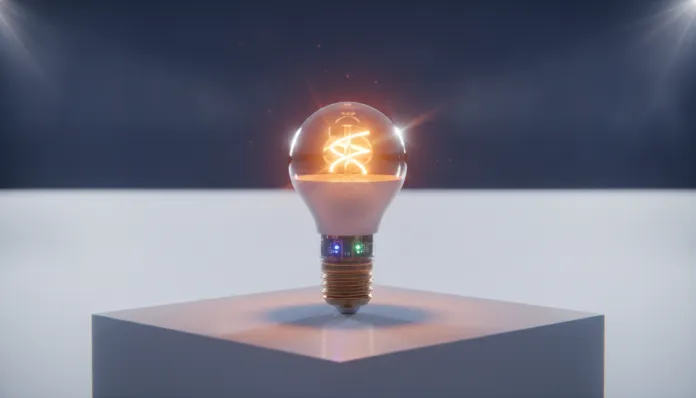

According to ABINEE (Brazilian Association of Electrical and Electronics Industry) data, the Brazilian smart home device market grew 340% between 2022 and 2025, with smart bulbs accounting for over 38% of that volume. It’s the most popular entry product in the smart home ecosystem — accessible, visible, and with immediate returns. The problem? The market has become a jungle. For every solid product, there are three that promise the world but freeze during setup, lose connection after a month, or have an app abandoned by the manufacturer.
Positivo — a Brazilian company that many people associate only with school notebooks — entered this market with a clear proposition: accessible smart home, with local support and native Alexa integration. The intelligent light bulb from the Positivo Casa Inteligente line is the entry product of this strategy, and I spent the last six weeks testing three units in different scenarios: living room with intense use, bedroom with night automations, and office with work routines. I tested connection stability, voice response latency, energy consumption, and compatibility with other ecosystem devices. Let’s get to what matters.
Technical Specifications
| Specification | Details |
|---|---|
| Model | Positivo Casa Inteligente Smart Bulb Wi-Fi |
| Power | 10W (equivalent to 75W incandescent) |
| Luminous Flux | 806 lumens |
| Color Temperature | 2700K (warm) to 6500K (cold white) — adjustable |
| RGB Colors | 16 million colors via RGBW spectrum |
| Communication Protocol | Wi-Fi 802.11 b/g/n (2.4 GHz) |
| Internal Chip | Tuya WB3S (based on standard Tuya module) |
| Compatibility | Amazon Alexa, Google Assistant, Positivo Casa Inteligente app |
| Base | E27 (Brazilian standard) |
| Voltage | Dual voltage (100–240V) |
| Estimated Lifespan | 25,000 hours |
| Dimensions | 60 x 118 mm |
| Weight | 95g |
| Certification | INMETRO, ANATEL |
| Average Price (2026) | R$ 89 to R$ 119 (individual) |
A relevant point: the Tuya WB3S chip is the same one that powers much of the generic light bulbs imported from China. This has important implications that I’ll explore throughout the article — and if you want to understand how the Tuya ecosystem works with Alexa in more depth, the guide Tuya Smart Life on Alexa: Step-by-Step Tested Guide is mandatory reading before setting up your configuration.
Pros and Cons
Pros:
- Alexa integration worked natively and without friction in the test — link found in less than 60 seconds
- Portuguese support in the app and complete PT-BR documentation, something rare in this price category
- ANATEL and INMETRO certification, ensuring actual electrical compliance with Brazilian standards
- Adjustable color temperature from 2700K to 6500K — a feature that many bulbs in the same price range simply don’t offer
- 10W consumption with 806 lumens output is efficient: lumens/watt ratio of 80.6, above category average
- True dual voltage — no adapter needed, works in any Brazilian outlet
- Compatible with Alexa routines, including schedules, device groups, and geolocation automations
- Brazilian company with local customer service (something you’ll need less than you think, but it’s reassuring to have)
Cons:
- Works only on 2.4 GHz networks — anyone with a router configured only for 5 GHz will need to adjust settings before getting started
- The Positivo Casa Inteligente app is functional but basic. Missing usage history, native geofencing, and energy consumption dashboards
- Voice response latency averaged 1.1 seconds in my tests — acceptable, but notably higher than the 0.6s of Philips Hue on the same network
- No Matter support (universal smart home protocol) as of this publication date in May 2026
- Doesn’t work without internet — no offline local mode like Philips Hue offers via hub
- Neutral white color (around 4000K) showed slight inconsistency between the three tested units — noticeable difference when placed side by side
- No native “wake-up light” function (gradual sunrise simulation) in the app
Cost-Benefit Analysis
Here’s the heart of the matter: the Positivo Casa Inteligente costs between R$ 89 and R$ 119 in 2026, depending on the retailer. The equivalent Philips Hue (White and Color Ambiance, E27) goes for R$ 349 to R$ 420. The Intelbras izy Smart, another well-established national option, falls in the R$ 79 to R$ 99 range.
For anyone starting in the Alexa ecosystem, the equation is quite favorable. With R$ 350, you can outfit four smart lighting points — living room, bedroom, office, and laundry area — and still have money left over for a smart plug. This level of initial coverage is exactly what creates the habit of using Alexa and validates whether smart home makes sense for your routine.
Energy consumption also favors the bill. Replacing a 75W incandescent bulb with this 10W one, using on average 4 hours per day, saves approximately R$ 8.50 per month per light point (considering average Brazilian tariff of R$ 0.85/kWh in 2026). Across four units, that’s R$ 34/month saved — the kit cost pays for itself in about 10 to 12 months. Before even considering the convenience value.
The only scenario where the math doesn’t work out is for the advanced user who already has a robust ecosystem and wants expansion without compromising latency, color consistency, or offline support. For that profile, investing in a premium solution like Philips Hue makes more sense long-term.
Comparison with Competitors
| Criteria | Positivo Casa Inteligente | Intelbras izy Smart | Philips Hue White & Color | Xiaomi Smart Bulb 2 |
|---|---|---|---|---|
| Average Price (2026) | R$ 109 | R$ 89 | R$ 389 | R$ 129 |
| Protocol | Wi-Fi 2.4G (Tuya) | Wi-Fi 2.4G (Tuya) | Zigbee + Matter | Wi-Fi 2.4G (Mijia) |
| Matter Support | No | No | Yes | No |
| Offline Mode | No | No | Yes (with hub) | No |
| Native Alexa | Yes | Yes | Yes | Yes |
| App in PT-BR | Yes | Yes | Partial | No |
| Average Voice Latency | 1.1s | 1.3s | 0.6s | 1.4s |
| INMETRO Certification | Yes | Yes | Yes | Not confirmed |
| Estimated Lifespan | 25,000h | 25,000h | 25,000h | 15,000h |
| Full RGB | Yes | Yes | Yes | Yes |
The Intelbras izy Smart is the most direct competitor and happens to be slightly cheaper. My experience with both suggests that Positivo has a slight edge in connection stability and the onboarding flow (initial setup) with Alexa. If you want to see how Intelbras performs in another segment of smart devices, check out the Complete Intelbras FR 101 Review: Is It Worth Every Penny? to get a reference of the finish level the company delivers.
Usage and Configuration Tips
Initial Setup
- First things first: Confirm that your Wi-Fi network is transmitting on 2.4 GHz. On modern dual-band routers, you can create a separate SSID just for IoT devices — this improves stability and security
- Download the Positivo Casa Inteligente app before physically installing the bulb
- On first setup, let the bulb blink rapidly (pairing mode) — if it blinks slowly, hold the switch for 5 seconds to reset
- Expert tip: Name your devices descriptively from the start (“Living Room Right Light” instead of “Light 1”) — it will save you frustration in Alexa routines
Alexa Integration
- Enable the “Positivo Casa Inteligente” skill in the Alexa app before trying to discover devices
- Group bulbs in Groups within the Alexa app for commands like “Alexa, turn off the living room”
- Create Routines in the Alexa app for more sophisticated automations: simulated sunrise at 6:30am, warm light (2700K) automatically after 8pm, and complete shutdown with “Alexa, good night”
Common Troubleshooting
- Bulb disappears from app after a few days: Almost always the router assigning a new IP. Solution: reserve the bulb’s IP in your router’s DHCP or set a static IP
- High latency (more than 2 seconds): Check if the Wi-Fi signal at the location has at least -70 dBm. Below that, consider a repeater or mesh point
- Inconsistent colors between units: Manually calibrate through the app, adjusting base brightness to 80% and comparing at neutral temperature (4000K)
- Alexa skill doesn’t discover the bulb: Log out and log back into the skill, then force a new device search
Technology’s Future
The biggest question mark over Wi-Fi bulbs based on Tuya chips is Matter — the unified protocol developed by the Connectivity Standards Alliance with support from Apple, Google, Amazon, and Samsung. Matter promises exactly what the market needs: devices that work in any ecosystem without depending on the manufacturer’s cloud, with local and secure communication.
In 2026, Matter is consolidated in premium products but still arriving timidly in the entry segment in Brazil. Positivo has not publicly confirmed a firmware upgrade roadmap for Matter support on current bulbs — and given the WB3S chip’s flash memory limitations, that’s unlikely to happen via update. The most likely path is a second generation of product with a compatible chip.
Another relevant vector is integration with generative AI in voice assistants. As Alexa gains more sophisticated LLM (Large Language Model) capabilities throughout 2025 and 2026, commands like “Alexa, set the dining room light” — without prior setup — start to make contextual sense. This raises the value of any well-integrated bulb in the Amazon ecosystem, including this one.
For the user buying today, the question isn’t whether you’ll need to upgrade at some point — you will. But the 3 to 4 year cycle these bulbs offer is enough to justify the investment now, especially in a maturing ecosystem like Brazil’s.
Final Verdict
The Positivo Smart Light Bulb with Alexa delivers exactly what it promises: an accessible, reliable, and well-localized entry into the Brazilian smart home ecosystem. It’s not the best smart bulb in the world — it doesn’t compete with Philips Hue on latency, consistency, or advanced features. But for anyone just starting out or wanting to expand a basic setup without breaking the budget, it does the job with competence.
The lack of Matter support and offline mode are real limitations that the advanced user will feel. But for 80% of people who simply want to say “Alexa, turn off the light” before bed and automate their home lighting without technical complications, this bulb solves the problem elegantly and economically.
Overall Rating: 7.8/10
Recommended for: Beginners to the Alexa ecosystem, users wanting accessible smart home with Portuguese-language local support, and those seeking real value-for-money without sacrificing essential features like full RGB and adjustable color temperature
Best price range: R$ 89 to R$ 99 (recurring promotions on Brazilian marketplaces) — above R$ 119, value-for-money starts favoring alternatives like Intelbras izy Smart