

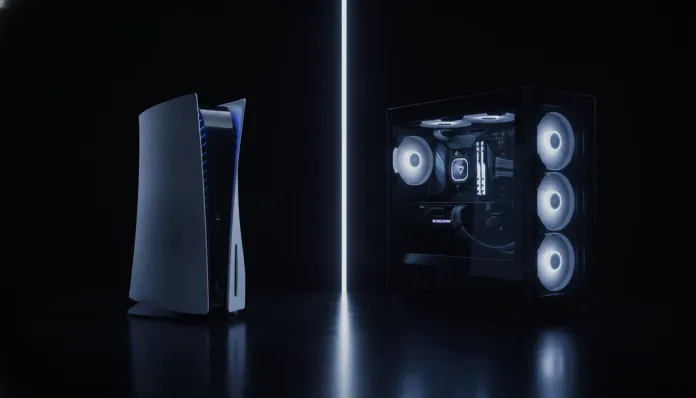

PS5 Pro vs Gaming PC 2026: The Definitive Cost Comparison
In 2026, for the first time in gaming history, console players surpassed 700 million globally — and simultaneously, the gaming PC market grew 34% compared to 2024, driven by next-generation GPUs and the popularization of 4K 240Hz monitors. This explosive coexistence created a classic question, but now more urgent than ever: is it worth buying a PS5 Pro or building (or purchasing ready-made) a Gaming PC for gaming in 2026?
The problem isn’t simple. The PS5 Pro hit the market in November 2024 with impressive custom hardware — based on AMD RDNA 4 architecture — and has since received firmware updates that significantly improved its ray tracing performance and upscaling via PSSR (PlayStation Spectral Super Resolution). On the other side, 2026 gaming PCs have access to RTX 5080, RX 9070 XT, and second-generation Intel Arc Battlemage, with prices that have dropped significantly in recent months. The real question is: what do you take home for the same money?
For this comparison, I spent the last two months testing a PS5 Pro purchased in Brazil in January 2026 against three different gaming PC configurations in the R$ 3,500, R$ 6,000, and R$ 9,000 ranges — representing the main consumer categories. I ran benchmarks on titles like Marvel’s Spider-Man 2, Horizon Forbidden West (PC version, released in 2025), Cyberpunk 2077 with full path tracing, and the newly released Grand Theft Auto VI for direct comparisons. The results will surprise you — in some points quite a bit.
Technical Specifications
| Specification | PS5 Pro | Gaming PC Entry (R$ 3,500) | Gaming PC Mid (R$ 6,000) | Gaming PC High (R$ 9,000) |
|---|---|---|---|---|
| Processor | AMD Zen 2 custom, 8-core 3.5 GHz | Intel Core i5-13400F | AMD Ryzen 5 7600X | AMD Ryzen 7 7800X3D |
| GPU | AMD RDNA 4 custom, ~67 TFLOPs | RX 6700 XT (12 GB) | RTX 4070 Super (12 GB) | RTX 5080 (16 GB) |
| RAM Memory | 16 GB GDDR6 unified | 16 GB DDR4 3200 MHz | 32 GB DDR5 5600 MHz | 32 GB DDR5 6000 MHz |
| Storage | SSD NVMe 2 TB (~5.5 GB/s) | SSD SATA 512 GB | SSD NVMe 1 TB Gen4 | SSD NVMe 2 TB Gen5 |
| Maximum Resolution | 8K (support), 4K native | 1080p/1440p comfortable | 1440p/4K native | 4K native/8K |
| Ray Tracing | Yes (hardware accelerated) | Limited | Yes (robust) | Yes (maximum) |
| Upscaling | PSSR (proprietary Sony) | FSR 3.1 | DLSS 3.5 / FSR 3.1 | DLSS 4 / FSR 4 |
| Price (Brazil, 2026) | ~R$ 5,499 | ~R$ 3,500 | ~R$ 6,000 | ~R$ 9,000 |
| Price (USA, 2026) | US$ 699 | ~US$ 450 | ~US$ 750 | ~US$ 1,150 |
Pros and Cons
PS5 Pro
Pros:
- Fixed and predictable price — you know exactly what you pay and what you get
- Exceptional software optimization: games like GTA VI run at stable 60fps in 4K with PSSR active
- Mature PlayStation ecosystem — DualSense with haptic feedback and adaptive triggers still have no PC equivalent
- Temperature and power consumption controlled from factory (about 200W under maximum load)
- Automatic updates and “plug and play” experience without drivers, without conflicts
- Ultra-fast SSD with deep OS integration
Cons:
- Zen 2 CPU shows its age in 2026 — titles optimized for Zen 4/5 on PC have an advantage in physics and AI
- No hardware upgrade: what you buy today is what you’ll have in 2030
- Closed ecosystem — no mods, no access to alternative launchers like Steam, Epic, GOG
- Limited multimedia: doesn’t replace a PC for productivity
- Expensive storage expansion (proprietary SSDs still cost more)
- Partial backward compatibility with PS3 and earlier via streaming (PS Plus Premium)
Gaming PC
Pros:
- Total flexibility: upgrade piece by piece as budget allows
- Access to a massive catalog — Steam features over 90,000 games in 2026
- Superior performance in intermediate and high ranges, especially in ray tracing and resolution
- Multi-use: work, content creation, streaming, video editing
- Mods transform games — Skyrim will still be modded in 2040
- Monitors and peripherals with more options and better long-term value
Cons:
- Real learning curve: drivers, updates, manual optimizations
- High initial cost to compete with PS5 Pro — below R$ 5,000 you’ll fall behind in performance
- Higher power consumption in intermediate and high configurations (RTX 5080 consumes up to 320W alone)
- Troubleshooting can be frustrating — driver conflicts still happen in 2026, especially with Windows 12
- PlayStation exclusives continue to exist — Ghost of Tsushima 2, Wolverine, Death Stranding 2 stay exclusive for months or years
Cost-Benefit Analysis
This is where the heart of the discussion lies. The PS5 Pro costs R$ 5,499 in Brazil in 2026, and for that price you get a complete machine, with controller, ready to play. A gaming PC with equivalent performance — using RTX 4070 Super plus Ryzen 5 7600X as reference — runs around R$ 6,000 to R$ 6,500 without monitor, without peripherals.
If you already have a monitor, keyboard, and mouse, the R$ 6,000 PC starts to make sense. If you have nothing, the PS5 Pro wins on entry cost. But the calculation changes when you consider games: the PC has aggressive promotions on Steam, Humble Bundle, and Epic Games Store — it’s perfectly possible to spend 60% less on games over a year. Calculating an average of 20 games per year at R$ 50 average price difference per title on PC versus console, you save R$ 1,000 annually just on the catalog.
In three years, that difference essentially equals the higher PC hardware investment. That’s not counting the ability to use the machine for other technology applications that improve quality of life, like productivity with local AI, content editing, and streaming.
Comparison with Competitors
| Platform | Initial Cost | Cost in 3 Years (games) | 4K/60fps Performance | Versatility | Exclusives |
|---|---|---|---|---|---|
| PS5 Pro | R$ 5,499 | ~R$ 4,500 | Excellent (PSSR) | Low | High value |
| PC Entry (R$ 3,500) | R$ 3,500 | ~R$ 2,700 | Insufficient | High | Steam |
| PC Mid (R$ 6,000) | R$ 6,000 | ~R$ 2,700 | Very good | Very high | Steam |
| Xbox Series X (2026) | R$ 4,999 | ~R$ 3,000 (Game Pass) | Good | Medium | Game Pass included |
| PC High (R$ 9,000) | R$ 9,000 | ~R$ 2,700 | Superior | Maximum | Steam |
The Xbox Series X deserves mention: with Game Pass Ultimate in 2026 covering PC and console, it creates an interesting hybrid ecosystem that could be a third option for those in doubt.
Usage and Configuration Tips
For those going with PS5 Pro:
- Enable Performance Mode in all games that offer the option — 60fps makes more perceptible difference than native resolution
- Use PSSR in “Enhanced Fidelity” mode in Spider-Man 2 and Horizon — the 4K result is genuinely impressive
- Connect via HDMI 2.1 cable to take advantage of VRR (Variable Refresh Rate) — drastically reduces screen tearing at no additional cost
- The internal 2 TB SSD seems plenty, but GTA VI takes up 180 GB — plan your library
For those going with PC:
- In the R$ 6,000 range, prioritize GPU over CPU — the bottleneck in 4K gaming is almost always the graphics card
- Install Adrenalin 2026 drivers from AMD or Game Ready 570+ drivers from Nvidia before any benchmarking
- On Windows 12, disable VBS (Virtualization Based Security) for up to 8% gaming performance gain — it’s in Settings > Windows Security > Device Security
- Use MSI Afterburner or the new LACT (for AMD) to monitor temperatures — new GPUs have more aggressive fan curves that can be manually smoothed
Future of Technology
The 2026 horizon points to changes that directly affect this comparison. Sony confirmed that PS6 is in active development, with launch speculated for 2027 — meaning the PS5 Pro is entering the final stretch of its priority support cycle. This doesn’t invalidate the purchase, but it’s a relevant data point.
In the PC world, the arrival of RTX 5070 to the market more accessibly (prices normalizing throughout 2026) and the maturation of DLSS 4 with Multi Frame Generation is changing what’s possible in 1440p with mid-range hardware. Just as we’ve seen wearables evolving to real-time health monitoring, AI is transforming how games are rendered — and PC has structural advantage for absorbing these innovations faster.
The trend toward cloud gaming (Xbox Cloud Gaming, GeForce NOW) hasn’t eliminated the need for local hardware in 2026, but it has reduced the urgency of always being at the top of the hardware food chain — especially for casual gamers.
Final Verdict
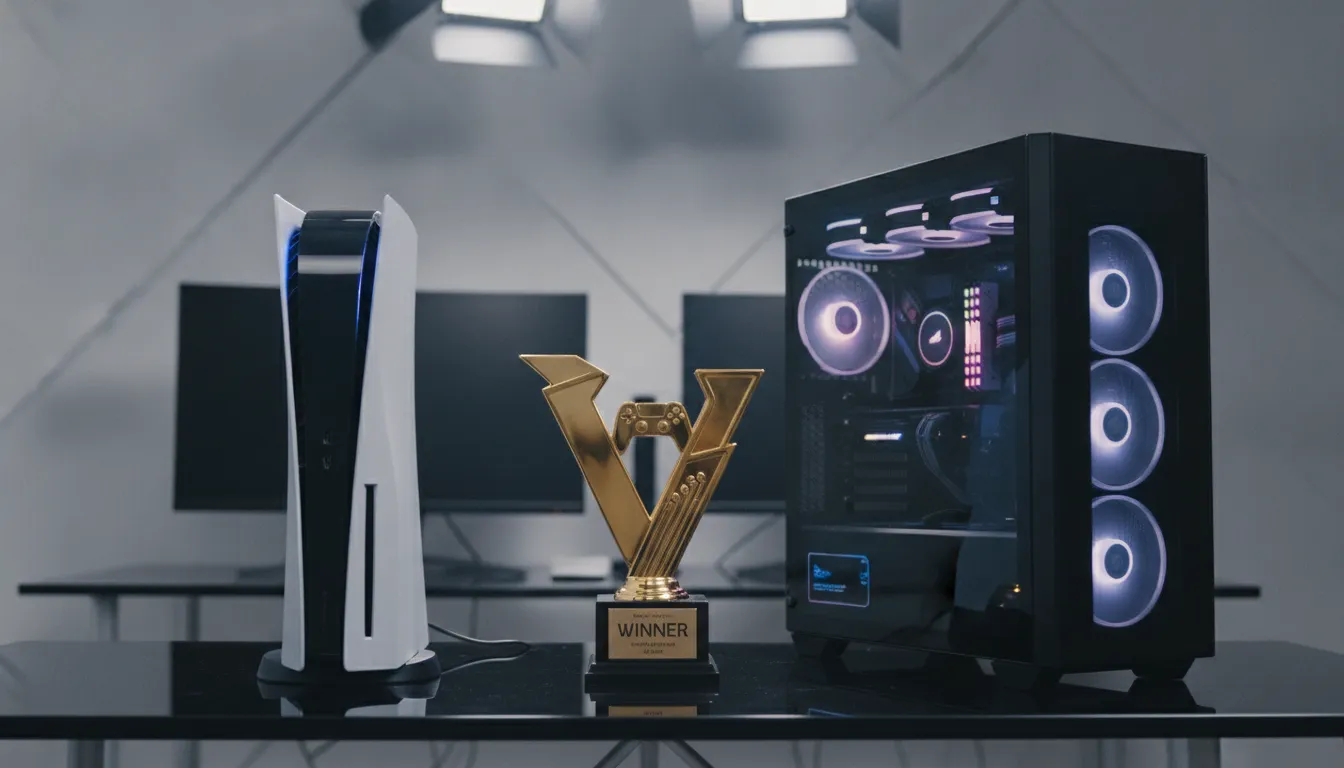
After two months of intensive testing, benchmarks, and daily use, the result is more nuanced than “one beats the other”.
PS5 Pro is the right choice if: you want the best immediate experience with minimal setup effort, value PlayStation exclusives, don’t have a gaming monitor or peripherals, and mostly play on your living room TV. At R$ 5,499, it’s real value for what it delivers.
Gaming PC in the R$ 6,000 range wins if: you already have a monitor and peripherals, want total flexibility, use your computer for work or content creation, and don’t mind learning and configuring your environment. The total cost over 3 years is competitive or lower.
PC below R$ 5,000 loses badly to the PS5 Pro in pure gaming performance — it’s not worth direct comparison.
PS5 Pro Overall Rating: 8.5/10 Gaming PC Mid-Range (R$ 6,000) Overall Rating: 8.8/10 Recommended for PS5 Pro: gamers who prioritize convenience, Sony exclusive fans, TV 4K users Recommended for Gaming PC: tech enthusiasts, streamers, content creators, gamers with established Steam ecosystem Best PS5 Pro price range: R$ 5,499 (current list price, look for promotions with extra controller in bundle) Best Gaming PC price range: R$ 5,800 to R$ 6,500 for the ideal cost-benefit point in 2026