

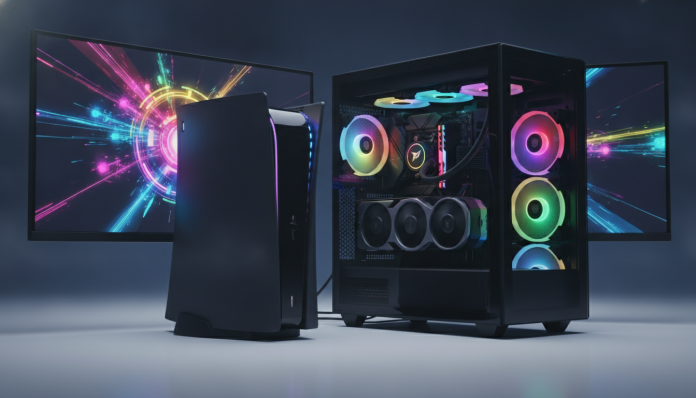

PS5 Pro x PC gamer: the comparison every Brazilian needs to make before spending
You have a budget in the range of R$ 7,000 to R$ 12,000 and are torn between buying a PS5 Pro or building (or buying) a gaming PC. This is one of the most recurring questions in technology forums and groups in Brazil in 2026, and it makes sense: both deliver high-level gaming experiences, but through completely different paths. The short answer is that there is no universally better option. What exists is the right option for your profile.
The PS5 Pro was launched in the US in November 2024 for US$ 699 (without disc reader). In Brazil, the console arrived with a launch price around R$ 5,499 in the basic version, but in 2026 the market has already accommodated variations depending on the retailer and available bundles. A gaming PC with comparable performance starts at configurations in the R$ 7,000 to R$ 9,000 range when built from parts, and can easily exceed R$ 12,000 depending on your choices. In this comparison, we’ll understand where each one performs better, where each one disappoints, and most importantly, which one makes more sense for you.
Comparative technical specifications
| Criteria | PS5 Pro | Gaming PC (mid-high reference 2025/2026) |
|---|---|---|
| CPU | Custom AMD Zen 2 (8 cores, up to 3.85 GHz) | AMD Ryzen 7 7700X or Intel Core i7-14700K (varies) |
| GPU | Custom AMD RDNA 4 (according to Sony, ~45% faster than standard PS5) | NVIDIA RTX 4070 Super or RX 7800 XT (varies) |
| RAM | 16 GB unified GDDR6 | 32 GB DDR5 (recommended configuration) |
| Storage | 2 TB custom NVMe SSD | 1 TB to 2 TB NVMe SSD (Samsung 990 Pro or similar) |
| Maximum resolution | 8K (declared support); focus on 4K/60 fps and 4K/120 fps with PSSR | Depends on GPU and monitor; 4K/144 fps viable with RTX 4070 Super |
| Upscaling | PSSR (PlayStation Spectral Super Resolution, Sony’s proprietary technology) | DLSS 3.5 (NVIDIA) or FSR 3 (AMD) |
| Ray tracing | Yes (hardware accelerated) | Yes (hardware accelerated, more versatile on PC) |
| Disc reader | Optional (sold separately) | Optional optical drive (standard without) |
| Operating system | PlayStation OS (closed) | Windows 11 (or Linux, with caveats) |
| Approximate price in Brazil (2026) | R$ 5,200 to R$ 6,500 (varies by store and bundle) | R$ 7,000 to R$ 12,000+ (built from parts) |
| Warranty in Brazil | 1 year (Sony Brasil, with Anatel certification) | Varies by component (12 to 36 months depending on part and manufacturer) |
> PC prices were calculated considering configurations built with parts purchased from national stores like Kabum, Pichau and Terabyte Shop. Prices vary based on exchange rates and promotions.
Gaming performance: does the PS5 Pro deliver what it promises?
The big technical innovation of the PS5 Pro is PSSR (PlayStation Spectral Super Resolution), Sony’s machine learning-based upscaling system. In simple terms, upscaling is the technique of rendering the game in lower resolution (say, 1440p) and using artificial intelligence to reconstruct the image in 4K with visual quality close to native. This saves GPU processing without sacrificing (much of) perceived visual quality.
According to Sony, the PS5 Pro’s custom graphics chip is about 45% faster than the standard PS5. In practice, titles compatible with PS5 Pro Enhanced run at 4K/60 fps with ray tracing enabled in scenarios where the standard PS5 forced the player to choose between visual quality and smoothness. The list of games with explicit Pro mode support has been growing since launch, but it’s important to check if the titles you play are on the list before buying.
On a gaming PC, performance is more variable because it depends on the parts you choose. An RTX 4070 Super, which costs around R$ 3,800 to R$ 4,500 in Brazil in 2026, delivers competitive 4K performance with DLSS enabled. DLSS 3.5 (Deep Learning Super Sampling, from NVIDIA) is widely considered the best upscaling quality available on PC, with frame generation that adds synthetic frames to increase perceived smoothness. FSR 3 (FidelityFX Super Resolution, from AMD) is the more accessible alternative and works on GPUs from any manufacturer, but presents slightly inferior image quality in comparison.
Ecosystem and exclusives: the advantage money can’t buy
This is, perhaps, the most concrete difference for those who game heavily. The PS5 Pro gives access to PlayStation’s exclusive catalog, which in 2026 includes franchises like God of War, Spider-Man, Gran Turismo, Demon’s Souls and other titles that either haven’t arrived on PC or arrived with a one to two year delay. If you’re a fan of these franchises, the PlayStation ecosystem has real weight in the decision.
On the other hand, PC has the largest game catalog in the world. Steam, Epic Games, GOG, legal emulators, indie games, mods, access to old titles that never reached consoles — the freedom is total. Games that cost R$ 300 on launch day on the PS Store frequently appear on sale on Steam for R$ 30 to R$ 50 months later. Over the years, this price difference on games can exceed the cost of hardware.
PlayStation Plus, Sony’s subscription service, also enters the account. To play online on PS5 Pro, you need PlayStation Plus Essential, which in 2026 costs about R$ 34.90 per month or R$ 149.90 per year. On PC, most online games don’t require a subscription beyond the game itself.
Real cost in Brazil: it’s not just the hardware price
Here lies a classic error in comparison. The PS5 Pro seems cheaper at the point of sale, but the total cost of ownership over three to four years is what really matters. Consider:
- PS5 Pro: console price + extra controller (around R$ 500 to R$ 600) + annual PlayStation Plus + games at launch price (which in Brazil reach R$ 250 to R$ 350 on the PS Store)
- Gaming PC: hardware price + monitor (if you don’t have one) + peripherals + games (with lower average price long-term)
The monitor is the item that most scares those migrating from console to PC. A good 4K/144 Hz monitor costs from R$ 2,500 and can exceed R$ 5,000 in more premium versions. If you already have a quality 4K TV, the PS5 Pro takes advantage of it directly — and with support for 4K/120 Hz via HDMI 2.1, as long as your TV has this input available.
Another important Brazilian point: the PS5 Pro officially sold in Brazil by Sony Brasil comes with Anatel certification and one year warranty with authorized technical assistance across the country. PC parts imported on your own (from sites like AliExpress or eBay) don’t have this guarantee and may face customs difficulties. National stores like Kabum and Pichau offer their own warranty on products they sell, which reduces this risk.
If you want to organize your budget intelligently, also think about other gadgets that can complement your setup. For those evaluating personal technology devices in parallel, this guide on the best smartwatch up to R$ 500 to buy in 2026 can help you balance spending without compromising quality.
Versatility: PC does more, but it has a cost
A gaming PC is not just a console. With the same hardware you edit videos, work from home, use design programs, stream to Twitch or YouTube without additional equipment and still play. For those who work from home or have a need for a computer anyway, the PC pays for itself in ways the console never will.
Those interested in content creation, for example, will find the PC a much more complete tool. By the way, if video editing is part of your plans, it’s worth checking out the guide on the best laptops for video editing under US$ 1,200 to understand what the market offers in that range.
The PS5 Pro, on the other hand, does one thing and does it very well. You turn it on to your TV, grab the controller and play. There’s no driver to update, no software incompatibility, no BIOS configuration. The simplicity of the console is a real feature, not a minor limitation.
Which to choose: recommendation by profile
Time to be direct.
Choose the PS5 Pro if:
- You mainly play PlayStation exclusives and follow Sony releases
- You have a 4K TV with HDMI 2.1 and don’t want to spend on a monitor
- You prefer a plug-and-play experience without hardware or software maintenance
- Your total budget is closer to R$ 6,000 to R$ 7,000
- You don’t use the equipment for work or study
Choose the gaming PC if:
- You use (or will use) the equipment for work, editing or productivity
- You prefer a larger catalog and games with lower average price over time
- You want the flexibility to upgrade parts as technology advances
- You have a 4K monitor or are willing to invest in one
- You have no specific interest in PlayStation exclusives
Frequently asked questions about PS5 Pro and gaming PC
Does PS5 Pro run PS4 games?
Yes. The PS5 Pro maintains backward compatibility with the vast majority of PS4 titles, according to Sony. Many PS4 games also receive automatic visual improvements when running on PS5 Pro, such as higher resolution and more stable frame rate. Check the compatibility list on the official PlayStation website before migrating your library.
Is it worth importing the PS5 Pro from the US to save money?
In theory the dollar price is lower, but in practice Brazilian import taxes (which can reach 100% of the product value depending on the route), the risk of customs hold and lack of local warranty make the operation risky. The PS5 Pro sold by Sony Brasil has national technical assistance and Anatel certification, which provides more security in the long run.
Is a PC built from parts cheaper than a pre-built gaming PC?
Generally yes, building from parts costs less and allows for more precise component choices. The downside is that it requires technical knowledge for assembly and, in case of problems, you need to identify which part failed. Pre-built PCs from brands like Dell, Lenovo or local manufacturers offer unified warranty, but typically cost between 15% and 30% more for the same performance.
Does the PS5 Pro really run in 8K?
Sony declares 8K support, but in practice the PS5 Pro’s focus is 4K with high frame rates and ray tracing. Native 8K games don’t exist in the current catalog and it’s unlikely they’ll appear in significant numbers this generation, given the computational effort involved. Consider 8K as a declared technical support, not as everyday use.
The final verdict depends on how you use it
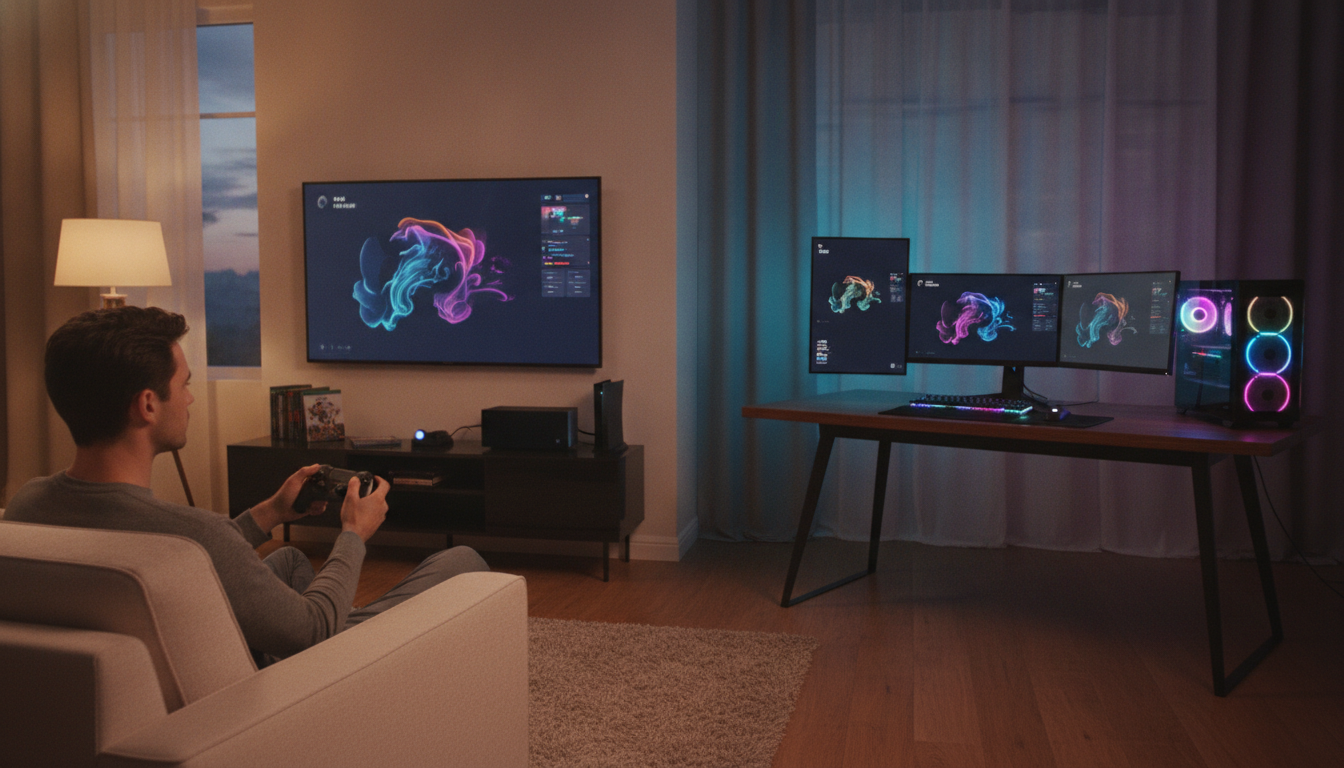
If your day-to-day revolves around PlayStation exclusive games, a 4K TV in the living room and a frictionless experience, the PS5 Pro delivers great value for the price, especially compared to what you’d spend to build a PC with equivalent performance. Sony built a refined product focused on its purpose.
If you want versatility, a broad catalog, better prices on games long-term and the ability to use the same machine for work, the gaming PC is the smarter investment — as long as you accept the learning curve and higher initial budget. In 2026, the two platforms are closer than ever in image quality, but further apart than ever in usage proposal. Knowing your profile is the only reliable shortcut to this decision.