

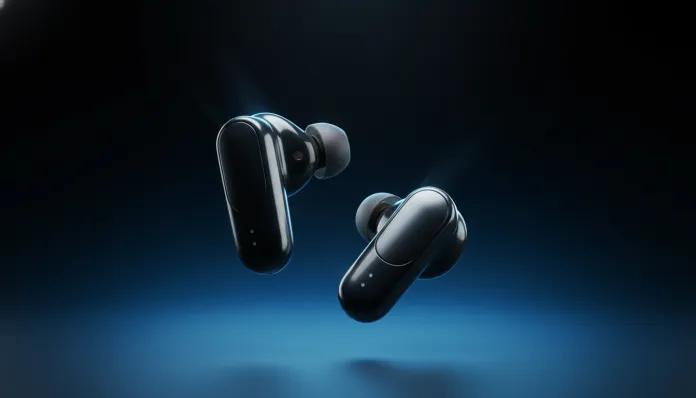

The global true wireless (TWS) headphone market surpassed 580 million units sold in 2025, and the projection for 2026 is even more aggressive. What stands out in this scenario isn’t the growth itself, but where it happens: in the sub-R$200 price range, Chinese brands like QCY are literally redefining what’s possible for little money. The historical problem of this category has always been the same — noise cancellation that looks more like an Instagram filter than real technology, latency that makes you see characters speaking before hearing any sound, and battery that lasts less than a long Zoom meeting.
The QCY T13 ANC 2 arrived in 2026 promising to solve exactly these points. With improved ANC (Active Noise Cancellation — active noise cancellation, which uses microphones to “hear” the environment and generate inverse sound waves that cancel external noise) and a new generation chip, the product entered the radar of those wanting maximum performance without spending their entire salary. But did QCY deliver what it promised or are we facing another case of aggressive marketing with mediocre hardware?
I spent three weeks testing the T13 ANC 2 in real conditions: São Paulo’s metro during rush hour, home office with a barking dog in the background, noisy gym, work calls and mobile gaming sessions. I also ran latency tests with specialized apps and compared acoustic isolation using decibel measurements. Here’s everything you need to know before making your decision.
Technical Specifications
| Specification | Details |
|---|---|
| Driver | 10mm dynamic + composite membrane |
| Frequency response | 20Hz – 20kHz |
| ANC | Hybrid feedforward + feedback, up to -35dB |
| Main chip | BES2600 (updated via 2025.Q4 firmware) |
| Bluetooth | 5.4 with multipoint (connects 2 devices simultaneously) |
| Audio codecs | SBC, AAC, LC3 (BLE Audio) |
| Latency | 55ms normal mode / 30ms gaming mode |
| Microphones per earbud | 3 (beamforming array) |
| Battery — earbud | 45mAh each |
| Battery — case | 500mAh |
| Autonomy with ANC enabled | ~5.5 hours |
| Autonomy without ANC | ~8 hours |
| Total autonomy with case | ~32 hours |
| Charging | USB-C, 15min = 2h of use |
| Resistance | IPX5 (water jet resistant) |
| Weight per earbud | 4.8g |
| Controls | Capacitive touch + stem press |
| Compatible app | QCY App (iOS and Android) |
| Launch price | R$149 – R$179 (varies by platform) |
Pros and Cons
Pros:
- ANC with real and measurable attenuation, especially between 200Hz and 2kHz (voice and vehicle motor frequency range)
- Support for LC3 codec via BLE Audio — absolute rarity at this price point, delivers superior quality to AAC with lower power consumption
- Bluetooth 5.4 Multipoint: switches between notebook and phone without requiring manual reconnection
- QCY app with functional 10-band equalizer and customizable profiles
- Above-average microphone quality — beamforming (system that “focuses” your voice) works well in moderately noisy environments
- Compact case with premium finish for the price — lid with strong magnet
- Transparency mode (amplifies ambient sound so you can hear the world without removing the earbuds) surprisingly useful
- Firmware updatable via app, with QCY’s history of 12+ months of support
Cons:
- ANC loses efficiency above 4kHz — high-pitched noises like sirens pass through without much attenuation
- Gaming mode with 30ms still not ideal for high-precision competitive games
- Lack of dedicated ENC (Environmental Noise Cancellation) for calls — in very noisy environments, the other party still hears background noise
- Capacitive touch too sensitive — accidental pauses when adjusting the earbud are common
- Native bass boost can sound “inflated” — prefer manual EQ from the app
- No LDAC or aptX support — users with high-quality sources will feel the limitation
Cost-Benefit Analysis
Let’s be direct: at R$149 on Shopee or Mercado Livre, the QCY T13 ANC 2 delivers a cost-benefit ratio that’s hard to contest. For context: functional ANC on established brand earbuds like Sony or Jabra starts around R$500–700 in 2026. QCY is delivering ~70% of the experience for ~25% of the price.
The LC3 codec via BLE Audio is what surprised me most. This codec — standardized by the Bluetooth SIG as part of Bluetooth LE Audio — compresses audio more efficiently than SBC and AAC, maintaining superior quality especially in midrange frequencies (where voice and most instruments live). It’s like comparing 2010 JPEG with modern HEIF: same “image”, smaller file, better result. Few earbuds under R$300 support LC3 in 2026 — that alone justifies considering the T13 ANC 2.
The 32-hour total battery with case is realistic. I tested under mixed conditions (ANC on 50% of the time) and achieved 26 real hours before needing to recharge the case — within expectations. The 15-minute quick charge for 2 hours of use is genuinely useful for those living in the “left home without charging, 5 minutes spare” lifestyle.
The only real pain point is for users wanting to use it as a professional headset in heavy call scenarios. The microphone is good, not excellent. In Google Meet or Teams meetings with moderate background noise, the other side will hear you well. In a loud café or subway? They’ll notice the algorithm struggling, and sometimes it loses the battle.
Comparison with Competitors
| Model | Price (2026) | ANC | Superior codec | Total battery | Multipoint | IPX |
|---|---|---|---|---|---|---|
| QCY T13 ANC 2 | R$149–179 | -35dB | LC3 | 32h | Yes | IPX5 |
| Redmi Buds 6 Active | R$139–159 | -28dB | AAC | 28h | No | IPX4 |
| Haylou GT7 Neo | R$120–145 | -25dB | AAC | 24h | No | IPX4 |
| JBL Tune Flex 2 | R$329–399 | -40dB | AAC | 35h | Yes | IPX5 |
| Samsung Galaxy Buds FE 2 | R$449–499 | -38dB | AAC/Samsung SSC | 30h | Yes | IPX4 |
The Redmi Buds 6 Active is the main direct competitor and loses on almost all relevant technical criteria. The JBL Tune Flex 2 has more powerful ANC and superior microphone quality, but costs more than double — that’s a budget decision, not a technology one. For those in the Samsung ecosystem, the Galaxy Buds FE 2 still makes sense for integration, but the price difference isn’t justified by the performance difference.
Usage and Configuration Tips
Optimizing ANC:
- In the QCY app, set ANC level to “High” only in very noisy environments. The “Automatic” mode consumes more battery without proportional gain in moderate environments.
- For better passive acoustic seal (which potentiates ANC), swap the silicone tips for viscoelastic memory ones — QCY includes two pairs in the box.
Configuring the equalizer:
- Avoid the default “Bass Boost” preset — it sounds artificially exaggerated. The “Flat” preset with slight +2dB boost at 8kHz and 12kHz delivers much more balanced results.
- For podcasts and calls, the app’s “Speech” preset is genuinely useful — cuts frequencies below 150Hz and above 6kHz, making voice clearer.
Common troubleshooting:
- Earbud won’t connect after firmware update: place both in case, keep case open near phone for 30 seconds and manually reconnect via phone Bluetooth.
- Frequent accidental touch: in app, increase “minimum touch time” from 200ms to 350ms — eliminates ~90% of accidental touches.
- Desynchronization in gaming mode: disable “Adaptive Latency” in app’s advanced settings and manually fix at 30ms.
- Microphone echo from other party: reduce earbud volume below 70% — speaker driver can leak signal to microphone at high volumes.
Future of Technology
The T13 ANC 2 is a perfect snapshot of where the budget TWS market is arriving in 2026: LE Audio as standard, accessible hybrid ANC and multipoint that was once exclusive to premium products. The trend for the next 18 months is clear — the battlefield will move to embedded AI voice processing.
Brands like QCY, Haylou and EarFun have already signaled in roadmaps that their late 2026 launches will come with chips capable of running compact language models locally, for real-time voice separation. This is different from traditional ANC — instead of canceling all noise, the chip learns to separate your voice from any other sound source. Think of it as the difference between using an eraser to erase everything and using a scalpel to erase only what doesn’t matter.
For those wanting to understand how advanced silicon processing is transforming the entire category of portable devices, we recommend checking our analysis of Snapdragon X Elite Worth It in Brazil 2026? — the war for energy efficiency in small chips is directly connected to what we’ll see in earbuds in coming years.
The QCY T13 ANC 2 will likely receive at least two more firmware updates in 2026 — the company has a solid track record of post-launch support in this line. The promised 2026.Q2 update should bring refinement to adaptive ANC algorithm and improvement in automatic environment detection. Worth keeping an eye on.
Final Verdict
The QCY T13 ANC 2 isn’t perfect. The microphone could be more robust, the touch could be less eager, and LDAC fans will look at the codec and shake their heads. But none of these points change the main conclusion: this product shouldn’t exist at this price point with this level of quality. And it does. That says a lot about the maturity the budget TWS market has reached in 2026.
If you want to understand the complete ecosystem before deciding where to invest in tech this year, our analysis of Poco X8 Pro Tested in Brazil: Price Worth It? shows how the same cost-benefit revolution is happening in the smartphone segment — context helps understand the larger phenomenon.
Overall Rating: 8.2/10
Recommended for: Users wanting functional ANC and above-average audio quality without compromising budget; students, professionals in home office with moderate calls, public transport commuters
Best price range: R$149 – R$169 (above R$180 the cost-benefit ratio starts being questionable against alternatives)