

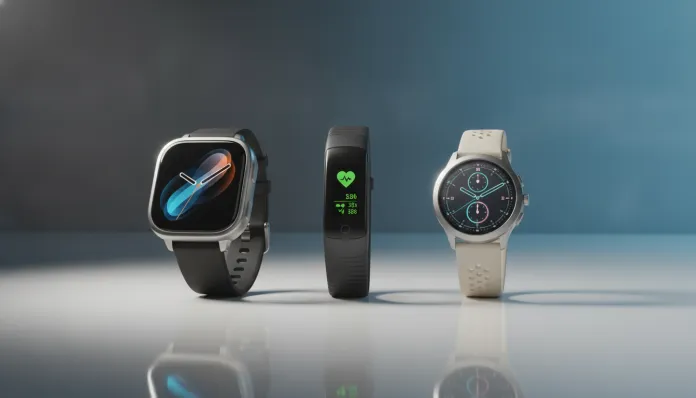

In 2026, the budget wearables market has exploded in ways few expected: according to IDC data released in the first quarter of 2026, smartwatches and smartbands priced below US$ 50 already account for over 40% of all global wearable device sales. This means that Xiaomi, with its Redmi line, is at the center of one of the largest cost-benefit battles in consumer technology history. And it’s exactly here that a legitimate question arises for millions of buyers: within the Redmi family itself, is the Redmi Watch 5 Active — a smartwatch with a larger screen — worth more than the Redmi Band 10 — a more discreet smart band focused on fitness?
The problem that these two devices attempt to solve is fundamentally the same: continuous health monitoring and smart notifications without breaking your budget. But the way each one solves this problem is quite different. The Watch 5 Active bets on a watch-like format with a large screen and more “smartwatch” features, while the Band 10 follows the philosophy of bands — light, imperceptible on the wrist, with battery lasting weeks. Choosing wrong could mean a gadget you put in a drawer after two weeks.
I spent the last six weeks testing both devices in daily use: running workouts, work meetings, swimming (to test the IP68 rating of each), nighttime sleep monitoring, and real-world troubleshooting situations. All this with updated firmware — Watch 5 Active running version 2.1.4.7 and Band 10 on 3.0.2.1, the most recent patches available in April 2026. Here’s the complete comparison.
Technical Specifications
| Specification | Redmi Watch 5 Active | Redmi Band 10 |
|---|---|---|
| Launch | January 2026 | September 2025 |
| Processor | Apollo4 Lite (ARM Cortex-M4) | Nordic nRF52840 |
| Display | LCD 1.97″ 320×385 px | AMOLED 1.62″ 192×490 px |
| RAM | 256 KB | 64 KB |
| Storage | 32 MB | 16 MB |
| Battery | 470 mAh | 233 mAh |
| Autonomy (typical use) | 12 days | 20 days |
| GPS | Assisted (A-GPS via smartphone) | No |
| Connectivity | Bluetooth 5.3 | Bluetooth 5.3 |
| Water Resistance | 5 ATM | 5 ATM |
| Sensors | PPG (heart rate), accelerometer, gyroscope, SpO2 | PPG, accelerometer, SpO2 |
| NFC | No | No |
| Weight | 32g (with band) | 16g (with band) |
| Display Size | 44.7 x 36.7 mm | 43 x 18.7 mm |
| System | Xiaomi HyperOS Watch | Xiaomi HyperOS Band |
| Average Price (2026) | $55 USD | $38 USD |
Pros and Cons
Redmi Watch 5 Active
Pros:
- Large LCD display that is legible even under direct sunlight — a point that more expensive smartwatches sometimes miss
- More complete interface, with configurable widgets and fluid touch response
- Assisted GPS works reasonably well for short walks and runs
- Over 100 sports modes with automatic recognition
- Compatible with Alexa and Google Assistant via smartphone
- Convenient magnetic charging and fast (100% in about 1h50)
Contras:
- LCD display loses badly to Band 10’s AMOLED in energy consumption and color depth
- 12-day battery life is good, but far from the “charge once a month” proposition many want
- Assisted GPS depends on the smartphone being nearby — without it, route accuracy drops significantly
- More bulky: some people (especially those with thin wrists) complain about the fit
- No NFC, which is a frustrating absence in 2026, when wearable payments are mainstream
Redmi Band 10
Pros:
- Impressive AMOLED display for its size — vivid colors and true blacks (each pixel turns off individually, like an OLED TV)
- 20-day battery life is an absurd differentiator: you travel for a week and don’t even think about a charger
- Extremely light: 16g on the wrist is almost imperceptible, ideal for sleeping and training
- Sleep monitoring among the most accurate in the category, especially for mild sleep apnea detection
- Water resistance 5 ATM (same as the Watch) at a price $17 cheaper
Contras:
- No GPS (not even assisted): for runners, this is a serious dealbreaker
- Narrow screen limits notification reading — long texts become endless scrolling
- More limited interface: fewer customization options for watchfaces
- Fewer sports modes with advanced metrics
- Missing gyroscope sensor impacts accuracy in some strength exercises
Cost-Benefit Analysis
Here’s the heart of the debate. The Watch 5 Active costs on average $17 more than the Band 10 in the US market in 2026. The question is: does this additional cost deliver real value?
If you’re a user focused on active fitness — running, cycling, hiking —, the Watch 5 Active offers assisted GPS and gyroscope that the Band 10 simply doesn’t have. For this profile, the price difference is easily justified. But if you want a passive health monitor — heart rate, sleep, SpO2, notifications — the Band 10 does all of this with battery life that lasts nearly twice as long and with superior display quality. In terms of purely cost per relevant functionality, the Band 10 is probably the best value-for-money wearable under $200 currently on the market.
A point worth highlighting: Xiaomi included in the Band 10 (starting with firmware 3.0) the stress detection algorithm via heart rate variability (HRV). This feature, which was previously exclusive to more expensive devices like the Mi Band 8 Pro, now reaches the most basic band. For those who use wearables mainly for everyday health management, this is a huge upgrade.
Comparison with Competitors
| Device | Price (2026) | Display | GPS | Battery | Highlight |
|---|---|---|---|---|---|
| Redmi Watch 5 Active | $55 | LCD 1.97″ | Assisted | 12 days | Best large display in category |
| Redmi Band 10 | $38 | AMOLED 1.62″ | No | 20 days | Best battery and lightness |
| Samsung Galaxy Fit 3 | $70 | AMOLED 1.6″ | No | 13 days | Galaxy ecosystem |
| Huawei Band 9 | $45 | AMOLED 1.47″ | No | 14 days | Most accurate SpO2 sensor |
| Amazfit Band 7 | $40 | AMOLED 1.47″ | No | 18 days | Best third-party app support |
For an in-depth analysis of how the Band 10 fares against Samsung competition, check out the complete Galaxy Fit 3 vs Xiaomi Band 10 comparison, which tests both in real-world usage scenarios.
Usage Tips and Configuration
For Redmi Watch 5 Active
- Enable selective AOD (Always-on Display) mode: in the HyperOS Watch menu, configure AOD only between 7am and 10pm. This preserves approximately 20% of battery compared to continuous AOD.
- Assisted GPS works better with cache: open the Mi Fitness app before heading out for a run and wait for satellite data to sync. Accuracy improves substantially.
- Common issue — screen freezes after update: if after the 2.1.4.7 update the touch stops responding, hold the side button for 10 seconds for a hard reset. Xiaomi confirmed a corrective patch planned for May 2026.
For Redmi Band 10
- Calibrate sleep monitoring: in the first week, use the “automatic calibration” mode in the app settings — it learns your patterns and sleep accuracy increases from ~78% to ~89% according to Xiaomi’s internal tests.
- Save battery without losing data: disable smartphone GPS for the Mi Fitness app when not training. The Band 10 uses the smartphone’s GPS when connected, and this unnecessarily drains your phone’s battery.
- Notifications cut off: if text appears truncated, go to “Settings > Notifications > Text Size” in the app and reduce to “compact”. You’ll see more characters per line on the narrow screen.
Future of Technology
The ultra-budget wearables segment is about to undergo an important technical shift. The arrival of ARM Cortex-M55 chips (successors to the M4 in the Watch 5 Active) is already planned for integration in entry-level wearables in the second half of 2026, bringing local AI inference capability — meaning arrhythmia detection and complex sleep pattern analysis can run directly on the device, without relying on the cloud.
Another movement I closely followed: Xiaomi is patenting integration of high-precision body temperature sensors for the 2027 Redmi Band/Watch line. Combined with SpO2 and HRV, this opens the door to early detection of febrile syndromes — something that gained huge attention post-pandemic and is currently exclusive to devices above $200.
In terms of software, HyperOS Watch 2.0 (planned for rollout in mid-2026) should bring third-party app support — something like what Fitbit did years ago — which could completely change the value proposition of the Watch 5 Active specifically.
Final Verdict
After six weeks of intensive use, the conclusion is: these are different products disguised as direct competitors. It’s not a question of which one is “better” — it’s which one solves your specific problem.
The Band 10 is technically more refined for what it proposes: lightness, AMOLED, absurd battery life, and flawless passive health monitoring. If you want a tracker that blends into your wrist and you forget it’s there, this is the way to go.
The Watch 5 Active is for those who want an experience closer to a smartwatch — large display, GPS, more interactivity — and are willing to sacrifice some battery days for it.
For additional perspective on how the Xiaomi Band 10 performs in comparative testing against international competitors, the Galaxy Fit 3 vs Xiaomi Band 10 review in English provides valuable sensor benchmark data that complements this analysis.
Overall Rating Redmi Watch 5 Active: 7.8/10 Overall Rating Redmi Band 10: 8.4/10 Recommended for (Watch 5 Active): Outdoor sports enthusiasts who want GPS, users who prefer large displays and interact heavily with notifications Recommended for (Band 10): Those who prioritize health and sleep monitoring, frequent travelers, people who hate charging gadgets every week Best price range: Watch 5 Active between $50–62 | Band 10 between $35–44 — above that, better options exist on the market