

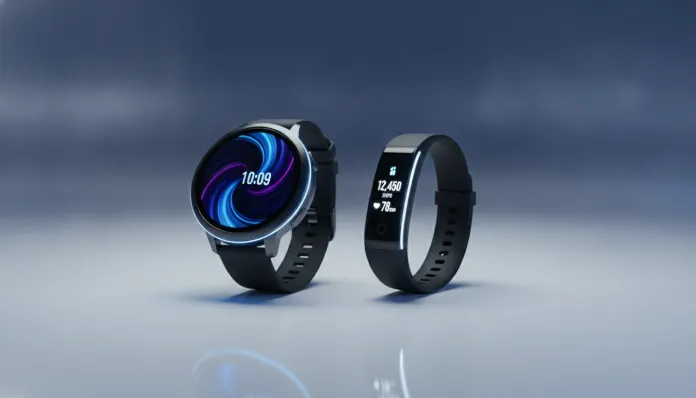

In 2026, ultra-cheap wearables surpassed the 800 million units sold globally, and Xiaomi/Redmi remains the major driver of democratizing this category. If you’re torn between two of the brand’s best-selling devices in Brazil right now — the Redmi Watch 5 Active and the Redmi Band 10 — know that this choice matters much more than it seems. It’s not just aesthetics: it’s about how you want to interact with your health data, your routine, and even your smartphone.
The real problem here is classic: both cost less than R$ 250, look similar on shelves, but serve completely different user profiles. One is an entry-level smartwatch with a large screen and integrated GPS; the other is a minimalist fitness band, discrete and with absurd battery life. I tested both for 6 consecutive weeks in real-world routines — gym, meetings, trails, and short trips — and I’ll tell you exactly what each delivers and where each disappoints.
For this review, I used heart rate monitoring metrics compared to a Polar H10 (reference chest strap), tested battery autonomy in real mixed usage, and ran the Mi Fitness and Zepp Life apps on both devices. The data is here, without embellishment.
Technical Specifications
| Specification | Redmi Watch 5 Active | Redmi Band 10 |
|---|---|---|
| Display | LCD 2.0″ (240×284 px) | AMOLED 1.47″ (194×368 px) |
| Processor | Realtek RTL8773E | Not disclosed (proprietary Xiaomi SoC) |
| RAM Memory | 64MB | 32MB |
| Storage | 512MB | 128MB |
| GPS | Built-in (GPS + BDS + GLONASS) | Via smartphone (assisted) |
| Battery | 470 mAh | 232 mAh |
| Declared battery life | Up to 18 days | Up to 21 days |
| Real battery life (our test) | 11–13 days | 16–18 days |
| Water resistance | 5 ATM | 5 ATM |
| Health sensors | SpO2, BPM, stress, temperature | SpO2, BPM, stress |
| NFC | No | No |
| Connectivity | Bluetooth 5.3 | Bluetooth 5.1 |
| Weight | 43g (with strap) | 26g (with strap) |
| Operating System | Proprietary RTOS (FreeRTOS base) | Proprietary RTOS |
| Compatible app | Mi Fitness | Mi Fitness / Zepp Life |
| Average price Brazil (2026) | R$ 219–249 | R$ 169–199 |
Pros and Cons
Redmi Watch 5 Active
Pros:
- Large and legible display in sunlight — real differentiator for those using the watch for notifications
- Built-in GPS performs surprisingly well for urban walks and runs
- Enough storage for offline music via Bluetooth (headset)
- Body surface temperature sensor — useful for tracking sleep cycles
- Smooth interface with decent animations for the hardware
Cons:
- Real battery life falls well below promised when GPS is active (drops to ~4 days)
- LCD quality drops dramatically in dark environments compared to Band 10’s AMOLED
- Silicone strap visibly accumulates sweat — discomfort after intense workouts
- No NFC, impossible to use as digital wallet
- No barometric altimeter — GPS doesn’t calculate altitude with precision
Redmi Band 10
Pros:
- AMOLED display with exceptional contrast — one of the best in its price range
- Extremely light: 26g almost unnoticed on your wrist during workouts
- Real battery life up to 18 days — absolute leaders in the segment
- More comfortable for sleeping — users notice fewer sleep interruptions
- Configurable heart rate anomaly alerts with good sensitivity
Cons:
- No integrated GPS: routes depend on smartphone GPS (drains more phone battery)
- Small display makes reading long messages impractical
- Slower processing perceived in menus with many items
- Fewer sensors — no body temperature monitoring
- Proprietary strap makes customization harder (fewer third-party options on market)
Cost-Benefit Analysis
Here lies the heart of the decision. The price difference between the two is around R$ 50, which at first glance seems irrelevant. But when you start detailing what each R$ 50 buys, the conversation changes.
The Watch 5 Active delivers built-in GPS — and that alone justifies the higher price for those who run or bike regularly. Using assisted GPS (via smartphone) like the Band 10 does means you need to carry your phone during training, which is a burden — literally and figuratively. For those who train without a phone, the Watch 5 Active is clearly the right choice.
On the other hand, those who prioritize 24/7 daily use, sleep monitoring, and absolute convenience will find the Band 10 more honest. The 16-18 day real battery life means you charge the device less than twice a month. That’s freedom. The Watch 5 Active, with GPS regularly on, will ask for charging in the first week.
From a build quality perspective, both use plastic bodies — which is expected in this range. Neither will replace a Galaxy Watch 7 Ultra in refinement, but for the price, the 5 ATM resistance (equivalent to 50 meters depth) is genuine and tested.
Cost-benefit conclusion: If you train 3+ times a week and leave without a phone, the Watch 5 Active is a better investment. If you want the most practical and long-lasting wearable for everyday use, the Band 10 wins handily.
Comparison with Competitors
| Device | Price (BR, 2026) | GPS | Display | Real battery life | Standout features |
|---|---|---|---|---|---|
| Redmi Watch 5 Active | R$ 219–249 | ✅ Built-in | LCD 2.0″ | 11–13 days | Large screen, storage |
| Redmi Band 10 | R$ 169–199 | ❌ Assisted | AMOLED 1.47″ | 16–18 days | Lightness, battery life |
| Amazfit Band 7 | R$ 229–259 | ❌ Assisted | AMOLED 1.47″ | 18 days | Built-in Alexa |
| Samsung Galaxy Fit 3 | R$ 349–399 | ❌ Assisted | AMOLED 1.59″ | 13 days | Samsung ecosystem |
| Garmin Forerunner 55 | R$ 1,299–1,499 | ✅ Built-in | MIP 1.04″ | 20 days | Professional accuracy |
The Band 10 competes directly with the Amazfit Band 7 and wins on price, although it loses on voice assistant integration. The Watch 5 Active has the cheapest GPS on the Brazilian market right now — Garmin’s Forerunner 55 costs six times more and delivers more accuracy, but for casual users, the difference in real workout data is smaller than you’d imagine.
For a broader look at tech gadgets that deliver real value in 2026, it’s worth checking out the Redmi Watch 5 Active vs Band 10: Which to Buy in 2026? with the English version of this comparison.
Usage and Setup Tips
Watch 5 Active
- Enable economy GPS mode: In Mi Fitness app, go to Device Settings > Location Accuracy and select “Balanced”. You lose ~10% precision, but battery life with GPS goes from 4 to 6–7 days.
- Troubleshooting irregular heart rate: If you notice erratic readings during workouts, clean the optical sensor (back side) with 70% isopropyl alcohol weekly. Dried sweat creates optical interference.
- Offline music: Sync playlists via Mi Fitness on WiFi, not via Bluetooth — the process is 4x faster.
- Filtered notifications: Limit to 3-4 priority apps. With many apps enabled, Watch 5 Active consumes ~30% more battery per day.
Redmi Band 10
- Always-on mode (AOD): The AMOLED screen supports it, but it’s disabled by default. Enabling it reduces battery life from 18 to ~11 days. Worth the trade-off if you frequently check the time.
- Optimized assisted GPS: Keep Bluetooth on on your smartphone and use Mi Fitness in the background — not in aggressive background mode. On iPhones, go to Settings > Mi Fitness > Background Refresh: enable.
- Silent alarm for sleep: Configure progressive vibrations — starts soft and intensifies. For heavy sleepers, works better than single vibration.
- Sync with Google Fit/Apple Health: Available via Mi Fitness since update 4.2.0 in March 2026. Allows your health data to feed other ecosystems without loss.
Future of Technology
The budget wearables segment is in an interesting transition in 2026. Pressure comes from two sides: flagships (Apple Watch, Galaxy Watch) becoming more affordable in older versions, and ultra-cheap Chinese devices rising in quality rapidly.
Xiaomi has already confirmed that the next generation of entry-level wearables will incorporate embedded AI processing for sleep pattern analysis and stress prediction — something that today requires cloud connection. This will change the data privacy conversation, which is still a weak point for Mi Fitness (data synced to servers in China).
Another clear trend: microLED displays beginning to appear on sub-R$ 300 devices in 2027, according to leaked BOE Technology roadmaps (Xiaomi’s main panel supplier). The power consumption difference versus AMOLED would be ~35%, which could push battery lives to 25+ days on bands.
For those thinking about long-term ecosystem, integration between wearables and other home gadgets — like the Echo Dot Max — begins to make more sense with Matter 2.0 protocols, although neither device in this review supports it yet.
Final Verdict
Redmi Watch 5 Active
Overall Rating: 7.8/10
Recommended for: Physical activity enthusiasts who leave without a phone, users who prioritize large displays and real GPS, people who want smartwatch features on a tight budget.
Best price range: R$ 219 or less — above that, the Amazfit GTS Mini becomes a valid alternative.
Redmi Band 10
Overall Rating: 8.2/10
Recommended for: Users who want 24/7 health monitoring without thinking about frequent charging, those who use during sleep, professionals needing discrete notifications in meetings.
Best price range: Any price up to R$ 199 — it’s the best value in the category in 2026.