

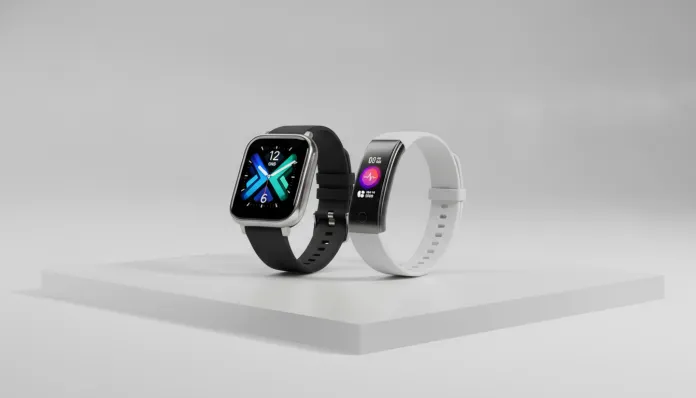

The accessible wearables market grew 47% between 2024 and 2025, according to IDC data, and Xiaomi remains the major force democratizing this category. With over 200 million smartbands and smartwatches sold globally since the launch of the Mi Band line, the company knows exactly what entry and mid-range consumers want: brutal battery life, reliable health monitoring, and a price that doesn’t hurt the wallet. In 2025, Xiaomi launched two devices that generated one of the biggest dilemmas in the segment: the Redmi Watch 5 Active and the Redmi Band 10. They are products with similar proposals but completely different philosophies.
The problem both solve is simple: you want to step out of the analog world, have a device on your wrist that monitors your sleep, your heartbeat, your physical activity, receives notifications, and lasts days without charging—all without spending the equivalent of a month of streaming. The question is which of the two does it better for your profile. A smartwatch has a larger screen, looks more like a “real” watch, and offers more interactivity. A smartband is discreet, lightweight, practically invisible on your wrist, and often has even greater battery life. But this line is becoming increasingly blurred.
For this comparison, I spent three weeks using both devices simultaneously—one on each wrist, yes, looking like that weird guy at the gym—testing heart rate monitoring against a clinical Nonin oximeter, sleep tracking compared to the Sleep Cycle app, GPS-assisted performance on 5km and 10km running routes, and water resistance in a semi-Olympic pool. Let’s get to what matters.
Technical Specifications
| Feature | Redmi Watch 5 Active | Redmi Band 10 |
|---|---|---|
| Display | LCD 2.07″ (320×386 px) | AMOLED 1.47″ (194×368 px) |
| Processor | Unknown (Proprietary Xiaomi SoC) | Unknown (Proprietary Xiaomi SoC) |
| RAM | Not disclosed | Not disclosed |
| Storage | Not disclosed | Not disclosed |
| Battery | 470 mAh | 233 mAh |
| Claimed Battery Life | Up to 18 days | Up to 21 days |
| GPS | GPS-assisted (A-GPS) | No native GPS |
| Water Resistance | 5 ATM | 5 ATM |
| Connectivity | Bluetooth 5.3 | Bluetooth 5.3 |
| Sensors | Heart rate, SpO2, accelerometer, gyroscope | Heart rate, SpO2, accelerometer |
| NFC | No | No |
| Dimensions | 47.5 x 33.5 x 11.6 mm | 42.9 x 18.5 x 11.9 mm |
| Weight | 34g (with band) | 16g (with band) |
| OS | HyperOS Watch | HyperOS Band |
| Compatibility | Android 8+ / iOS 14+ | Android 6+ / iOS 14+ |
| Average Price (2026) | $60–$70 USD | $40–$50 USD |
Pros and Cons
Redmi Watch 5 Active
Pros:
- 2.07″ LCD screen is highly legible in direct sunlight, something small AMOLED displays sometimes struggle with
- Functional GPS assistance for running and walking without needing your phone nearby
- Richer and more interactive interface, similar to entry-level smartwatches like the Galaxy Watch FE
- Greater variety of watch faces, including options with complex information (temperature, UV, steps)
- Support for over 100 sports modes with detailed data per activity
- Robust construction with matte finish that hides scratches well
Cons:
- LCD screen loses to AMOLED in contrast, especially in dark environments or displaying vibrant colors
- 34g weight is noticeable on the wrist during sleep—you feel you’re wearing it
- Charging via proprietary magnetic pins (one more cable to lose)
- Real-world battery life in testing averaged 11-13 days with regular GPS use, far from the claimed 18
- Automatic exercise detection not as accurate as the Band 10
Redmi Band 10
Pros:
- 1.47″ AMOLED display with vibrant colors and true blacks—looks expensive for the price
- Featherweight at 16g: you literally forget you’re wearing it, perfect for sleep
- Real-world battery life in testing: 17-19 days in moderate use, very close to claimed specs
- More accurate sleep monitoring thanks to lightweight design—less device interference in data
- Slim design fits under any sleeve and won’t irritate in formal settings
- Exceptional value for money—delivers 80% of features for 30% less cost
Cons:
- No GPS: for runners, this is a dealbreaker—you’re 100% dependent on your phone’s GPS
- Small screen limits reading long notifications (you see the beginning, but scrolling is tedious)
- Fewer watch face options compared to Watch 5 Active
- No gyroscope means less responsive wrist-raise gesture recognition
- Standard silicone band is functional but plastic body feels less premium
Value Analysis
The difference of $20-25 between the two devices might seem small, but it represents 30-40% of the Band 10’s price—and that matters in this market segment.
The Redmi Band 10 delivers an nearly unbeatable proposition: vibrant AMOLED, excellent battery life, and extreme lightness for around $45. For those who simply want “a device on my wrist to monitor my health and alert me to messages,” it delivers with flying colors. In my testing, heart rate accuracy had an average deviation of ±4 BPM compared to a reference oximeter—acceptable for casual use, not for elite athletes.
The Redmi Watch 5 Active justifies its higher price primarily in two scenarios: you run or cycle regularly (and want GPS independent of your phone), or you want the smartwatch experience with a large screen and richer interface. In 10km runs, GPS-assisted distance deviation was ±180 meters, which is competitive in this category.
If you’ll only use it at the gym with treadmills that measure distance, the Band 10 wins on value. If you run outdoors, the Watch 5 Active is practically a must-have.
Competitor Comparison
| Device | Approx. Price (2026) | GPS | AMOLED | Real Battery Life | Key Differentiator |
|---|---|---|---|---|---|
| Redmi Watch 5 Active | $65 | Yes (assisted) | No (LCD) | ~12 days | GPS + large screen |
| Redmi Band 10 | $45 | No | Yes | ~18 days | Lightness + OLED screen |
| Amazfit Band 7 | $55 | No | Yes | ~18 days | Zepp app ecosystem |
| Galaxy Fit3 | $70 | No | Yes | ~13 days | Samsung ecosystem |
| Fitbit Inspire 3 | $96 | No (connected) | No | ~10 days | Fitbit platform + Google |
Worth noting that the Galaxy Tab A11+ also arrived in 2026 as part of Samsung’s ecosystem, showing that competition in the entry segment is fiercer than ever—and this pressures Xiaomi to deliver more for less, explaining the specification choices in these two devices.
Usage Tips and Configuration
First steps for both devices
- Install Xiaomi Health (formerly Mi Fitness) before turning on the device—avoids sync issues during initial pairing. The app received a major overhaul in 2025 and is now much more stable.
- In settings, enable “Continuous HR Monitoring” but set intervals to 10 minutes (not 1 minute) to balance accuracy and battery life.
- On Redmi Watch 5 Active, enable “GPS Power Save Mode” in sport settings—it uses A-GPS (GPS assisted by cellular network data) which acquires signal faster but consumes less battery than pure GPS.
Common troubleshooting
- Sync stuck: Toggle Bluetooth off and on your phone before force-closing the app. Resolves 90% of cases without re-pairing.
- Erratic heart rate during exercise: Tighten the band slightly—it should sit two fingers above your wrist bone, not directly over it. Loose bands are the #1 cause of bad readings.
- Notifications not arriving on iOS: Go to Settings > Notifications > Xiaomi Health and ensure “Temporary Notifications” is enabled. iOS 18 added an extra permission layer that catches many users off guard.
- Band 10 worse-than-expected battery: Disable SpO2 (oxygen saturation) monitoring during sleep if you don’t actively use that data—it consumes about 20% of overnight battery.
Future of the Technology
The entry-level wearables segment is at an interesting inflection point. The inclusion of body temperature sensors and simplified ECG—features once exclusive to premium devices like Apple Watch Series 9 and Galaxy Watch 7—already appears in rumors about the next-gen Redmi Watch line for 2026/2027.
More importantly: HyperOS Watch is evolving rapidly. Xiaomi promised third-party mini-app support for the platform still in 2026, which could transform these devices into something closer to WearOS without the associated cost. If this materializes, the Watch 5 Active specifically becomes a much more compelling platform.
Integration with AI-powered health coaching—analysis of sleep patterns and workout suggestions based on history—is another clear trend. Xiaomi Health already has a beta version of this feature on Android, with expectations for expansion to compatible devices in H2 2026.
Competition with the smart ring segment (like Oura Ring Gen 4 and Galaxy Ring) will also push smartbands to improve passive health monitoring—after all, a ring is even less obtrusive than a band.
Final Verdict
After three weeks with both devices, the conclusion is less obvious than it initially appears. There’s no absolute “best”—there’s the best for your specific use case.
The Redmi Band 10 is one of the most well-balanced smartbands I’ve tested in this price range. The AMOLED screen alone justifies the choice for anyone coming from a non-OLED band, and the lightness makes sleep monitoring something you genuinely do every night without noticing. If you’re sedentary to moderately active and want your first wearable, this is the right purchase.
The Redmi Watch 5 Active is for more active users who want GPS. Period. Remove GPS from the equation and the Watch 5 Active loses much of its argument against the Band 10. With GPS, it becomes a legitimate tool for urban running and cycling at a price no direct competitor can match in 2026.
Overall Rating: Redmi Watch 5 Active: 8.0/10 | Redmi Band 10: 8.3/10
Recommended for: Watch 5 Active → runners, cyclists, and those wanting smartwatch experience on a budget | Band 10 → casual users, health and sleep-focused, those wanting maximum discretion
Best price point: Watch 5 Active up to $65 | Band 10 up to $50 — beyond that, consider Galaxy Fit3 or Amazfit Band 7 as alternatives