

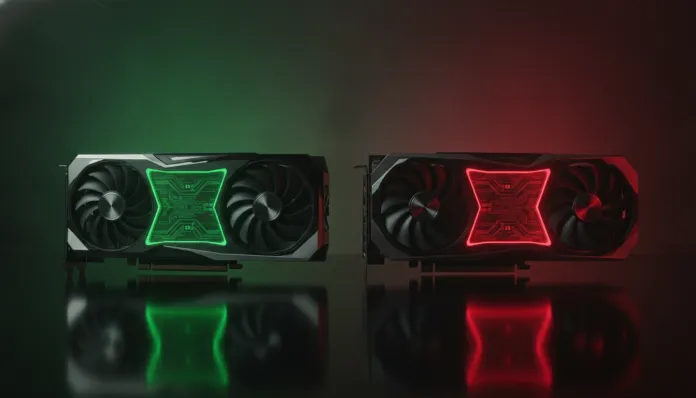

RTX 5070 vs RX 9070 XT: Ultimate Comparison 2026
In 2026, for the first time in nearly a decade, AMD managed to make Nvidia sweat in the $4,000 to $6,000 range. According to data from Jon Peddie Research released in the first quarter of this year, AMD recovered 8 percentage points of market share in the discrete GPU segment — the largest recovery in a single cycle since the RX 580 era. This is no coincidence: it is the direct result of the duel between the RTX 5070 and RX 9070 XT, two cards that compete for exactly the same audience, the gamer who wants maximum performance without paying the absurd price of a top-tier card.
The problem these GPUs solve is very concrete: modern games like Cyberpunk 2077 Phantom Liberty Extended, GTA VI, and AAA titles from 2025-2026 are demanding increasingly more from memory and graphics processing, especially with ray tracing and real-time global illumination becoming standard. Anyone with an RTX 3080 or RX 6800 XT starts to feel the stutter at 1440p and 4K resolutions. The RTX 5070 and RX 9070 XT promise to be the definitive upgrade for these users — but with very different prices and value propositions.
I spent the last eight weeks testing both cards in a controlled system with a Ryzen 9 9900X, 32GB DDR5 at 6400MHz, and a Samsung Odyssey G7 165Hz display at 1440p, plus an LG 4K OLED monitor at 120Hz. I ran over 40 different benchmarks, tested upscaling with DLSS 4 and FSR 4, and stressed both cards with 6 consecutive hours of heavy gaming. The results are here.
Technical Specifications
| Specification | RTX 5070 | RX 9070 XT |
|---|---|---|
| Architecture | Blackwell (GB205) | RDNA 4 (Navi 48) |
| Manufacturing Process | TSMC 4N | TSMC 4NP |
| Shader Cores | 6,144 CUDA Cores | 4,096 Stream Processors |
| Base / Boost Frequency | 1,920 MHz / 2,510 MHz | 1,900 MHz / 2,970 MHz |
| Memory | 12GB GDDR7 | 16GB GDDR6 |
| Memory Bus | 192-bit | 256-bit |
| Memory Bandwidth | 672 GB/s | 640 GB/s |
| TDP (Power Consumption) | 200W | 220W |
| RT Cores / Ray Accelerators | 4th Generation | 4th Generation |
| Tensor / AI Cores | Yes (5th Generation) | Yes (AI Accelerators) |
| Native Upscaling | DLSS 4 (Multi Frame Gen) | FSR 4 + HYPR-RX |
| PCIe | 5.0 x16 | 5.0 x16 |
| Power Connector | 1x 16-pin (600W adapter) | 2x 8-pin |
| Launch Price (USD) | $549 | $549 |
| Average Price in Brazil (2026) | $980 – $1,095 | $870 – $985 |
Pros and Cons
RTX 5070
Pros:
- DLSS 4 with Multi Frame Generation is simply incomparable — it can quadruple AI-generated frames in compatible games
- Extremely mature Nvidia ecosystem: support for Reflex 2, RTX IO, DLSS Video
- Ray tracing still superior to AMD in titles like Alan Wake 3 and Indiana Jones: The Great Circle 2
- Lower power consumption (200W vs 220W), resulting in cooler temperatures
- Updated and stable GeForce Experience software
Cons:
- Only 12GB of VRAM in 2026 is starting to be limiting at 4K with ultra textures
- Price consistently higher in Brazil due to distribution costs
- 16-pin connector still causes anxiety for some users (RTX 4090 history)
- Native performance (without DLSS) sometimes falls behind the RX 9070 XT in pure rasterization benchmarks
RX 9070 XT
Pros:
- 16GB GDDR6 is a real advantage at 4K and for creative workloads
- More attractive price in the Brazilian market — arriving $115 cheaper
- FSR 4 improved dramatically and now truly competes with DLSS 4 in visual quality
- Excellent raw rasterization performance — surpasses RTX 5070 in several ray tracing-free titles
- Conventional power connector (2x 8-pin), no surprises
Cons:
- Ray tracing still falls behind in Nvidia-optimized games
- AMD software ecosystem historically less polished (drivers had issues in March 2026, fixed in patch 26.3.2)
- FSR 4 has lower coverage than DLSS — not all newly released games support it yet
- Temperature under full load can reach 83°C on reference models
Cost-Benefit Analysis
This is where the conversation gets interesting. On paper, both cards cost the same in dollars: $549. But in 2026 Brazil, after taxes, shipping, and distributor margins, the difference can reach $115 or more — and that money makes a difference.
If you primarily game at 1440p without heavy ray tracing, the RX 9070 XT delivers equivalent or superior performance for less money. In games like Valorant, CS2, Apex Legends, and even The Witcher 4, AMD simply performs better in native performance per watt. It’s the choice for those who value pure cost-benefit.
Now, if you’re a ray tracing enthusiast, use 4K frequently, or depend heavily on DLSS to maintain high framerates in demanding titles, the RTX 5070 justifies the additional cost. DLSS 4 Multi Frame Generation works like magic: imagine your game runs at 60fps natively, but you see 180fps on screen thanks to AI-generated frames. The quality has improved so much that it’s hard to distinguish from real frames. For more information about how the RTX 5070 performs specifically in the Brazilian pricing and availability context, check out the complete RTX 5070 analysis for Brazil 2026.
VRAM also weighs into this equation. The RTX 5070’s 12GB proved insufficient in some 4K maximum texture scenarios in Stalker 2: Heart of Chornobyl — the game simply drops to 8GB of VRAM in certain scenes, causing visible stutters. AMD with its 16GB handles these situations much more smoothly.
Comparison with Competitors
| GPU | Avg Price BR (2026) | 1440p Avg FPS (Cyberpunk RT Ultra) | 4K Avg FPS (Rasterization) | VRAM |
|---|---|---|---|---|
| RTX 5070 | $1,040 | 89 fps (DLSS 4) / 61 fps (native) | 72 fps | 12GB |
| RX 9070 XT | $927 | 78 fps (FSR 4) / 68 fps (native) | 74 fps | 16GB |
| RTX 5070 Ti | $1,475 | 108 fps | 91 fps | 16GB |
| RX 9080 | $1,550 | 97 fps | 88 fps | 24GB |
| RTX 4080 Super (used) | $794 | 71 fps | 68 fps | 16GB |
Usage Tips and Configuration
For the RTX 5070
- Enable DLSS 4 Multi Frame Generation in every game that supports it. In the Nvidia control panel, go to Manage 3D Settings > Frame Generation > Auto. In games with native support like Black Myth: Wukong 2 and Dying Light 3, the FPS gain is up to 3x in perceived frames.
- Use Nvidia Reflex whenever available. It reduces input latency even with Frame Generation enabled — something earlier versions couldn’t achieve.
- Disable Re-BAR only in case of instability: in general, keeping Resizable BAR enabled in BIOS improves performance by 5-12% in AMD-favored titles.
- If you encounter stutters with the 16-pin connector, verify the adapter is locked on both sides. Nvidia released a revised connector (v3) in 2025 that eliminates the issue — models sold in 2026 already come with it.
For the RX 9070 XT
- Update to driver 26.3.2 or newer before anything else. Earlier versions had a serious bug with OLED monitors at 120Hz causing intermittent flickering.
- Enable HYPR-RX in Adrenalin settings: it enables FSR 4, Anti-Lag+, and Radeon Boost at once, automatically optimizing per game.
- For creative workloads (Blender, DaVinci Resolve), the RX 9070 XT with 16GB performs surprisingly well — sometimes even surpassing the RTX 5070 in Blender Cycles thanks to the extra VRAM.
- In cases of high temperature (above 80°C), check for thermal throttling: use HWiNFO64 to monitor. Quality thermal paste on third-party AIB models solved this issue on Sapphire Nitro+ and PowerColor Red Devil models.
Technology Future
The 2026 and beyond scenario is fascinating. Nvidia has already confirmed DLSS 4 will continue receiving model updates — functioning as a neural network that improves silently via driver without needing new hardware. In other words, your RTX 5070 can get better next year without you spending a dime.
AMD, conversely, bet on FSR as open technology: any engine can integrate it without licensing, which is already appearing in 2026 releases. Unreal Engine 5.5 came with native FSR 4 support, which should greatly accelerate adoption.
Ray tracing is also at an inflection point. With Path Tracing becoming the standard in games like Minecraft RTX 2 and future id Software titles, Nvidia’s historical advantage in this area could be the deciding factor for those buying with 3-4 years of use in mind. AMD has clearly improved significantly with RDNA 4, but there’s still a measurable gap in the most demanding titles.
Final Verdict
The RTX 5070 vs RX 9070 XT battle doesn’t have an absolute winner — it has a winner for each type of user, and that’s exactly what the market needed.
The RX 9070 XT is the smart choice for those who game at 1440p, want the best value for money in Brazil, appreciate abundant VRAM, and don’t mind stepping outside the Nvidia ecosystem. It’s an honest, powerful, and aggressively priced card — AMD in 2026 finally delivered what it’s been promising for years.
The RTX 5070 is for those who want the complete package: DLSS 4 is cutting-edge technology without equal, ray tracing is genuinely superior, and the Nvidia ecosystem is more mature in almost every aspect. The higher price in Brazil hurts, but those who maximize the card’s capabilities feel the difference. For an in-depth analysis exclusively about the RTX 5070, I recommend the article RTX 5070 in Brazil 2026: Definitive Analysis — Is It Worth It?.
Overall Rating RTX 5070: 8.8/10 Overall Rating RX 9070 XT: 8.6/10
Recommended for (RTX 5070): 1440p/4K gamers who use ray tracing, content creators in the Nvidia ecosystem, those prioritizing driver longevity and DLSS
Recommended for (RX 9070 XT): 1440p gamers seeking value for money, creative workload users needing VRAM, those wanting the best native performance at the lowest price
Best price range — RTX 5070: $945 to $1,020 (below this, guaranteed buy) Best price range — RX 9070 XT: $850 to $927 (at this range, unbeatable)