

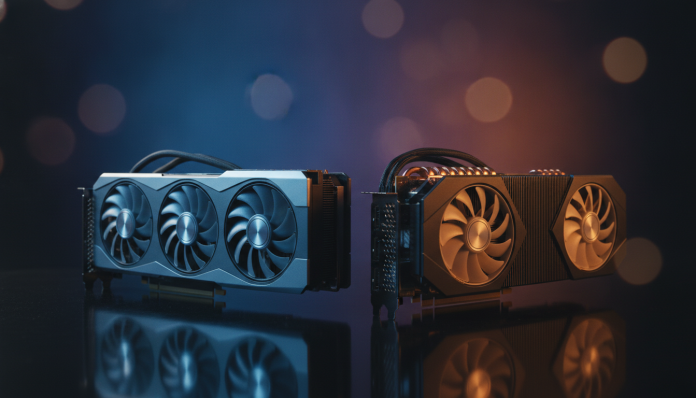

RTX 5070 vs RX 9070 XT: which graphics card is worth your money in 2026
The question on many people’s minds right now is exactly this: Nvidia RTX 5070 or AMD RX 9070 XT? Both graphics cards target the same audience, arrived on the market with similar value propositions, and on paper compete evenly in most scenarios. The short answer is that it depends on what you do with your PC, but that short answer deserves an honest explanation.
The RTX 5070 is part of Nvidia’s Blackwell line, the same generation that brought the RTX 5090 and 5080. The RX 9070 XT represents AMD’s RDNA 4 architecture, the company’s bid to reclaim space in the high-performance segment. Both cards were launched in the first quarter of 2025 in the United States and arrived in Brazil throughout 2025 and early 2026, with prices varying significantly depending on the partner manufacturer (ASUS, MSI, Gigabyte, PowerColor, Sapphire, among others) and the store where you shop.
This comparison won’t invent benchmark numbers or claim we ran the cards in a lab. What you’ll find here are official specifications, publicly released information from manufacturers, and practical criteria to help you decide. Let’s go.
Comparative Specifications
| Specification | RTX 5070 | RX 9070 XT |
|---|---|---|
| Architecture | Blackwell (GB205) | RDNA 4 (Navi 48) |
| Manufacturing Process | TSMC 4N | TSMC 4N |
| Shader Processors / CUDA | 6,144 CUDA Cores | 4,096 Stream Processors |
| Memory | 12 GB GDDR7 | 16 GB GDDR6 |
| Memory Bus | 192 bits | 256 bits |
| Memory Speed | 28 Gbps | 20 Gbps |
| TDP (Power Consumption) | ~150 W | ~304 W |
| Ray Tracing | Yes (dedicated hardware) | Yes (dedicated hardware, improved generation) |
| Native Upscaling | DLSS 4 (Multi Frame Generation) | FSR 4 |
| Launch Price (USA) | US$ 549 | US$ 549 |
| Price Range in Brazil (2026) | R$ 4,500 to R$ 6,500 | R$ 3,800 to R$ 5,500 |
Prices subject to variation according to store, exchange rate and availability. Always check national stores before buying.
Gaming Performance: Where Each Stands Out
The most important metric for most buyers is simple: how many frames per second can you get at 1440p and 4K. Without going into specific benchmark numbers (which vary greatly depending on the game, driver, and system configuration), the technical specs and information released by manufacturers point to a fairly balanced scenario in rasterization, which is the traditional method for rendering 3D graphics without physical light simulation.
The RX 9070 XT has a clear advantage in memory bus width (256 bits versus 192 bits on the RTX 5070) and 16 GB of VRAM, which is especially relevant in games that use heavy textures at 4K. Nvidia compensates with faster GDDR7 memory and remarkable energy efficiency: the ~150 W TDP is impressive for the level of performance offered. For those building a compact PC (ITX or micro-ATX), the RTX 5070 is much easier to cool and accommodates smaller builds.
In ray tracing (a technique that simulates the physical behavior of light in real-time, generating more realistic reflections and shadows), Nvidia has historically held an advantage, and the Blackwell architecture maintains that tradition. AMD has significantly improved ray tracing in RDNA 4 compared to the previous generation, but according to public information released by AMD itself and analysis from international tech press, Nvidia still leads in this specific area.
DLSS 4 vs FSR 4: The Intelligent Upscaling Battle
Upscaling is a technology that renders the game at a lower resolution and then reconstructs the image to the final resolution using algorithms, saving processing power without sacrificing (much) visual quality. Think of it as a camera that takes a photo at lower resolution and then uses AI to enlarge it with artificially created details.
DLSS 4 from Nvidia introduced Multi Frame Generation, which is capable of generating multiple intermediate frames for each real rendered frame. On paper, this significantly multiplies perceived performance in compatible games. The limitation is that support depends on specific implementation in each game, and although the list of compatible titles has grown significantly since launch, it’s not universal.
FSR 4 (FidelityFX Super Resolution 4) from AMD is based on machine learning like DLSS, and unlike previous versions, requires RDNA 4 hardware to function in its most advanced version. A historical advantage of FSR is being compatible with practically any card from any manufacturer, which doesn’t apply to the full FSR 4. For games with DLSS 4 Multi Frame Generation support, Nvidia pulls ahead in frames per second on screen. For titles without support for either or with support only for older FSR, the field levels out.
Memory and Your Setup’s Future
Sixteen gigabytes of VRAM is a serious argument in the RX 9070 XT’s favor. In 2026, 4K games with ultra-quality textures are already starting to pressure 12 GB in some titles. Nvidia made a different choice by prioritizing GDDR7 memory speed and overall chip efficiency, but those planning to use the card for four or five years might feel the difference over time.
For those using the PC also for content creation, such as video editing in DaVinci Resolve or work in 3D modeling software, VRAM amount matters quite a bit. Nvidia’s software ecosystem (CUDA, which is a parallel computing platform widely used by professional applications, and NVENC, the company’s dedicated video encoder) still has superior support in many creation programs. If you professionally edit video or use applications like Adobe Premiere, the RTX 5070 may have a practical advantage even with less VRAM.
Brazilian Context: Availability, Warranty, and Importing
Buying a graphics card in Brazil requires attention to some points that don’t appear in benchmarks. First, Anatel certification (National Telecommunications Agency) is mandatory for electronic equipment legally sold in the country. Cards sold by parallel importers may not have this seal and, in case of problems, you’re left without local warranty.
Manufacturers like ASUS, MSI, Gigabyte, Sapphire, and PowerColor have official distributors in Brazil and offer two or three-year warranties depending on the product. Brazilian legal warranty (Consumer Protection Code) guarantees 90 days for durable goods purchased through national retail, but manufacturer warranty contracts typically extend beyond that in most cases. Always verify which national distributor is responsible for the product before buying.
Regarding availability: throughout 2025 and early 2026, both cards went through periods of limited stock, especially reference models. Partner models (AIB, as the industry calls customized card manufacturers) are easier to find. The RX 9070 XT has arrived at Brazilian stores with a more accessible initial price than the RTX 5070, which represents a real difference in the consumer’s wallet, even though values fluctuate with exchange rates.
For those building a complete PC and thinking about total system cost, the RTX 5070’s energy efficiency could mean a smaller and cheaper power supply, plus less heat generated in the case. This is a real long-term cost that many comparisons ignore.
Frequently Asked Questions About RTX 5070 and RX 9070 XT
Is the RX 9070 XT better than the RTX 5070 because it has more VRAM?
It depends on the usage. In games with heavy textures at 4K, AMD’s 16 GB can make a difference as titles become more demanding. For 1440p everyday use and DLSS 4 usage, Nvidia’s 12 GB will hardly limit you now. The reader thinking of using the card for more than four years should consider more VRAM as a factor in AMD’s favor.
Does DLSS 4 Multi Frame Generation make up for everything?
No. Multi Frame Generation generates frames artificially between real frames, which increases frames per second on screen but can introduce perceived latency in very fast-paced competitive games. For slow-paced single-player action games and RPGs, the technology works very well. Competitive shooter players in tournaments should evaluate carefully.
Is it worth importing one of the two to save money?
Generally, no. Besides the risk of having no local warranty and possible lack of Anatel certification, importing on your own has freight costs, import taxes, and the risk of the product being held at customs. The price difference rarely compensates when all these factors are added together.
Which one consumes less energy?
The RTX 5070 has a considerably lower design TDP, according to Nvidia’s official specifications. This is relevant both for choosing a power supply and for heat generated inside the case. Those building compact systems or wanting to save on electricity bills long-term have a concrete argument in Nvidia’s favor here.
Which to Choose: Recommendation by Profile
If you’re a gamer who wants maximum performance at 1440p or 4K with DLSS 4 enabled in games that support the technology, and you’re building a compact PC or concerned about power consumption, the RTX 5070 is the most balanced choice. Nvidia’s software ecosystem also benefits content creators using applications with CUDA support.
If you prioritize more memory for setup longevity, prefer spending less on the card itself (since the RX 9070 XT has arrived cheaper at Brazilian stores), or simply don’t depend on DLSS, the RX 9070 XT delivers very competitive value for money. The improvement in ray tracing on RDNA 4 also makes AMD a more viable option than it was in the previous generation for those who like this type of visual effect.
Speaking of value for money in technology, those interested in exploring AI tools alongside a new PC might be interested in a practical guide to free alternatives to Midjourney in Portuguese, which shows how to generate images with AI for free using the hardware you already have.
For most Brazilian buyers in 2026, the recommendation is clear: if the price of both is close at the store, see if you use content creation with CUDA support. If you do, get the RTX 5070. If you don’t, get whichever is cheaper, because both deliver an excellent gaming experience.
Recommended for 1440p gamers and content creators: RTX 5070 Recommended for value for money and 4K longevity: RX 9070 XT
Price range in Brazil: RTX 5070 between R$ 4,500 and R$ 6,500 / RX 9070 XT between R$ 3,800 and R$ 5,500 (approximate values, subject to exchange rate and stock variation)