

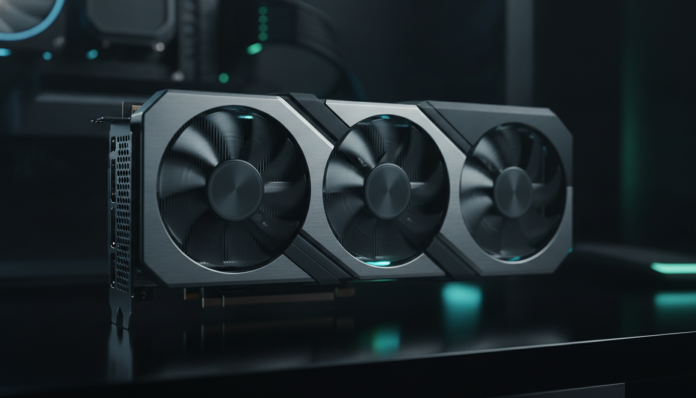

RTX 5070: what you need to know before buying in 2026
The GeForce RTX 5070 arrived as NVIDIA’s bet for those who want high-level performance without paying the absurd price of Ti lines and top-tier cards. Launched in early 2025, it represents the Blackwell generation for the segment the company calls “accessible enthusiast”—that sweet spot where serious gamers start looking with real attention. But we’re in 2026 now, and the question that matters is different: after more than a year on the market, with prices settling (or not), does it still make sense to buy this card?
The short answer is: it depends on your monitor and your ambitions. For those gaming at 1440p (2,560 x 1,440 pixels—the ideal point between image quality and hardware demands) who want to push past 100 fps in heavy 2025 and 2026 titles, the RTX 5070 delivers. Anyone who already owns an RTX 4080 or similar will probably find the jump too small to justify the swap. But anyone still running an RTX 3070 or any card from before the Ada Lovelace generation will feel a concrete difference.
This article organizes publicly available information about the RTX 5070, covers what weighs on the purchase decision, and brings the Brazilian context that international reviews ignore: real price in Brazilian reais, availability, imports, and alternatives sold here.
RTX 5070 Specifications
| Specification | Data |
|---|---|
| GPU | GB205 (Blackwell architecture) |
| CUDA Cores | 6,144 |
| Tensor Cores | 4th Generation (Gen 4) |
| RT Cores | 4th Generation |
| VRAM | 12 GB GDDR7 |
| Memory Bus | 192 bits |
| Memory Bandwidth | Approximately 672 GB/s (check manufacturer specs) |
| TDP (Design Power) | 250 W |
| Power Connector | 1x 16-pin (PCIe 5.0) |
| DLSS Support | DLSS 4 with Multi Frame Generation |
| Launch Price (USA) | US$ 549 |
| Average Price in Brazil (2026) | Starting from R$ 4,500 (varies by store and exchange rate) |
Performance: what the specs mean in practice
The Blackwell generation brought two innovations that change how you interpret performance numbers. The first is DLSS 4 with Multi Frame Generation, an AI-powered frame generation technology that, according to NVIDIA, can generate up to three synthetic frames for every natively rendered frame. This means the FPS (frames per second) displayed in compatible games can be much higher than the “real” FPS the GPU calculates. Think of it like slow-motion that creates intermediate frames to smooth movement: the visual result is fluid, but it’s not the same as rendering everything from scratch.
This distinction matters because benchmark numbers you’ll see on specialized sites like Digital Foundry, Hardware Unboxed, and Tom’s Hardware will show two scenarios: with and without DLSS enabled. Without DLSS, the RTX 5070 performs at a level close to the RTX 4080 at 1440p, according to comparative technical data published by NVIDIA itself and corroborated by specialized press analysis. With DLSS 4 Multi Frame Generation enabled in compatible games, FPS numbers rise significantly, but latency (delay between your action and screen response) also needs monitoring via NVIDIA Reflex, a feature that compensates for some of this delay.
For 4K gaming (3,840 x 2,160 pixels), the RTX 5070 achieves good results in optimized titles with DLSS enabled, but may hit limits in games demanding high VRAM. The 12 GB of memory is adequate for 2026 in most cases, but falls short of the 16 GB the RTX 5070 Ti offers, which can make a difference in some recent releases. If you have a 4K monitor and play heavy AAA titles without DLSS, check game-specific benchmarks before deciding.
VRAM, memory, and why it matters in 2026
VRAM is the exclusive memory of the graphics card, used to store textures, geometry, and scene data being rendered. It’s like the GPU’s workbench: the larger it is, the more things it can keep in hand without fetching from the SSD or main RAM, which is far slower for this type of operation.
In 2026, games like Alan Wake 2, Cyberpunk 2077 with full path tracing, and new releases already consume 10 GB or more of VRAM at ultra settings with high resolution. The RTX 5070’s 12 GB gives reasonable headroom, but it’s not generous. The good news is that the GDDR7 bus is significantly faster than the GDDR6X from the previous generation, meaning the GPU can exchange data with memory at higher speed, partially compensating for capacity differences versus cards with more VRAM but slower memory.
For content creation use, such as 3D rendering, high-resolution video editing, and local generative AI applications, the 12 GB could be a bottleneck depending on the workflow. Anyone using the card for heavy work should evaluate whether the RTX 5070 Ti or professional-line models make more sense.
Power consumption and PC compatibility
The 250 W TDP is well-behaved for the performance level offered. For comparison, the previous-generation RTX 4090 reached 450 W. This means a 750 W power supply is sufficient for a system with the RTX 5070 and a high-performance CPU in most configurations, but checking an online PSU calculator (sites like OuterVision have free tools) is always the safest practice.
The 16-pin connector (PCIe 5.0 standard, which NVIDIA calls 16-pin or 600W connector) requires attention. Older power supplies don’t have this connector natively, and adapters included with some card models have already caused overheating issues in previous generations when poorly seated. If your power supply doesn’t have the native connector, considering an upgrade or verifying certified adapters is prudent.
RTX 5070 in Brazil: price, availability, and imports
Here’s the point that most differentiates the Brazilian experience. The RTX 5070 launched in the USA for US$ 549, but in Brazil the reality is very different. High-performance graphics cards have no local manufacturing, so the final market price reflects exchange rates, import duties, ICMS taxes, and distributor margins. In 2026, models available officially through major retailers like Kabum, Pichau, and Terabyte start at approximately R$ 4,500, reaching R$ 6,000 or more depending on the model (cards with premium coolers from brands like ASUS ROG, MSI Gaming X Trio, and Gigabyte Aorus typically cost more).
Regarding Anatel certification, GPU chipsets themselves don’t require individual certification, but the complete product may have certification variations depending on radio components. Cards without integrated Wi-Fi, which is the case for the vast majority of dedicated GPUs, typically don’t go through this process. Still, buying from recognized national retailers ensures access to 90-day legal warranty for non-durable products and 1-year warranties offered by manufacturers on models with invoices. International mail imports are subject to entry taxation and may have difficulties claiming warranty.
Speaking of value-for-money and comparing with other entertainment categories, if you’re weighing hardware investments for gaming and want a broader picture, the analysis of PS5 Pro worth it in Brazil in 2026? can help contextualize how much the Brazilian market charges for top gaming performance.
Pros and cons
Pros:
- Exceptional performance at 1440p, especially with DLSS 4 enabled
- Controlled power consumption (250 W) for the performance level delivered
- GDDR7 with high bandwidth, improving efficiency even with 12 GB
- Full NVIDIA ecosystem support (DLSS 4, Reflex, Broadcast, RTX IO)
- Available at national stores with invoice and manufacturer warranty
- Multi Frame Generation delivers real gains in compatible games
Cons:
- 12 GB VRAM may be limiting at 4K ultra or professional workloads
- Price in Brazil is significantly higher than USA launch price
- DLSS Multi Frame Generation adds noticeable latency without NVIDIA Reflex
- Small jump for those already owning RTX 4080 or better
- 16-pin connector requires attention with older power supplies
Competitors and alternatives in Brazil
| Card | VRAM | Price Range in Brazil | Strong Point |
|---|---|---|---|
| RTX 5070 (NVIDIA) | 12 GB GDDR7 | Starting from R$ 4,500 | DLSS 4, energy efficiency |
| RTX 5070 Ti (NVIDIA) | 16 GB GDDR7 | Starting from R$ 6,500 (estimate) | More VRAM, comfortable 4K |
| RTX 4070 Super (previous gen) | 12 GB GDDR6X | R$ 3,200 to R$ 4,000 | More accessible price, good availability |
| RX 7800 XT (AMD) | 16 GB GDDR6 | R$ 3,000 to R$ 3,800 | More VRAM per price, open source drivers |
| RX 7900 GRE (AMD) | 16 GB GDDR6 | R$ 3,500 to R$ 4,500 | Strong value-for-money, good at rasterization |
AMD maintains a competitive advantage through higher VRAM per price, which is relevant for those prioritizing 4K gaming or content creation. The disadvantage is the ecosystem: DLSS isn’t available on AMD cards (AMD’s equivalent, FSR, works on any GPU but typically delivers lower quality than DLSS 4).
Frequently asked questions about the RTX 5070
Can the RTX 5070 run games at 4K satisfactorily?
At 1440p, the RTX 5070 is excellent. At 4K, it achieves good results in optimized games with DLSS enabled, but may struggle with very demanding titles at maximum settings without AI assistance. For native 4K without DLSS, the RTX 5070 Ti or higher are more comfortable choices.
Is it worth importing the RTX 5070 from the USA to save money?
The price difference looks attractive in direct conversion, but personal imports over US$ 50 are subject to 20% tax (under the Remessa Conforme program) plus possible IOF and shipping/insurance costs. Warranty can also be complicated to claim abroad. Do the math carefully before finalizing any purchase.
Is the RTX 5070 compatible with any motherboard?
It uses the PCIe 4.0 x16 slot, compatible with the overwhelming majority of motherboards launched in recent years. The PCIe interface is backward compatible: the card works in PCIe 3.0 slots with usually small performance loss in most games. The bigger point of attention is the 16-pin power connector.
Does DLSS 4 make a real difference or is it marketing?
It makes a real difference, especially Multi Frame Generation, but with an important caveat: the FPS gain isn’t equivalent to natively rendering more frames. Latency increases, and competitive games at high refresh rates may be more impacted. For single-player cinematic and open-world games, the smoothness gain is genuinely noticeable.
Is it worth buying the RTX 5070 in 2026?
The RTX 5070 is a solid card, well-positioned technically and with better energy efficiency than previous generations. The problem isn’t the product itself: it’s the price the Brazilian market charges for it.
If you’re stepping up from an RTX 3070, RX 6700 XT, or any card from two or more years ago, and gaming at 1440p, the difference will be concrete and satisfying. If your monitor is 4K and you want maximum performance without relying on DLSS, consider stretching the budget for the 5070 Ti. And if you already own an RTX 4080, honestly, wait for the next generation.
Recommended for: gamers with a 1440p monitor seeking high performance with good energy efficiency, people upgrading from GPUs two or more generations old, and anyone wanting to enter the DLSS 4 ecosystem without paying top-tier card prices.
Price range: starting from R$ 4,500 at national retailers (with invoice and warranty). Launch price in the USA was US$ 549. Prices vary by exchange rate, partner model, and store.