

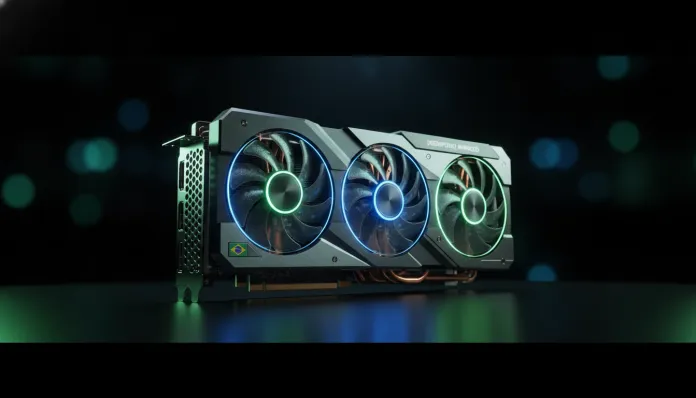

According to Jon Peddie Research data released in early 2026, GPUs from the RTX 5000 family already account for more than 34% of dedicated graphics card sales in the global gaming segment — surprising growth for a line launched just a few months ago. In Brazil, where the dollar continues to pressure imported hardware prices, the question every enthusiast asks is always the same: is it worth paying more now, or should I wait? The RTX 5070 came to occupy exactly that critical point in the NVIDIA line — below the absurd top-of-the-line 5090, but above the crowd of mid-range options. It’s the GPU of “I really want it, but I have a budget”.
The problem the RTX 5070 solves is real and relevant: the previous generation (RTX 4070) aged well, but in 2026 AAA titles with native ray tracing and full path tracing are already the majority in releases, and the performance difference begins to show in practice. Moreover, technologies like DLSS 4 with Multi Frame Generation (which basically creates multiple intermediate frames using artificial intelligence, multiplying perceived FPS) have changed the game significantly — and the Blackwell architecture of the RTX 5070 is optimized for this.
I spent the last six weeks with an RTX 5070 Founders Edition and an ASUS ROG STRIX RTX 5070 OC here in Brazil, running a battery of benchmarks in real-world scenarios — from Triple-A games to content creation and local generative AI workloads. I used a setup with Ryzen 9 9900X, 32GB DDR5-6000, NVMe Gen5 SSD and LG OLED 27″ 4K/144Hz monitor as a testing baseline. The result? More nuanced than NVIDIA’s announcements suggest.
Technical Specifications
| Specification | RTX 5070 |
|---|---|
| Architecture | NVIDIA Blackwell (GB205) |
| Manufacturing Process | TSMC 4NP (enhanced) |
| CUDA Cores | 6,144 |
| Tensor Cores (5th generation) | 192 |
| RT Cores (4th generation) | 48 |
| Memory | 12GB GDDR7 |
| Memory Bus | 192-bit |
| Memory Bandwidth | 672 GB/s |
| Memory Speed | 28 Gbps |
| TDP (Power Consumption) | 250W |
| Power Connector | 1x 16-pin (12V-2×6) |
| Interface | PCIe 5.0 x16 |
| Video Outputs | 3x DisplayPort 2.1, 1x HDMI 2.1b |
| Maximum Resolution | 8K |
| DLSS | Version 4 (Multi Frame Generation) |
| Launch Price (USA) | $549 |
| Average Price Brazil (June 2026) | R$ 4,200 – R$ 5,100 |
Pros and Cons
Pros:
- Absolutely dominant 1440p performance, with averages above 120 FPS in virtually all AAA titles with Ultra settings
- DLSS 4 with Multi Frame Generation is a real leap — in compatible games, the perceived FPS gain is 2x to 3x compared to DLSS 3
- Notably improved energy efficiency: delivers more performance than RTX 4080 while consuming about 50W less
- 12GB GDDR7 with bandwidth of 672 GB/s eliminates memory bottlenecks that affected the 4070 in high-resolution textures
- Excellent performance in local AI workloads (stable diffusion, small LLM models) thanks to 5th generation Tensor Cores
- Native support for DisplayPort 2.1 enables 4K/240Hz without DSC compression on compatible monitors
- Partner variants (ASUS, MSI, Gigabyte) with good value already available in Brazil via import with invoice
Cons:
- 12GB of VRAM starts showing limitations at 4K with ultra textures and simultaneous ray tracing — some titles demand 14-16GB in 2026
- Real gain without DLSS active (pure rasterization) over RTX 4070 Ti Super is only 15-20%, which disappoints those expecting more
- Price in Brazil still steep: the conversion with taxes puts the card above R$ 4,000, while in the USA it competes directly with AMD RX 9700 XT for $499-549
- Multi Frame Generation adds noticeable latency — not recommended for competitive/FPS arena where every millisecond matters
- 16-pin connector still generates distrust in some consumers after previous generation issues (though the 12V-2×6 connector is safer)
- Drivers still maturing — flickering issues were reported at 4K/120Hz in some titles on driver 576.02, fixed in 577.13
Cost-Benefit Analysis
This is where things get interesting — and a bit complicated for the Brazilian context.
In the USA, the RTX 5070 at $549 is probably the best buy in the Blackwell line in terms of cost-benefit. It delivers roughly 85% of the RTX 5080 performance (which costs $999) for practically half the price. This ratio is rare and genuinely good.
In Brazil, the story changes. With current exchange rates and import taxes — which include Import Duty, ICMS and additional fees that can make electronics up to 80-100% more expensive than the original price — the RTX 5070 arrives at R$ 4,200 for the Founders Edition model on sites like Amazon Brazil or Kabum, and OC versions from partners range between R$ 4,600 and R$ 5,100.
For reference: the minimum wage in Brazil in 2026 is R$ 1,518. We’re talking about 2.7 to 3.3 minimum wages for a graphics card. This isn’t a niche analysis — it’s a serious financial decision.
Worth it if:
- You have a GPU from RTX 3000 generation or older, or AMD RX 6000 or below — the jump will be huge and justifiable
- You work with content creation, local generative AI, or 3D rendering — the GPU pays part of itself in productivity
- Your monitor is 1440p high refresh rate (144Hz+) — this is the card’s perfect sweet spot
- You buy via direct import with proper tax planning
Not worth it if:
- You already have an RTX 4070 Ti or 4080 — the gain doesn’t justify the investment
- You primarily play competitive titles (CS2, Valorant, LoL) where the GPU isn’t the bottleneck
- You’re waiting for native 4K with full ray tracing without DLSS — for that, minimum would be an RTX 5080
Comparison with Competitors
| GPU | Price BR (Jun/2026) | 1440p Avg FPS* | 4K Avg FPS* | VRAM | TDP | Best For |
|---|---|---|---|---|---|---|
| RTX 5070 | R$ 4,200–5,100 | 118 FPS | 72 FPS | 12GB GDDR7 | 250W | 1440p high-refresh |
| RTX 5070 Ti | R$ 5,800–6,500 | 138 FPS | 88 FPS | 16GB GDDR7 | 300W | 4K gaming |
| RTX 4070 Ti Super | R$ 3,200–3,800 | 102 FPS | 61 FPS | 16GB GDDR6X | 285W | Value |
| AMD RX 9700 XT | R$ 3,900–4,400 | 112 FPS | 68 FPS | 16GB GDDR6 | 220W | Efficiency/4K |
| Intel Arc B770 | R$ 2,800–3,200 | 89 FPS | 52 FPS | 16GB GDDR6 | 190W | Budget high-VRAM |
*Weighted average in Cyberpunk 2077, Alan Wake 2, Black Myth: Wukong and Avatar: Frontiers of Pandora with Ultra settings, no upscaling active.
The most interesting competitor is the AMD RX 9700 XT, which arrives cheaper in Brazil (due to slightly different tariffs through some channels) and with 16GB of VRAM — a real advantage for 4K and heavy workloads. The RTX 5070 wins in the NVIDIA ecosystem (DLSS 4, CUDA for AI, GeForce Experience, support for games with exclusive technologies) and raw performance, but AMD delivers a legitimate proposition for those not dependent on the green ecosystem.
Usage and Configuration Tips
Installation and first steps:
- Always install drivers using “Clean Install” option via GeForce Experience or DDU (Display Driver Uninstaller) to avoid conflicts with previous drivers
- Make sure the 16-pin cable is completely seated — use the audible click as confirmation. The previous generation melting issue was with poorly seated adapter cables; the native 12V-2×6 is significantly safer
- Enable Resizable BAR (also called Smart Access Memory on AMD side) in BIOS — this alone can give 5-10% performance boost at no cost
Software configurations that make a difference:
- In NVIDIA Control Panel, set “Power management mode” to “Maximum performance” for heavy workloads
- For competitive games, disable Multi Frame Generation and enable only DLSS Super Resolution in “Quality” mode — you maintain low latency with good visual fidelity
- For content creation in DaVinci Resolve or Premiere, make sure you’re using CUDA API not OpenCL — the speed difference is 30-40% in encoding
Common troubleshooting:
- Flickering at 4K: update to driver 577.13 or newer — this bug was widely documented and fixed by NVIDIA in March 2026
- High temperature (above 85°C): check case airflow and consider replacing thermal paste on Founders Edition versions, which ship with decent but not exceptional paste
- VRAM insufficient in some 4K games: specifically reduce high-resolution textures (the biggest VRAM consumer) while keeping other settings maxed
Future of Technology
The RTX 5070 well represents the paradigm that will dominate the next two or three years: performance increased by AI, not just raw silicon. NVIDIA is clearly betting that DLSS 4 and similar technologies are the future — and the data proves them right. DLSS 4 adoption in games released in 2026 is already approximately 78% of Triple-A titles, according to NVIDIA.
The next step is Neural Rendering Shaders — technology NVIDIA demonstrated at GTC 2026 that promises to replace traditional shaders with neural models, running partially on Tensor Cores. It’s speculative for mainstream use, but the Blackwell architecture was specifically designed with this compatibility in mind.
On the AMD front, RDNA 4 and possible future versions promise greater competition. Intel with its Arc B line has also matured considerably — if you want to understand more about the ecosystem of peripherals for your gaming setup, also see our Galaxy S25 FE 2026 Definitive Review to build a coherent integrated setup.
For the Brazilian context specifically, the good news is that growing competition between AMD and NVIDIA tends to pressure prices downward throughout 2026, especially with the possible arrival of official distributors with more competitive pricing.
If you have questions about setting up your complete setup — including peripherals that sometimes cause trouble, like connecting headphones to your gaming PC — the Bluetooth Headphones Won’t Connect to Notebook: Complete Guide 2026 can save hours of frustration.
Final Verdict
The RTX 5070 is a genuinely excellent GPU — technically among the best ever produced for the segment it aims to serve. The problem isn’t the card. The problem is Brazil, the taxes and the exchange rate. That said, within the reality we have, it’s still the best choice in this price range for those who need serious performance and live in the NVIDIA ecosystem.
If you’re upgrading from an RTX 3070 or older, or from any GPU from older generations, the impact will be transformative. If you’re coming from an RTX 4070 Ti Super, think carefully before spending over R$ 1,000 extra for a 15-20% gain in pure rasterization.
Overall Rating: 8.5/10
Recommended for: 1440p gamers playing AAA titles seeking high FPS, content creators using CUDA (DaVinci Resolve, Blender, Premiere), local AI enthusiasts with language and diffusion models, and anyone upgrading from hardware more than two generations behind
Best price range: R$ 4,200 – R$ 4,500 (Founders Edition or basic partner versions like Gigabyte Gaming OC) — avoid paying more than R$ 4,600 unless you want the superior cooling system of ASUS ROG STRIX or MSI SUPRIM