

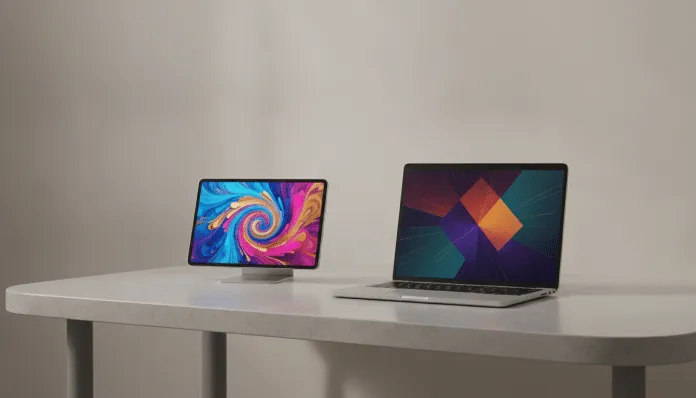

In 2026, for the first time in the history of personal device markets, global tablet sales surpassed traditional notebook sales — according to IDC data released in the first quarter of this year, there were 187 million tablets sold versus 164 million notebooks in the period. It’s no small number. It’s a cultural and technological shift that had been developing since the launch of the first ARM chips focused on productivity, and which has now finally solidified in hardware, software, and real use cases.
The problem this change solves — or attempts to solve — is simple to state, but complex in practice: most people carry a notebook to do things that a modern tablet can do with more lightness, more battery life, and less stress. But “most people” is a dangerous generalization. There are tasks where the notebook still dominates by a wide margin, and ignoring that would be dishonest. So in this definitive comparison, the question isn’t “which is better” in absolute terms — it’s for whom, in what context, and with what budget the tablet truly replaces the notebook in 2026.
I spent the last eight weeks testing the leading tablets on the market — iPad Pro M4, Samsung Galaxy Tab S10 Ultra, OnePlus Pad 3, and Lenovo Tab Extreme 2 — against notebooks in equivalent categories, running real work tasks, content creation, consumption, and gaming. I used standardized benchmarks like Geekbench 6, PCMark for Android/iOS, and battery tests with controlled loads. Let’s get to what matters.
Technical Specifications
To have a fair baseline, I compared the leaders in each category in 2026:
| Specification | iPad Pro M4 (2025) | Galaxy Tab S10 Ultra | MacBook Air M4 | Dell XPS 13 (2026) |
|---|---|---|---|---|
| Processor | Apple M4 (3nm) | Snapdragon X Elite | Apple M4 (3nm) | Intel Core Ultra 7 258V |
| RAM | 16 GB LPDDR5X | 12 GB LPDDR5X | 16 GB LPDDR5X | 32 GB LPDDR5X |
| Storage | Up to 2 TB NVMe | Up to 1 TB UFS 4.0 | Up to 2 TB NVMe | Up to 2 TB NVMe |
| Display | 13″ OLED Tandem, 120Hz | 14.6″ Dynamic AMOLED 2X, 120Hz | 13.6″ Liquid Retina | 13.4″ OLED, 120Hz |
| Battery | 38.99 Wh | 11,200 mAh | 52.6 Wh | 55 Wh |
| Real Battery Life | ~12h mixed use | ~11h mixed use | ~15h mixed use | ~10h mixed use |
| Weight | 579g | 732g | 1.24 kg | 1.19 kg |
| Operating System | iPadOS 19 | Android 16 | macOS Sequoia | Windows 11 24H2 |
| Base Price (USD) | $2,400 | $1,900 | $2,800 | $2,500 |
Pros and Cons
Tablets (category overview)
Pros:
- Incomparable portability — 600g to 750g versus 1.2kg+ for notebooks
- Superior battery life in light and mixed use, especially with ARM chips
- Versatility of use mode: touchscreen, stylus (Apple Pencil Pro, S Pen), external keyboard
- Ultra-high quality OLED displays for content consumption and design
- Instant boot, no boot rituals
- Native cellular connectivity available on most models (4G/5G)
- More accessible entry price for basic use
Cons:
- Multitasking still limited compared to macOS/Windows — especially on iPadOS
- Lack of support for complete professional applications (full Adobe Premiere, full DaVinci Resolve, robust IDEs)
- File management is still a nightmare on iPadOS
- External peripherals have inconsistent compatibility
- Keyboards and covers add weight and cost, bringing it closer to notebook territory
- AAA games and heavy simulations are still PC/notebook territory
- No native support for multiple external displays on many models
Cost-Benefit Analysis
Here’s the truth no YouTube unboxing will tell you: when you add up tablet + keyboard + stylus + USB-C hub adapter, the cost often exceeds that of an equivalent notebook.
An iPad Pro M4 13″ + Magic Keyboard + Apple Pencil Pro + multiport adapter = approximately $3,400 to $3,700 in the U.S. in 2026. For that value, you can comfortably buy a MacBook Air M4 — which runs complete applications, has a better physical trackpad, and unrestricted file systems.
The equation changes when you don’t always need the keyboard and stylus. For those who use tablets primarily for consumption (streaming, reading, social media), video meetings, and light document editing, the cost-benefit is excellent. The Galaxy Tab S10 Ultra with Android 16 and DeX Mode (which transforms the tablet into a desktop interface when connected to an external monitor) delivers 80% of a notebook’s functionality at 60% of the price in many scenarios.
The inflection point happens around $1,200 to $1,600: in this range, tablets like the OnePlus Pad 3 and Lenovo Tab Extreme 2 deliver solid hardware for light productivity, while equivalent notebooks in this range have worse screens, smaller batteries, and inferior construction.
Competitor Comparison
| Criterion | iPad Pro M4 | Galaxy Tab S10 Ultra | MacBook Air M4 | Dell XPS 13 2026 |
|---|---|---|---|---|
| Raw Performance | ⭐⭐⭐⭐⭐ | ⭐⭐⭐⭐ | ⭐⭐⭐⭐⭐ | ⭐⭐⭐⭐ |
| Multitasking | ⭐⭐⭐ | ⭐⭐⭐⭐ | ⭐⭐⭐⭐⭐ | ⭐⭐⭐⭐⭐ |
| Portability | ⭐⭐⭐⭐⭐ | ⭐⭐⭐⭐ | ⭐⭐⭐ | ⭐⭐⭐ |
| Battery Life | ⭐⭐⭐⭐ | ⭐⭐⭐⭐ | ⭐⭐⭐⭐⭐ | ⭐⭐⭐⭐ |
| App Ecosystem | ⭐⭐⭐⭐ | ⭐⭐⭐ | ⭐⭐⭐⭐⭐ | ⭐⭐⭐⭐⭐ |
| Value for Money | ⭐⭐⭐ | ⭐⭐⭐⭐ | ⭐⭐⭐⭐ | ⭐⭐⭐ |
| Content Creation | ⭐⭐⭐⭐⭐ | ⭐⭐⭐⭐ | ⭐⭐⭐⭐⭐ | ⭐⭐⭐⭐ |
| Gaming | ⭐⭐⭐ | ⭐⭐⭐ | ⭐⭐ | ⭐⭐⭐⭐ |
In Geekbench 6 benchmarks, the iPad Pro’s M4 chip scored 3,850 single-core points and 15,200 multi-core — numbers identical to the MacBook Air M4, because it’s literally the same chip. The difference lies in software: macOS lets the chip breathe on tasks like code compilation and 4K video editing, while iPadOS still imposes active memory restrictions that make perceived performance drop in long multitasking sessions.
For perspective on other gadgets in the ecosystem that complement these devices, it’s worth checking the Moto G67 2026 Worth It: Surprising Analysis — understanding where the smartphone fits in this equation is crucial to avoiding duplicate functionality.
Usage Tips and Configuration
To maximize the tablet as a notebook substitute:
- Set up Stage Manager (iPadOS) or DeX Mode (Samsung) from day one — these floating window interfaces are what make the tablet viable for real work with multiple apps open
- Invest in a quality USB-C hub: look for models with at least HDMI 2.1, two USB-A ports, 100W USB-C pass-through, and SD card reader. Brands like Anker and Baseus have reliable options in 2026 for $40 to $80
- Use hybrid cloud storage: tablets have expensive and non-expandable storage in most cases. Set up automatic sync with iCloud, Google Drive, or OneDrive to avoid the classic “out of space” problem at the wrong time
- For programmers: tools like Code App (iOS) and Termux (Android) have evolved a lot, but if you need to run Docker, heavy virtual environments, or compile large projects, the notebook is still necessary. An elegant solution is using the tablet as an SSH terminal to a remote server
- Common troubleshooting — app frozen on iPadOS: force-close (swipe up in the app switcher) and restart Stage Manager. In long sessions, iPadOS still has less aggressive memory management than macOS
- On Galaxy Tab with Android 16: Samsung’s January 2026 patch fixed the critical data loss bug in DeX mode with external drives — update immediately if you haven’t already
Technology’s Future
The trajectory is clear: tablets are becoming more capable, and the gap with notebooks will shrink, but won’t disappear completely in the next two to three years.
Apple confirmed at WWDC 2026 that iPadOS 20 (expected for late 2026) will bring native support for multiple external displays and overhauled file management — two of the biggest current pain points. If the company delivers on that promise, the iPad Pro M5 (expected for late 2026 or early 2027) with that software could genuinely replace notebooks for 70% of professionals.
On the Android side, the Samsung and Google partnership for Android 17 development includes a compatibility layer for native Linux apps in desktop mode — something that would transform Android tablets into viable development machines.
The big question is the professional application ecosystem. While Adobe, Microsoft, and Figma continue expanding their tablet versions, tools like full DaVinci Resolve Studio, professional CAD tools, and enterprise IDEs still require Windows or macOS. That’s a software problem, not a hardware one — and software can change faster than hardware.
For those wanting to keep an eye on the audio ecosystem that rounds out a mobile setup, our QCY T13 ANC 2 Review 2026: Exclusive and Surprising offers an interesting perspective on accessories that work equally well with tablets and notebooks.
Final Verdict

Do tablets replace notebooks in 2026? For many people, yes. For everyone, not yet.
If you’re a student, visual creation professional, executive living in meetings and presentations, or someone who primarily uses a browser, spreadsheets, and communication, a top-tier tablet with keyboard solves your needs with real advantages in portability and battery life.
If you’re a software developer, professional video editor, gamer, or work with legacy corporate tools, the notebook remains irreplaceable — and pretending otherwise would be selling you an expensive dream.
The most honest truth of 2026 is that we’re in the era of complementary devices, not absolute substitutes. The right question isn’t “tablet or notebook?” but “which of these makes more sense as my primary device, given what I do?”
Overall Rating: 8.5/10 (tablets as a category for productivity in 2026)
Recommended for: Creative professionals, university students, mobile executives, content consumers who need occasional productivity
Best price range: $1,400 to $2,000 (tablet + essential accessories) for real value without severe functionality compromises