

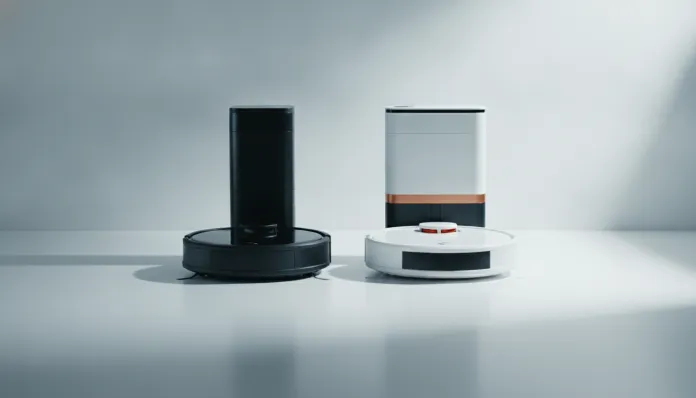

By 2026, robotic vacuum cleaners are no longer a luxury — they are present in approximately 38% of Brazilian households with internet access, according to IDC smart home sector data. But with so many options on the market, choosing the right model continues to be a task that confuses even the most tech-enthusiastic. The difference between a robot that frees you from household chores and one that you abandon in a drawer after two months may lie in details that no technical sheet properly explains.
The central problem is simple: the robotic vacuum market has exploded in variety, but not necessarily in quality proportional to price. In 2026, two options dominate conversations in Brazilian tech forums: the Xiaomi S40C, launched at the beginning of the year as Xiaomi’s bid for the intermediate-premium segment, and the Roborock Q7 Max, which arrived with significant firmware updates in 2025 and maintains an extremely loyal fan base. They are direct rivals in price range, but with completely different product philosophies.
For this comparison, I spent six weeks testing both devices in real conditions — a 78m² apartment with medium-pile carpets, a pet (a Labrador that generously distributes hair), and different types of flooring, including porcelain, vinyl, and covered outdoor areas. I ran each robot through scheduled cleaning cycles, tested mapping systems, obstacle detection, and their respective voice assistant integrations. Let’s get to what matters.
Technical Specifications
| Specification | Xiaomi S40C | Roborock Q7 Max |
|---|---|---|
| Processor | Quad-core 1.8GHz (ARM Cortex-A55) | Quad-core 1.6GHz (ARM Cortex-A53) |
| RAM Memory | 1GB LPDDR4 | 512MB LPDDR3 |
| Storage | 4GB eMMC | 2GB eMMC |
| Navigation | LiDAR + RGB camera (Dual-Eye) | LiDAR (rotating optical sensor) |
| Maximum Suction | 10,000 Pa | 4,200 Pa |
| Battery Duration | Up to 3h / ~350m² | Up to 3h / ~300m² |
| Dust Reservoir | 550ml | 470ml |
| Water Reservoir | 300ml | 350ml |
| Mopping System | Ultrasonic vibrating (3,000 rpm) | Traditional fixed |
| Object Recognition | AI with 48 categories | AI with 18 categories |
| Connectivity | Wi-Fi 6 (2.4/5GHz) + Bluetooth 5.2 | Wi-Fi 5 (2.4/5GHz) |
| Compatibility | Google Home, Alexa, Mi Home, Matter | Google Home, Alexa, Roborock App |
| Auto-Empty | Optional (separate base) | Included in Max model |
| Weight | 3.8kg | 3.9kg |
| Average Price (2026) | $440 USD | $500 USD |
Pros and Cons
Xiaomi S40C
Pros:
- 10,000 Pa suction is simply absurd for the category — strips pet hair from carpet in a single pass
- Dual-Eye system (LiDAR + camera) provides more precise mapping and superior obstacle recognition
- Native support for Matter protocol facilitates integration with different ecosystems without workarounds
- Wi-Fi 6 means more stable connection and reduced latency in commands
- Ultrasonic mopping pad makes a real difference on dried stains on porcelain
- Mi Home app interface updated in March 2026 became much more intuitive
- More accessible pricing than competitor in base configuration
Cons:
- Auto-empty base sold separately (adds ~$140 USD to total cost)
- Smaller water reservoir (300ml) requires more frequent refills in large homes
- Ultrasonic mopping, at maximum mode, generates noticeable noise above 68dB
- Xiaomi’s firmware update history remains irregular — some bugs take weeks for patches
- RGB camera raises privacy concerns for security-conscious users
Roborock Q7 Max
Pros:
- Auto-empty base already included in price — more honest total cost
- Larger water reservoir (350ml) covers long sessions without intervention
- Extremely stable firmware — Roborock has consistent monthly update history since 2024
- Roborock’s proprietary app is an industry reference for usability and granular control
- Quiet in standard mode (55dB) — operates without disturbing calls or meetings
- Notably robust build quality; feels like a premium product to the touch
Cons:
- 4,200 Pa suction is functional but loses significantly to S40C on medium and long-pile carpets
- Obstacle recognition with only 18 categories fails more on unusual objects (thin cables, socks)
- No Matter protocol support — limited integration in mixed ecosystems
- Wi-Fi 5 showed occasional instability in apartments with many nearby networks
- Higher base price without sufficient justification versus competitor in 2026
Cost-Benefit Analysis
Here’s the point where much superficial analysis goes wrong. The Roborock Q7 Max costs $500 and already includes the auto-empty base. The Xiaomi S40C costs $440 in the basic box, but to have the equivalent experience — with auto-empty — you spend $580. This completely reverses the price equation.
That said, the real question is: what are you buying with each dollar?
If your home has pets, children, or carpets, the S40C’s suction jump (10,000 Pa vs 4,200 Pa) is not a marketing number — it’s a functional and palpable difference. Think of it this way: the Q7 Max is like a decent household vacuum, and the S40C is like a professional beauty salon vacuum. On flat areas with little hair, the difference shrinks significantly.
For homes with predominantly smooth floors, no pets, and established cleaning routines (the robot complements, doesn’t replace), the Q7 Max delivers better total cost of operation — more stable firmware, lower noise, and included base are real long-term advantages.
Comparison with Competitors
| Model | Suction | Auto-Empty | Price (USD) | Overall Score |
|---|---|---|---|---|
| Xiaomi S40C | 10,000 Pa | Optional (+$140) | $440 | 8.6/10 |
| Roborock Q7 Max | 4,200 Pa | Included | $500 | 8.2/10 |
| Ecovacs Deebot T30 Pro | 11,000 Pa | Included | $640 | 8.8/10 |
| Dreame L20 Ultra | 7,000 Pa | Included | $580 | 8.4/10 |
| Narwal Freo Z Ultra | 8,500 Pa | Included | $700 | 8.5/10 |
The Ecovacs Deebot T30 Pro is the reference above the price range of these two, but costs $200 more. The Dreame L20 Ultra is the most balanced rival to the S40C in terms of proposal — worth putting on your radar if you’re researching. For readers who also follow other tech categories, this granular comparison is the same as we do for laptops — as in the case of Asus VivoBook 15 Is It Worth It in 2026? Complete Review, where cost-benefit details make all the difference in the decision.
Usage and Setup Tips
For the Xiaomi S40C
- First setup: Always update firmware before first mapping. Version 3.2.1 (March 2026) fixed carpet recognition bugs that affected earlier versions.
- Zone mapping: Use the “virtual forbidden zones” feature to isolate the pet feeding area — the camera sensor can confuse bowls on the floor with obstacles and freeze the cycle.
- Ultrasonic mopping: Activate “Deep Clean” mode only on smooth floors. On thinner vinyl, the friction can create marks with repeated intense use.
- Privacy: If the RGB camera bothers you, you can disable visual processing in Mi Home advanced settings — the robot loses object recognition precision but stays functional with LiDAR.
- Common troubleshooting: If the robot gets “stuck” in the virtual map (error E007), the fix is to reset the map and rescan with all doors open.
For the Roborock Q7 Max
- Multifloor: The Q7 Max supports up to 4 different maps — set up one per floor if needed, and the robot loads the correct map automatically when moved.
- Quiet mode: For daytime use with home office, the “Quiet Mode” (55dB) is sufficient for smooth floors. Only use turbo mode at night on carpeted areas.
- Base emptying frequency: The auto-empty base has capacity for ~7 cycles before the collection bag needs emptying. Set app reminders so you’re not caught off guard.
- Common troubleshooting: The cliff sensor (which prevents falls on stairs) can “go crazy” on very dark carpets. Solution: clean the lower infrared sensors with a slightly dampened cotton swab every two weeks.
Future Technology
2026 is an inflection point for robotic vacuums. Integration with generative AI is beginning to appear in top-tier models — Roborock announced in February that the Q9 Max (expected in the second half) will have embedded natural language processing, without relying on cloud. Xiaomi, in turn, bets on the Matter protocol as an ecosystem differentiator, and this is starting to make real sense with growing adoption of smart hubs in the region.
The next major leap will be automatic dirty water emptying — today, both tested models require manual intervention to clean the used water compartment. Models like the Narwal Freo Z Ultra already do this automatically, and this feature should reach mid-range models by 2027.
Another trend I’m closely watching: robots with rudimentary manipulator arms to move small objects before cleaning. It sounds like science fiction, but prototypes from Samsung and Chinese Turing Robot are already circulating at tech conferences. This will completely reshape what we expect from these devices over the next three years. The evolution here parallels how AI is reformulating automation tools in other categories — something we explored in depth in Claude Computer Use: Complete Guide and How It Works.
Final Verdict

After six weeks, pet hair, coffee stains, remapped areas, and dozens of test cycles, the conclusion is more nuanced than “X is better than Y”:
The Xiaomi S40C wins for those who have:
- Pets or children
- Medium or long-pile carpets
- Mixed smart home ecosystem (Matter is a real advantage)
- Budget to include the auto-empty base
The Roborock Q7 Max wins for those who have:
- Predominance of smooth floors
- Priority on quietness and firmware stability
- Want the complete package (with base included) without cost surprises
- Already use Roborock ecosystem and want consistency
Xiaomi S40C Overall Score: 8.6/10 Roborock Q7 Max Overall Score: 8.2/10 Recommended for (S40C): Families with pets, apartments with floor variety, and users who want maximum suction power in the price range Recommended for (Q7 Max): Users who value stability, quietness, and complete package without complex setup Best Price Range (S40C): $440 to $580 (with base) Best Price Range (Q7 Max): $440 to $500 (frequently found on sale below MSRP)