


Does 65W Charging Really Make a Difference on Your Phone?
The short answer is: it depends on your daily routine. Fast 65W (watt) charging is no longer exclusive to top-of-the-line devices, but many people still don’t know what this number means in practice, and more importantly, whether it’s worth paying more for it.
Watt, in this context, is the measure of power that the charger delivers to the phone. The higher the number, the more energy reaches the battery per second, which in theory reduces the time you spend waiting by an outlet. A 15W charger, which still comes with many mid-range devices, can take more than two hours to fill a 5,000 mAh battery. A 65W charger, according to technical specs from manufacturers like Xiaomi, Motorola, and realme, can do the same job in around 40 to 55 minutes, depending on the model and battery.
What complicates the conversation is that the power advertised on the box isn’t the only factor that matters. The charging chip inside the device, the protocol used, and even the ambient temperature directly influence the result. So before deciding whether 65W makes a difference for you, it’s worth understanding what happens behind the scenes.
How Fast Charging Really Works
Fast charging isn’t simply “throwing more energy at the battery.” Modern charging chips, like the Surge in some Xiaomi phones or the internal circuits of Motorola devices with TurboPower technology, manage voltage and current throughout the charging process. When the battery is empty at the start, the system accepts maximum power. As the battery approaches 80%, the power is deliberately reduced to protect the cells and extend the lifespan of the battery pack.
This curve behavior is important because the time you save with 65W is disproportionately greater when you charge from 0% to 50%, for example. If your habit is always to charge your phone overnight, a 25W charger is more than enough to fill any battery before you wake up. The 65W truly makes a difference for those who charge their devices during cramped moments of the day.
Communication protocols between charger and phone also enter the equation. You could have a 65W charger in hand and the phone only accept 33W if the protocols aren’t compatible. The most common ones in the Brazilian market are USB Power Delivery (USB PD), Qualcomm Quick Charge (QC), and proprietary protocols from brands like OPPO’s VOOC and Huawei’s SuperCharge. Always check the technical specs of the device to confirm which protocol it supports before buying a separate charger.
Practical Difference in Daily Brazilian Life
For those with busy schedules, who work outside and use their phone as a primary tool, the difference between 18W and 65W can be more than an hour of waiting per day. Imagine arriving home with 10% battery, needing to leave in 30 minutes, and having a 65W charger: according to technical specs of devices like the Motorola Edge 50 Ultra, you can go from 0% to about 50% in approximately 20 minutes at that power level. With an 18W charger, that same level would take around 50 to 60 minutes.
Now imagine the opposite scenario: you charge your phone every night and always wake up with 100%. In this case, a 33W charger fulfills the role abundantly and the difference to 65W completely disappears in practice. It makes no sense to pay more for a capability your usage will never exploit.
Another relevant point for the Brazilian consumer is the charger that comes in the box. Since 2022, most brands sold in Brazil no longer include a charger in the packaging of flagships, and when they do, it’s not always the most powerful one available for that device. Check the technical specs and packaging carefully before buying, and consider the cost of a compatible separate charger in your total budget.
What 65W Does to the Battery Over Time
A legitimate and frequent question: does fast charging damage the battery faster? The honest answer is that it depends on the implementation. Manufacturers like Xiaomi and Motorola, which have worked with high power for several years, tend to include thermal management systems and protection algorithms precisely to minimize degradation. According to public information from companies like Motorola, charging cycles with TurboPower were designed to preserve battery health within normal usage parameters.
Heat is the main enemy of lithium-ion batteries. Poorly manufactured chargers or those that force incompatible power levels tend to heat the device more, which yes, accelerates degradation. That’s why using original or manufacturer-certified chargers makes a difference not just in safety, but in the phone’s longevity. Unauthorized chargers without Anatel certification (the Brazilian agency that approves telecommunications equipment to ensure safety and compatibility in the national market) can pose real risk to the device and user.
If you want to better understand how to preserve your battery beyond just choosing the right charger, it’s worth checking out this complete guide on how to increase battery life on Android and get more hours of use, which brings practical tips applicable today.
65W Chargers in the Brazilian Market: What’s Available
The 65W power range is already present in mid-range devices in Brazil, especially in the Xiaomi, Motorola, and realme lines. According to technical specs and public information available in 2026, devices like the Redmi Note 14 Pro and Motorola Edge 50 support this charging range and, in some cases, include the charger in the box depending on the version sold in the country.
Separate 65W chargers compatible with USB Power Delivery and Qualcomm Quick Charge cost, on average, between R$ 80 and R$ 200 in national retail, varying greatly by brand and number of ports. Chargers with GaN certification (Gallium Nitride, a material that allows building smaller and more efficient chargers than traditional ones) tend to cost a bit more, but are more compact and generate less heat. Always check if the product has Anatel approval before buying, especially on marketplaces with third-party sellers.
For those who use their phone connected to a computer or notebook, it’s worth knowing that many 65W USB-C chargers are capable of powering both the phone and a light notebook from the same outlet. This directly relates to the discussion on USB-C hubs and accessories, which you can deepen in Is a USB-C Hub Worth It for a Notebook with Few Ports? if you use multiple devices in the same setup.
Quick Comparison: Charging Power Levels and What to Expect
| Power | Suitable Usage Profile | Estimated Time (~5,000 mAh battery) | Note |
|---|---|---|---|
| 15W to 18W | Overnight charging | 2h to 2h30 | Standard on many mid-range devices |
| 30W to 33W | Moderate use, 1 charge/day | 1h to 1h20 | Good overall value |
| 65W | Quick and frequent charging | 40 to 55 min | Requires compatible protocol |
| 120W or more | Intensive professional use | 20 to 35 min | Available on specific flagships |
The times above are estimates based on technical specs and public information from manufacturers; battery capacity, protocol, and environmental conditions influence the actual result.
Frequently Asked Questions About 65W Charging
Can any phone charge with 65W if I use the right charger?
No. The device needs to support the correct protocol to take advantage of maximum power. If the phone only supports 25W, it will charge at the maximum speed that the internal hardware allows, regardless of the charger you use. Always check the technical specs of the device, not just the charger.
Does 65W Charging Heat Up the Phone a Lot?
It depends on the quality of the manufacturer’s thermal management system. Devices with well-developed implementations, like Xiaomi’s with MiFC technology and Motorola’s with TurboPower, tend to control heat well. Non-original chargers or those without adequate certification are the main culprits for overheating.
Is It Worth Buying a Separate 65W Charger for My Current Phone?
Only if your phone already supports that power level. Finding this out is simple: open the official technical specs from the manufacturer, look for the charging section, and check the supported protocol and maximum power. If the device supports 33W, a 65W charger will work normally but will only deliver 33W.
Are Imported 65W Chargers Safe in Brazil?
Chargers without Anatel approval have not passed the electrical safety tests required for the Brazilian market. Besides the safety risk, these products have no legal warranty and can damage your device. Choose approved products, even if they cost a bit more.
Who Really Benefits From 65W and Who Doesn’t
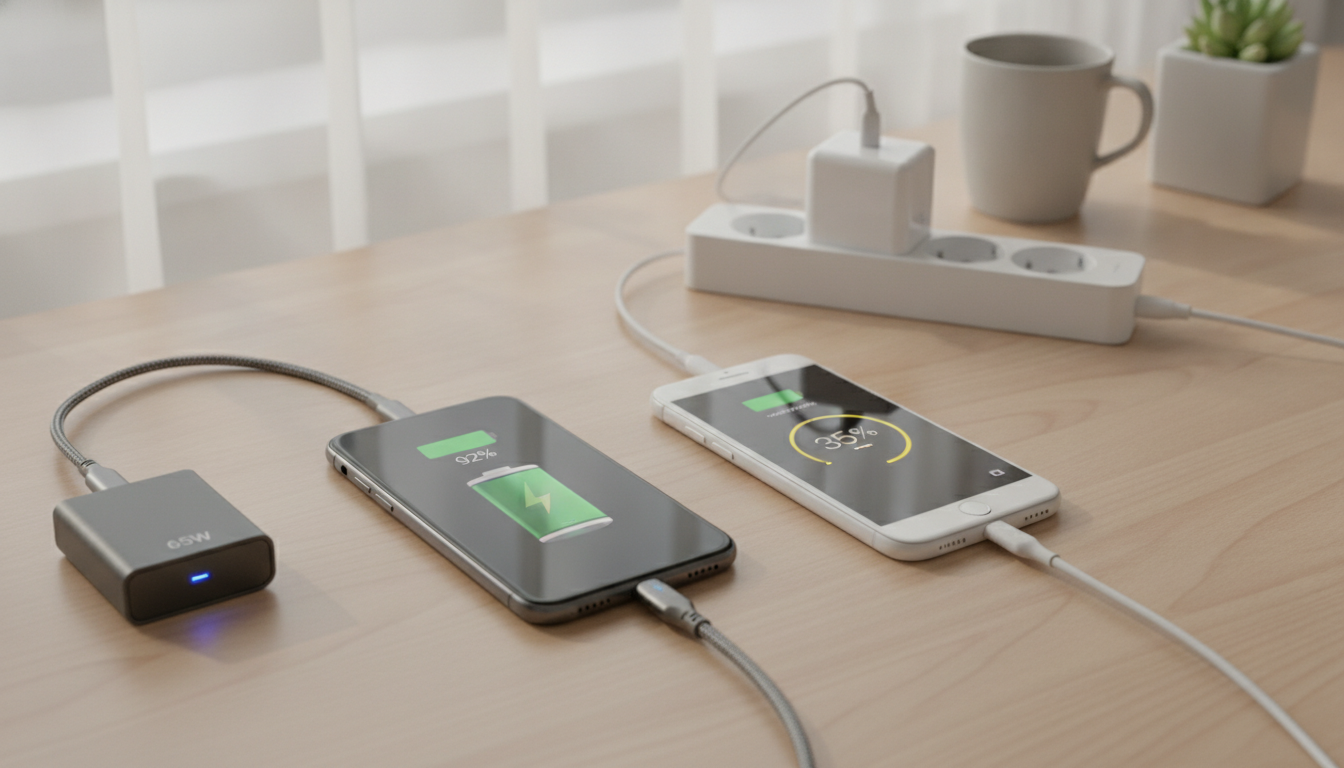
If you charge your phone every night and wake up at 100%, any power above 30W is unnecessary spending. The money you save by choosing a model with 33W can be better invested in camera, screen, or storage.
Now, if you spend your time charging your phone in the middle of the day, between meetings, in the car, or on frequent trips, 65W changes the experience concretely. The difference of 40 to 50 minutes per charging session, repeated several times a week, is real time that comes back to your day. For this profile, it makes complete sense to prioritize devices and chargers that support this range, as long as they are properly approved and compatible with each other.
The number alone guarantees nothing. What guarantees it is the right combination between the phone’s protocol, the compatible charger, and the actual usage habit you really have.