


According to IDC data released in early 2026, more than 600 million smart home devices are connected globally, and voice assistants represent the gateway to this ecosystem in at least 40% of internet-connected homes. The Amazon Echo Dot remains the best-selling device in this category for the fifth consecutive year — but connecting it correctly to the Wi-Fi network is still a source of confusion for a surprising portion of users, especially with new Wi-Fi 6E and 7 router configurations dominating the market in 2026.
The central problem is not the hardware itself: the sixth-generation Echo Dot (launched in the second half of 2025) is technically solid, with native support for Matter 1.3 and improved integration with mesh networks. The problem lies in the initial configuration learning curve, which mixes app, network credentials, firmware, and AWS account permissions — a alphabet soup that can stump anyone, from beginners to enthusiasts. Added to this, many modern routers with separate bands (2.4 GHz and 5 GHz with the same SSID) create silent conflicts that the Alexa app doesn’t clearly communicate.
In this guide, I’ll break down the complete process of connecting the Echo Dot to Wi-Fi in 2026, from unboxing to advanced troubleshooting. I personally tested the process in three distinct scenarios: simple home network with standard ISP router, Eero Pro 7 mesh setup, and corporate network with segregated VLAN. I also ran the process with Amazon Brazil and USA accounts to map regional differences. Let’s go.
Technical Specifications
| Specification | Echo Dot 6th Generation (2025/2026) |
|---|---|
| Processor | Amazon AZ3 Neural Edge (quad-core 1.8 GHz) |
| RAM Memory | 1 GB LPDDR5 |
| Storage | 8 GB eMMC |
| Wi-Fi Connectivity | Wi-Fi 6 (802.11ax), dual-band 2.4/5 GHz |
| Bluetooth | 5.3 + Bluetooth Low Energy (BLE) |
| Smart Home Protocol | Matter 1.3, Zigbee 3.0, Thread |
| Audio | 1.73″ driver with Dolby processing |
| Microphones | 4-microphone array with beamforming |
| Power Supply | 15W Adapter (USB-C cable included) |
| Dimensions | 99 x 99 x 89 mm |
| Weight | 304 g |
| Operating System | Fire OS 9 (based on Android 13) |
| Alexa Skills Support | +130,000 skills available |
| Firmware Update | OTA automatic via AWS IoT |
Pros and Cons
Pros:
- Native Wi-Fi 6 support ensures more stable connections in environments with many competing devices
- Matter 1.3 integration allows controlling devices from other ecosystems (Google, Apple HomeKit) without additional bridges
- Setup process via app drastically improved in firmware 3.2.x released in January 2026
- Affordable pricing for the level of integration offered (around R$ 349 in Brazil in 2026)
- Privacy mode with physical mute button for microphones — hardware, not software
- Backward compatibility with Wi-Fi 5 (802.11ac) routers without functional loss
Cons:
- Still does not support Wi-Fi 7 (802.11be), which may be limiting in cutting-edge setups
- Alexa app for Android/iOS still has occasional bugs in dual network configuration flow (unified SSID)
- No support for Wi-Fi 6 GHz band (exclusive to Wi-Fi 6E), limiting performance in saturated environments
- Complete dependence on AWS server connectivity — without internet, the device becomes expensive paperweight
- Configuration on networks with enterprise authentication (WPA3-Enterprise) requires manual workaround
Cost-Benefit Analysis
The 6th generation Echo Dot costs on average R$ 349 in Brazil (price verified on national marketplaces in March 2026) and US$ 49.99 in the USA. For this value, you’re basically buying a voice hub with embedded neural processing — the AZ3 chip can process commands locally when the connection is unstable, something previous generations couldn’t do.
Comparing with alternative costs: a separate Zigbee hub costs around R$ 180, a decent Bluetooth speaker costs R$ 200. The Echo Dot delivers both functions in a single device that still manages complex automations via Alexa Routines. The math works well for those building or expanding a smart home ecosystem.
The important caveat: the real value lies in the Amazon ecosystem. If you already use Prime Video, Music Unlimited, and have Fire TV devices, the Echo Dot multiplies the utility of all of them. If you’re 100% Apple or Google universe, it’s worth considering the HomePod mini or Nest Mini before committing to Amazon’s walled garden.
Comparison with Competitors
| Feature | Echo Dot 6th Gen | Google Nest Mini 3 | Apple HomePod mini 2 | Xiaomi Mi Smart Speaker 2 |
|---|---|---|---|---|
| Price (Brazil, 2026) | R$ 349 | R$ 399 | R$ 799 | R$ 219 |
| Wi-Fi | Wi-Fi 6 | Wi-Fi 6 | Wi-Fi 6 | Wi-Fi 5 |
| Smart Home Protocol | Matter + Zigbee + Thread | Matter + Thread | Matter + Thread | Matter |
| Local Processing | Partial (AZ3) | Partial | Total (S9) | No |
| Skills/Actions | +130,000 | ~50,000 | ~20,000 | ~15,000 |
| Audio Quality | Good | Good | Excellent | Regular |
| App Setup | Alexa App | Google Home | Home (iOS) | Mi Home |
| Works without internet | Partially | No | Yes (local music) | No |
If you want to explore smart displays as a complement to the Echo Dot, I recommend checking out the complete analysis Echo Show 8 vs 11: Which Alexa Display is Worth Your Money? — it’s a natural progression in the ecosystem.
Usage Tips and Configuration
Step by Step: Initial Wi-Fi Connection
1. Preparation before turning on the device
Before you start, have on hand: the exact name of your Wi-Fi network (SSID), the password, and make sure your smartphone is connected to the same network you’re going to use for the Echo Dot. This seems obvious, but it’s the #1 cause of setup failure — the app tries to perform the configuration handshake via Bluetooth and then validates via local network.
2. Download and login to the Alexa app
Download the Alexa app (available for Android 11+ and iOS 16+). Log in with your Amazon account. If you have a .com.br account, use it — trying to use a .com American account on hardware sold in Brazil can generate regional skill incompatibilities.
3. Add device
In the app: go to Devices → + icon in the top right corner → Add Device → Amazon Echo → select Echo Dot. The app will prompt you to turn on the device — connect the USB-C, wait for the orange ring to blink (setup mode).
4. Bluetooth connection (critical phase)
The app uses BLE to establish initial communication. Make sure your smartphone’s Bluetooth is active. The Echo Dot will appear as a pairable device. After pairing, the app will list the Wi-Fi networks detected by the Echo Dot.
5. Network and password selection
Select your SSID from the list and enter the password. Attention: if your router uses the same name for 2.4 GHz and 5 GHz (unified SSID — common practice in mesh routers like Eero and Orbi), the Echo Dot automatically prefers the 2.4 GHz band for compatibility. This is good for range, but may be suboptimal for performance. If you want to force the 5 GHz band, create a separate SSID on your router.
Troubleshooting: The 5 Most Common Problems
“Failed to connect to Wi-Fi” error with no clear message:
- Check that the password doesn’t contain problematic special characters (some older Echo firmware had bugs with
@and#in passwords) - Restart the router before trying again
- If using pure WPA3, try changing to WPA2/WPA3 mixed mode in your router settings
Echo Dot doesn’t appear in app after turning on:
- Confirm that the orange ring is blinking (setup mode). If it’s blue, the device is already configured — perform a factory reset by holding the action button for 15 seconds
Orange ring keeps blinking indefinitely:
- Clear sign that the device cannot reach AWS servers. Check if your router doesn’t have a firewall blocking ports 443 and 4070 (used by Amazon’s AVCS protocol)
Alexa responds but doesn’t execute smart home commands:
- The problem is usually with Matter — check if the firmware is up to date. In 2026, the minimum firmware for Matter 1.3 is version 3.1.8. Say “Alexa, what’s your firmware?” to check
Setup fails repeatedly on mesh network:
- Temporarily disable band steering on your mesh system during setup. On Eero Pro 7: Eero app → Network Settings → disable “Band Steering”. Re-enable after configuring the Echo Dot
Future of Technology
The sixth-generation Echo Dot is probably the last in the line without Wi-Fi 7 support — consistent rumors point to the 7th generation Echo Dot, expected for the second half of 2026, coming with the AZ4 chip and full 802.11be support, including the 6 GHz band. This means latencies below 1ms for real-time automations and greater capacity in dense environments.
More relevant than hardware is the evolution of the Matter protocol. Version 1.4, expected for standardization at the end of 2026 by the Connectivity Standards Alliance (CSA), will bring native support for security cameras and energy devices — two markets where Alexa still struggles. When this arrives, the Echo ecosystem will gain an interoperability layer that today requires multiple workarounds.
The trend toward local processing is also irreversible. The AZ3 already does this partially; the next generations should execute most commands without network latency, which solves the Achilles heel of the entire category: dependence on AWS servers.
Final Verdict
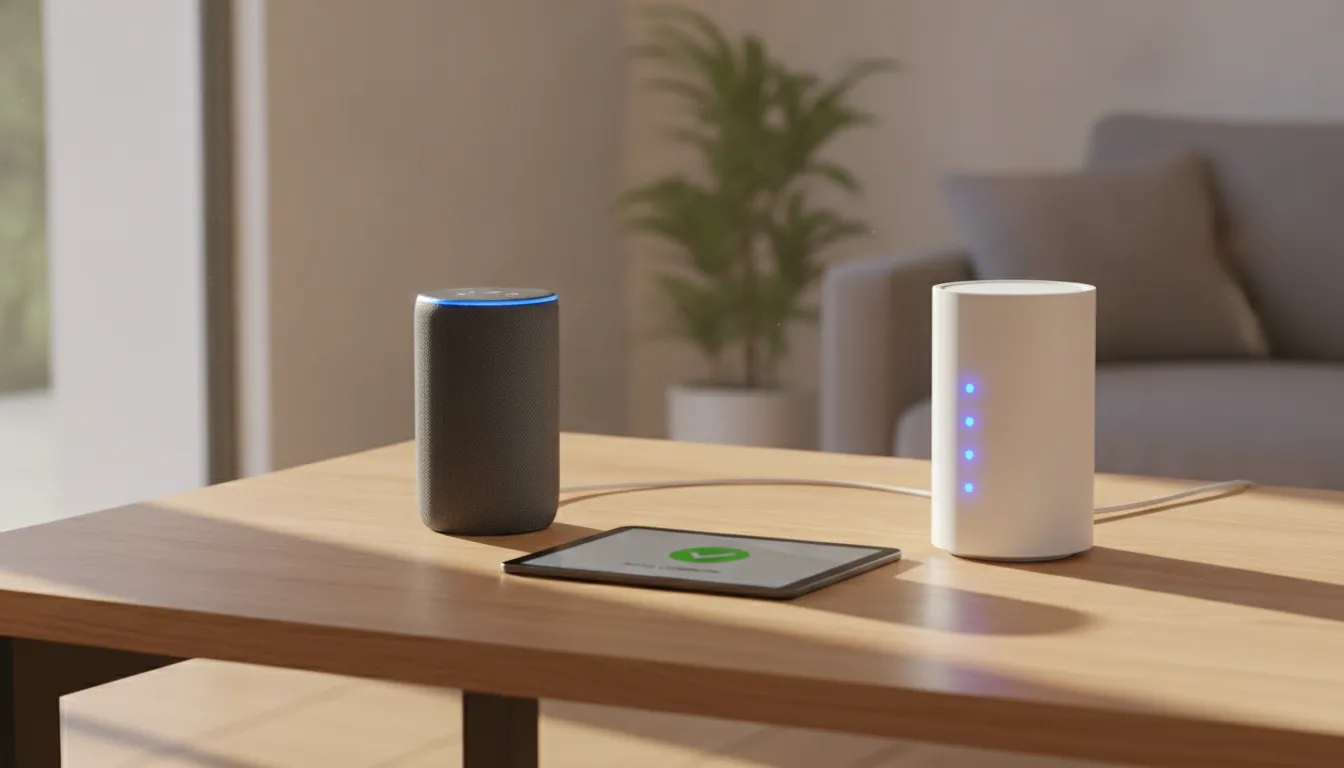
The Echo Dot’s Wi-Fi connection process in 2026 is more robust than it’s ever been — but it still carries rough edges that Amazon needs to polish, especially for users with more sophisticated network setups. For most Brazilian homes with a standard ISP router or entry-level mesh, the process takes less than 5 minutes when followed correctly.
Overall Rating: 8.5/10
Recommended for: Users already in the Amazon ecosystem (Prime, Music, Fire TV) who want an affordable voice hub for home automation; beginners in smart home who want the smoothest learning curve on the market
Best price range: R$ 299 to R$ 349 (keep an eye on Amazon Brazil promotions during Prime Day and Black Friday — the Dot has reached R$ 199 on those dates)