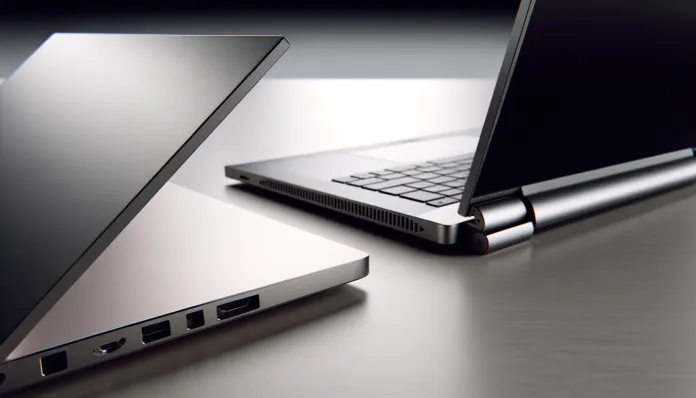
The decision between a Dell or Lenovo laptop is one of the most crucial for those seeking a portable computer in 2026. This comparison goes beyond initial technical specifications, involving factors like repairability, total cost of ownership, and long-term durability. Therefore, analyzing these brands from a broader perspective becomes essential for making an informed decision.
Build Quality: Where Each Brand Excels
Dell has set a consistent quality standard across its portfolio, from basic Inspiron models to premium XPS ones. Firstly, the brand invests in minimalist designs with extensive use of carbon fiber, especially in high-performance models. This allows for visual and structural consistency across different price ranges.
On the other hand, Lenovo offers a more diversified approach. However, this strategy results in significant variations between its lines. Nevertheless, the ThinkPad line is globally renowned for its exceptional durability, undergoing rigorous tests for impact, liquid, and extreme temperature resistance.
Consequently, Lenovo’s corporate expertise strengthened after acquiring IBM’s PC division in 2005. This heritage is primarily reflected in the ThinkPad line, whereas IdeaPad models may show more inconsistent quality.
Ergonomics is another important differentiator. In this context, Lenovo prioritizes high-precision keyboards and 360° touch screens in the Yoga line. Indeed, this approach appeals to users who value comfort during long work sessions.
Price and Real Cost-Benefit (Beyond Specs)
The initial cost is only a fraction of the total investment in a laptop. Additionally, factors like energy consumption, part lifespan, and upgradeability directly impact the long-term budget.
Line
Dell (R$)
Lenovo (R$)
Average Lifespan
Basic
Inspiron: 2,500 – 5,500
IdeaPad: 2,200 – 4,500
3-4 years
Gamer
G15: 5,000 – 9,000
Legion: 4,500 – 8,500
4-5 years
Premium
XPS: 12,000+
Yoga: 5,000 – 10,000
5-7 years
Corporate
Latitude: 6,000 – 12,000
ThinkPad: 4,000 – 15,000
6-8 years
Therefore, Lenovo offers more accessible starting prices in most categories. However, Dell compensates with better resale value and lower depreciation over time. Thus, the total cost of ownership balances between the brands in most scenarios.
Conversely, ThinkPad models offer the best return on investment for intensive corporate use. Similarly, Dell’s XPS line justifies its premium price through superior materials and extended support.
Technical Support and Parts Availability
The technical support infrastructure in Brazil is a decisive factor in choosing between the brands. Additionally, the availability of replacement parts and ease of repair directly influence the total cost of ownership.
Both brands maintain technical assistance centers in major Brazilian capitals. However, their approach differs significantly in terms of service philosophy and repair structure.
Dell: On-Site Assistance vs Lenovo: Repair Ease
Dell stands out for its on-site assistance service, especially for corporate and premium products. Consequently, certified technicians visit the customer’s location for diagnosis and repair, minimizing downtime.
On the other hand, Lenovo prioritizes a more robust and accessible repair structure. This facilitates access to replacement parts and technical documentation, allowing for quicker and more economical repairs.
However, Lenovo has a significant advantage in the modularity of its equipment. Thus, components like the keyboard, battery, and RAM can be replaced more easily, especially in the ThinkPad line.
Firstly, the availability of parts is adequate for both brands. Nonetheless, Lenovo maintains a more extensive catalog of individual components, facilitating partial repairs instead of complete motherboard replacements.
Main Lines of 2026 and Best Use
Each product line caters to specific user profiles. In this context, understanding the characteristics and limitations of each series facilitates the appropriate choice for different needs.
Conversely, Dell’s G15 series focuses on the gaming segment with dedicated RTX 4060 and higher graphics cards. However, the design remains relatively discreet, allowing use in corporate environments without drawing excessive attention.
Similarly, Lenovo’s IdeaPad line offers an impressive variety of configurations. Therefore, models like the IdeaPad Gaming cater to casual gamers, while Slim versions prioritize portability and battery life.
Consequently, Lenovo’s Yoga series stands out for the versatility of convertible screens. Indeed, these models function as a tablet, traditional laptop, or presentation station, depending on the screen’s position.
The ThinkPad line maintains its focus on the corporate market with features such as:
Backlit keyboard with red TrackPoint
Military-grade durability certifications
Advanced security features (TPM 2.0, biometric reader)
The choice between a Dell or Lenovo laptop primarily depends on the usage profile and individual priorities. Firstly, users who value consistency and premium support should consider Dell. On the other hand, those seeking a variety of options and better initial cost-benefit will find Lenovo an attractive alternative.
For intensive corporate use, Lenovo’s ThinkPad line is the undisputed leader. Thus, companies relying on reliable equipment for critical operations find the robustness and durability of ThinkPads an ideal solution.
However, home users and creative professionals may benefit more from Dell’s approach. Consequently, the uniformity of experience across different models facilitates transition and reduces the learning curve.
Nevertheless, repairability tilts the balance in favor of Lenovo for technical users. Therefore, those with the knowledge to perform upgrades and basic maintenance will better utilize Lenovo’s modular equipment structure.
Thus, the ideal choice is based on three fundamental pillars: available budget, usage intensity, and technical support needs. In this context, both brands offer competitive products in their respective specialties.
Frequently Asked Questions
Is Dell more durable than Lenovo for intense daily use?
Durability varies by product line. However, Lenovo’s ThinkPad outperforms most Dell models in resistance tests, especially for intensive corporate use. On the other hand, Dell’s XPS line offers comparable durability with a more premium design.
Which laptop offers better value between R$ 3,000 and R$ 5,000?
In this price range, Lenovo’s IdeaPad offers more robust configurations, including more powerful processors and greater RAM. Additionally, some models include SSD as standard. However, Dell’s Inspiron compensates with better screen quality and superior finish.
Is Lenovo easier to repair than Dell when it breaks?
Yes, especially the ThinkPad line. Consequently, Lenovo designs its equipment with modularity in mind, facilitating the replacement of individual components. Thus, repairs become quicker and more economical compared to Dell models.
Does Dell have better technical support than Lenovo in Brazil?
Dell offers premium services like on-site assistance, especially for corporate lines. However, Lenovo maintains a broader network of authorized centers and superior availability of replacement parts. Therefore, both adequately serve, but with different approaches.
Is it worth paying more for a Lenovo ThinkPad vs Dell Inspiron?
For corporate or intensive professional use, yes. Additionally, ThinkPad offers superior durability, advanced security features, and better ergonomics. However, for casual home use, the price difference may not justify, making Dell Inspiron a more balanced choice.
The choice between Dell and Lenovo transcends technical specifications, involving factors like design philosophy, support structure, and total cost of ownership. Therefore, the correct decision depends on aligning these characteristics with the specific needs of each user, ensuring satisfaction and productivity in the long term.
Discover which laptops under R$ 3,000 are worth buying for studying in 2026. Compare models from Acer, Samsung, Lenovo, and Dell with specifications, prices, and expert advice on what matters for students.
Find the perfect student laptop under R$ 3,000 in Brazil with our comprehensive 2026 guide. Compare top models, specs, and recommendations for studying, work, and everyday use.
Learn how to set up a universal remote on any TV model. Step-by-step instructions for code-based remotes, IR learning, and smart app-controlled remotes. Works with Samsung, LG, TCL, and more.
Compare Amazon Prime Video and Max (formerly HBO Max) in Brazil. Find out which streaming service is best for your profile based on price, catalog, video quality, and exclusive content.
Discover which laptops under R$ 3,000 are worth buying for studying in 2026. Compare models from Acer, Samsung, Lenovo, and Dell with specifications, prices, and expert advice on what matters for students.
Find the perfect student laptop under R$ 3,000 in Brazil with our comprehensive 2026 guide. Compare top models, specs, and recommendations for studying, work, and everyday use.
Learn how to set up a universal remote on any TV model. Step-by-step instructions for code-based remotes, IR learning, and smart app-controlled remotes. Works with Samsung, LG, TCL, and more.