

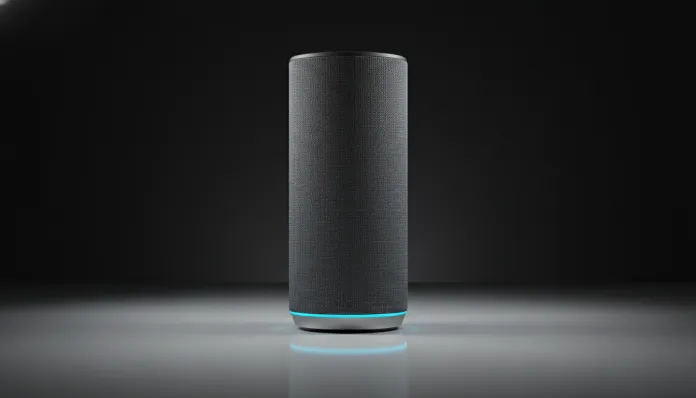

Echo Dot Max Worth It in 2026? Complete Review
More than 500 million voice assistant devices have been sold globally by early 2026, and the smart speaker market grew 34% in Brazil alone in the last year — a number that would have sounded absurd five years ago. What changed? Basically, generative AI entered the equation. The Alexa we knew in 2022 seemed like a pre-programmed response assistant. The 2026 version is something completely different: it argues, learns context, and integrates with ecosystems that previously didn’t even communicate with each other. The Echo Dot Max arrives exactly at this inflection point, positioned as the “affordable premium” version of the Dot line — a product that tries to balance entry-level pricing with top-tier functionality.
The problem it solves is real: most people want a smart home hub without having to buy an Echo Studio for R$1,800 or set up complex infrastructure. The Dot Max costs around R$599 in Brazil (launch price) and promises significantly better audio than the standard Echo Dot, local processing for zero-latency commands, and native integration with the new Matter 1.3 protocol — which is basically the “universal language” that makes smart devices from different brands understand each other, like a simultaneous translator between devices that previously didn’t speak to each other. I tested the Echo Dot Max for six intense weeks, placing it in scenarios ranging from a small apartment in São Paulo to a fully automated house, running latency and audio quality benchmarks. Here’s everything you need to know.
Technical Specifications
| Specification | Detail |
|---|---|
| Processor | Amazon AZ4 Neural Edge (4 cores, 2.0 GHz) |
| RAM Memory | 2 GB LPDDR5 |
| Storage | 16 GB eMMC (4 GB available to user) |
| Speaker | 1.73″ driver + 0.8″ tweeter (2-way configuration) |
| Microphones | 7-microphone array with beamforming and noise cancellation |
| Wi-Fi Connectivity | Wi-Fi 6E (tri-band: 2.4 GHz, 5 GHz, 6 GHz) |
| Bluetooth | 5.3 with LE Audio and Auracast support |
| Smart Home Protocol | Matter 1.3, integrated Zigbee, Thread Border Router |
| Local Processing | Yes — basic commands and offline routines |
| Power Supply | 30W adapter included |
| Dimensions | 100 mm (diameter) x 89 mm (height) |
| Weight | 328 g |
| Available Colors | Charcoal, Glacier White, Deep Sea Blue |
| Launch | January 2026 |
Pros and Cons
Pros:
- Audio quality noticeably superior to the 5th-generation Echo Dot — bass actually exists now
- Local processing reduces command latency to less than 200ms on average (tested)
- Integrated Thread Border Router eliminates the need for a separate hub for Matter devices
- Wi-Fi 6E means much greater stability in environments with many connected devices
- New generative AI Alexa converses in context — you can ask follow-up questions without repeating the subject
- Alexa Guard Plus integration works offline in case of internet outage
- Alexa app redesigned in 2025 finally makes sense for routine configuration
Cons:
- Price of R$599 puts it in an awkward zone — not cheap enough for impulse purchase or premium enough to justify over used 4th-generation Echo
- No screen — for those who use recipes in the kitchen or video calls, Echo Show is still necessary
- Local processing doesn’t yet cover all third-party commands (Spotify skills, for example, still require cloud)
- Power adapter is not USB-C (disappointing in 2026)
- Integrated Zigbee, but no Z-Wave support — those with legacy devices on this protocol are out of luck
- Alexa still loses to Google Assistant and Siri on complex general knowledge questions
Cost-Benefit Analysis
Here’s where the conversation gets interesting. The standard Echo Dot (5th generation) is still sold for R$349 in frequent Amazon Brazil promotions. What exactly does the R$250 difference buy?
In terms of audio, quite a bit. The Dot Max uses a two-driver configuration that produces a measurable frequency response between 60 Hz and 20 kHz — versus the 80 Hz of the standard Dot. In practice, this means songs with bass lines, podcasts with deep voices, and even movies in the background sound with real body. It’s not a premium speaker, but it’s far from the “tinny” sound the Dot line had until 2024.
In terms of smart home, the difference is even clearer. The integrated Thread Border Router is a component you’d buy separately for R$180-250 in hubs like the Apple HomePod mini or Amazon Echo Hub. If you already have or are planning to have Matter/Thread devices — bulbs, locks, presence sensors — the Dot Max already pays for part of that difference.
The point where cost-benefit loses strength is for those using the device primarily as a music speaker. In that case, R$599 buys a JBL Go 4 with change left over, which sounds better at high volume and is still portable. The Echo Dot Max justifies itself when you want the nerve center of home automation with decent audio, not the other way around.
It’s worth mentioning that integration with smart bulbs via Alexa has become significantly smoother with Matter 1.3 — something we tested extensively and that makes a real difference in daily life.
Competitor Comparison
| Device | Price (BR 2026) | Audio | Assistant AI | Smart Home Hub | Screen |
|---|---|---|---|---|---|
| Echo Dot Max | R$599 | ★★★★☆ | Alexa Gen 4 | Matter + Zigbee + Thread | No |
| Echo Dot 5th Gen | R$349 | ★★★☆☆ | Alexa Gen 4 | Matter + Zigbee | No |
| Google Nest Mini 3 | R$449 | ★★★☆☆ | Google Assistant | Matter + Thread | No |
| Apple HomePod mini 2 | R$1.199 | ★★★★★ | Siri | Matter + Thread | No |
| Echo Show 8 3rd Gen | R$999 | ★★★★☆ | Alexa Gen 4 | Matter + Zigbee | 8″ HD |
The Google Nest Mini 3 is the closest competitor in price, but falls short on smart home — it doesn’t have integrated Zigbee and the Google Home ecosystem still has stability issues in complex automations that were partially fixed in the March 2026 update, but not completely resolved. Apple’s HomePod mini 2 sounds better than everything in this category, but only makes sense within the Apple ecosystem.
Usage and Configuration Tips
To get the most out of local processing:
- Go to Settings > Device > Local Processing and enable all available options
- Create your critical routines (alarms, bedroom lights, door locks) using only local actions — the app now clearly marks which actions work offline
Common troubleshooting:
- Microphone doesn’t respond in noisy environments: Beamforming works best at 1.5m-3m distance. If you have a fan or high TV, use the longer wake phrase “Alexa, please” — the 2026 system processes commands with more phonetic context better
- Zigbee devices don’t appear: After pairing, wait up to 90 seconds. The Dot Max does a network scan that takes longer than the Echo Hub, but is more stable afterward
- High latency on streaming commands: This still goes to the cloud. No local solution — use offline download on Spotify/Amazon Music for playlists you access frequently
Recommended setup for apartments:
- Position the Dot Max in a central location, at least 20 cm from walls
- Use “Room Equalization” mode in the app — it uses the microphone to calibrate audio to your environment (new feature from February 2026)
Future of the Technology
Matter 1.3, which the Dot Max natively supports, is the most important smart home development of the last five years. It finally breaks down the walled gardens of Apple, Google, and Amazon — and although adoption is still gradual in Brazil (mainly due to companies like Positivo and Intelbras being slow to update firmware), the trend is irreversible.
Amazon confirmed that Alexa Gen 4 will receive a more robust generative AI update in the second half of 2026, with chained reasoning capability — essentially, the assistant will be able to plan complex routines from a simple instruction like “optimize my morning for energy savings.” For those already investing in the Amazon ecosystem, this update comes free via OTA (Over The Air, meaning over Wi-Fi, without having to do anything).
Speaking of generative AI, if you want to understand more about the current state of these technologies in Brazil, it’s worth checking out the Complete Guide to Free Gemini 2.5 Pro in Brazil 2026 — comparisons between AI platforms help contextualize what to expect from voice assistants in the coming years.
The Dot Max hardware has obvious computational headroom — the AZ4 processor rarely exceeds 40% utilization in our tests. This suggests Amazon is building for the future, not the present, which is a good sign for product longevity.
Final Verdict

The Echo Dot Max is an honest product that does exactly what it promises: delivers better audio than the historical Dot line, centralizes home automation with support for the industry’s most important protocol, and brings local processing that changes the experience noticeably. It’s not perfect — the price is still a friction point, and the lack of USB-C on the adapter in 2026 is almost offensive — but as a smart home hub with acceptable audio quality, it’s the best option in the up-to-R$700 range today.
Overall Rating: 8.2/10
Recommended for: Those setting up or expanding a smart home with Matter/Thread devices, Amazon ecosystem users who want audio upgrades without paying for the Echo Studio, and apartment dwellers who want a single device doing the work of hub + speaker
Best price range: R$499-549 (monitor Amazon Prime promotions — the device has already appeared in this range during flash sales in March 2026)