

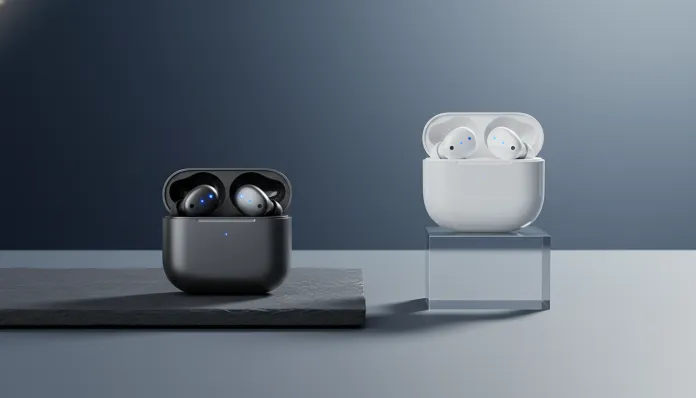

The true wireless earbuds (TWS) market has exploded impressively: in 2025, the entry-level segment below R$ 300 grew 47% in sales volume in Brazil, according to IDC data. This means more people than ever are seeking quality sound without paying the absurd price of AirPods Pro or Galaxy Buds Pro. The problem? With so many options, it’s hard to separate what actually delivers value from what’s just pretty packaging and inflated specs on paper.
That’s exactly where the Samsung Galaxy Buds FE and Redmi Buds 6 Play enter the battle. Two entry-level earbuds with similar proposals: decent sound, reasonable comfort, smartphone integration, and a price that won’t empty your bank account. But which one actually justifies the expense? Is Samsung’s heritage worth the premium price over Xiaomi’s competitor? Or does the Redmi deliver 80% of the experience for 60% of the price—the so-called sweet spot of value for money?
I’ve spent the last three weeks alternating between both models in daily use: on São Paulo’s subway, working from home, at the gym, and on video calls. I used frequency response measurement apps like AudioTool and tested latency with mobile games and YouTube videos. I’ll bring you everything I discovered, straight to the point.
Technical Specifications
| Specification | Samsung Galaxy Buds FE | Redmi Buds 6 Play |
|---|---|---|
| Driver | 8.5mm dynamic | 12mm dynamic |
| Frequency response | 20Hz – 20kHz | 20Hz – 20kHz |
| Noise cancellation | Active ANC (1 mic per earbud) | No ANC |
| Audio codec | AAC, SBC | AAC, SBC |
| Bluetooth | 5.2 | 5.4 |
| Declared latency | ~130ms (gaming mode: ~60ms) | ~80ms (gaming mode) |
| Battery (earbud) | 5.5h (with ANC) / 6.5h (without) | 6h |
| Battery (case) | 21h total | 30h total |
| Durability | IPX2 | IP54 |
| Microphones | 3 per earbud | 2 per earbud |
| Weight (each earbud) | 5.6g | 4.8g |
| Compatibility | Android/iOS (Galaxy Wearable app) | Android/iOS (Xiaomi Earphones app) |
| Average price Brazil (2026) | R$ 249 – R$ 289 | R$ 149 – R$ 179 |
Pros and Cons
Galaxy Buds FE
Pros:
- Functional ANC for the price—well attenuates continuous noises like fans and air conditioning
- Premium build quality with matte plastic that doesn’t accumulate fingerprints
- Excellent integration with Samsung smartphones (appear automatically, control in notification panel)
- Three microphones per earbud ensure voice quality in calls well above the segment average
- Galaxy Wearable app with 8-band equalizer—real sound customization flexibility
- Well-implemented Ambient Sound mode, good for hearing the world around you without removing the earbuds
Cons:
- IPX2 is very basic protection—not recommended for rain or intense gym sweat
- Case scratches easily and feels cheap compared to the earbud itself
- No aptX or LDAC—those with high-quality audio sources are limited to AAC
- ANC loses much effectiveness against transient noises (horns, nearby human voices)
- Price increased in 2025 and value for money became less obvious than at 2023 launch
Redmi Buds 6 Play
Pros:
- 12mm driver delivers fuller bass and greater physical sound presence
- Bluetooth 5.4 with notably more stable connection in high-interference environments (malls, subways)
- IP54—can be used in light rain and at the gym without real concern
- Case with 30h total battery life is absurdly generous for the price
- ~80ms latency in gaming mode beats many higher-tier earbuds
- Aggressive pricing leaves room to err—if you lose or break them, the pain is lesser
Cons:
- No ANC whatsoever—isolation depends only on physical silicone fit
- Xiaomi Earphones app is functional but less polished, with limited EQ options (5 bands)
- Microphone quality in calls is visibly inferior to Galaxy Buds FE
- Plastic finish is brighter and cheaper feeling to the touch
- No native integration with operating systems beyond standard Bluetooth notification
Value for Money Analysis
Here’s the heart of the matter. The Galaxy Buds FE costs on average R$ 270 in 2026, while the Redmi Buds 6 Play sits around R$ 160. That R$ 110 difference—almost 70% more—needs justification.
The answer depends entirely on your usage profile.
If you work from home or make many video calls, the Galaxy Buds FE wins hands down. The microphone quality difference is noticeable from the first call. In environments with background noise (child, pet, fan), Samsung’s three-microphone system with beamforming (technology that focuses on voice capture and filters side sounds, like a spotlight for audio) delivers clean voice where the Redmi sounds muffled and echoing.
If you use earbuds mainly for music and podcasts, the argument changes. The Redmi’s 12mm driver delivers surprisingly satisfying sound for the price. Bass has presence and punch without popping, mids are clear enough for voice and guitar, and highs don’t hurt your ear. The Galaxy Buds FE has more balanced and refined sound, especially with the equalizer, but the difference isn’t categorical—it’s one of subtlety.
For gym and sports users, the Redmi’s IP54 is a game-changer. IPX2 means the Galaxy Buds FE can handle water dripping on it, but not sweat running. The Redmi handles splashes from all angles. That’s a huge practical difference.
The Galaxy Buds FE’s ANC deserves honest commentary: it works, but it’s basic. It reduces the constant hum of AC and airplane engines well, but doesn’t come close to a Sony WF-1000XM5 or AirPods Pro. For the price, it’s a useful bonus—especially on public transport—but shouldn’t be the deciding factor.
Comparison with Competitors
| Earbud | Price (BR 2026) | ANC | Total Battery | Highlight |
|---|---|---|---|---|
| Samsung Galaxy Buds FE | R$ 270 | ✅ | 27h | Best microphone in the segment |
| Redmi Buds 6 Play | R$ 160 | ❌ | 30h | Best absolute value for money |
| JBL Wave Flex 2 | R$ 220 | ❌ | 32h | Powerful bass, durability |
| Motorola Moto Buds 2025 | R$ 199 | ❌ | 24h | Good Android integration |
| QCY T13 ANC | R$ 180 | ✅ (weak) | 35h | Cheapest ANC on the market |
The QCY T13 ANC deserves mention because it’s the only competitor offering ANC in the Redmi’s price range. The problem is its noise cancellation is notoriously inconsistent—sometimes it helps, sometimes it seems like placebo. The Galaxy Buds FE has more reliable ANC.
If you’re considering Xiaomi ecosystem devices, it’s also worth checking the value for money of domestic gadgets in 2026 to understand how the brand currently positions its products in the Brazilian market.
Usage Tips and Setup
Galaxy Buds FE
- Run the silicone fit test in the Galaxy Wearable app—it uses the microphone to measure sound leakage and recommend the ideal tip size. Wrong tip = ineffective ANC and weak bass.
- Enable “Voice Detect” mode if you frequently need to switch between listening to music and talking. It automatically pauses audio when you start speaking.
- In the equalizer, the “Bass Boost” preset tends to distort at high volumes. Prefer creating a custom setting with +3dB at 80-100Hz frequencies.
- If ANC creates a pressure sensation in your ears (common with sensitive ears), reduce the intensity in the app rather than disabling it completely.
Redmi Buds 6 Play
- The gaming mode (latency ~80ms) must be manually activated in the Xiaomi Earphones app—it’s not automatic. Enable it before opening the game.
- Common iOS connection issue: some users report connection drops with iPhones. The solution is to go to Settings > Bluetooth, forget the device, and re-pair with the case open and nearby.
- The default fit tends to loosen during running. Switch to the smaller medium tip that comes in the box—surprisingly improves retention.
- Resync both earbuds: place both in the case, close, open, and remove them. Solves 90% of audio channel desync problems.
Future of Technology
What’s becoming clear in 2026 is that effective ANC is rapidly migrating to the R$ 200-300 range, something that seemed impossible three years ago. The next frontier for entry-level earbuds is personalized noise cancellation by ear profile—technology that Sony already uses in premium lines and should reach mid-range by 2027-2028.
Bluetooth LE Audio, with the LC3 codec (offering superior quality to AAC at half the energy consumption), is still absent from both earbuds in this comparison—but already appears in products like the JBL Tour Pro 3. We expect that by late 2026, at least the LC3 codec will appear in earbuds in this price range via firmware update on compatible devices.
Integration of AI for voice cancellation in calls is also evolving rapidly—the Galaxy Buds FE already has a basic version of this, and the trend is that the microphone advantage Samsung has today will become standard in 18-24 months.
For those wanting to understand how the connected device ecosystem is evolving in 2026, the Amazfit Bip 6 vs Active 2 comparison gives good perspective on how brands are differentiating software and sensors in entry-level gadgets.
Final Verdict
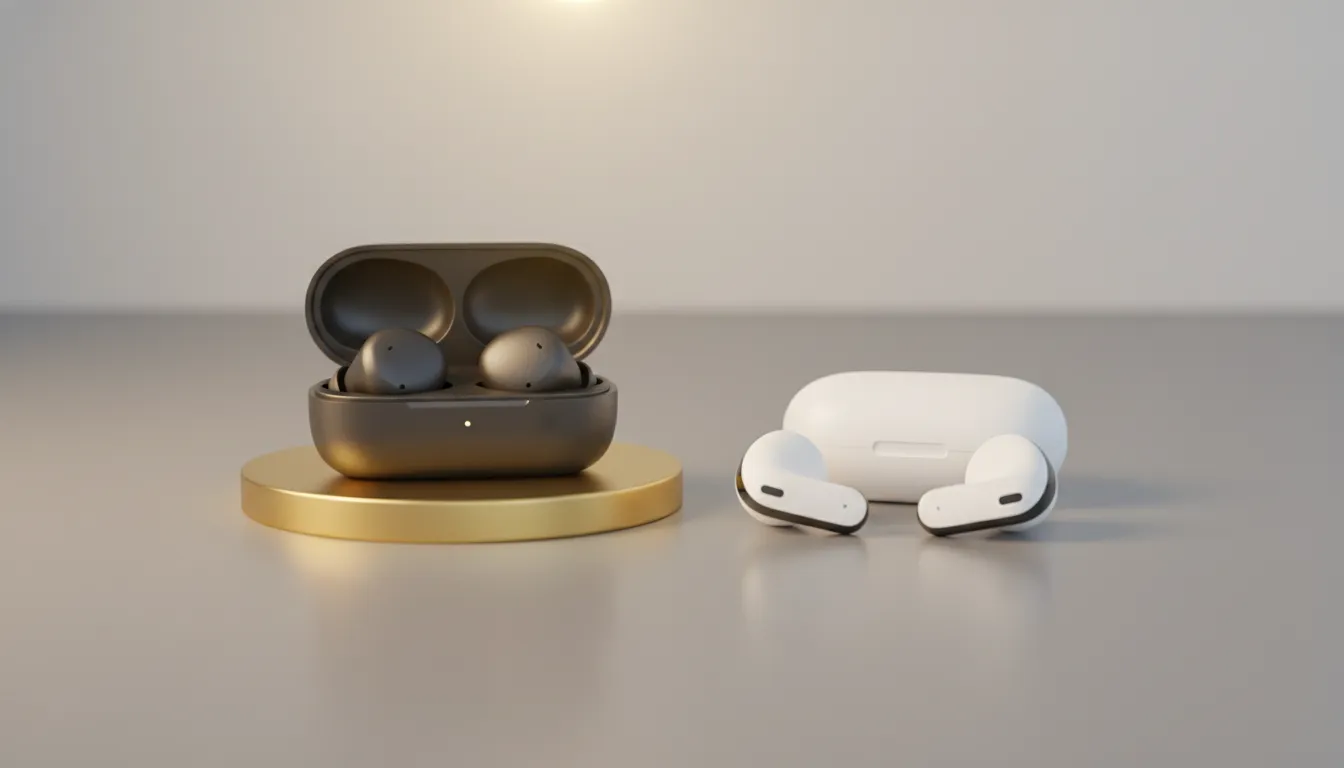
After three weeks of intensive use, the conclusion is less obvious than it seemed at first—and that’s exactly the point.
The Galaxy Buds FE is the technically superior earbud. Better microphone, functional ANC, more complete equalizer, and more polished integration with Android. If you use video calls often, work in noisy environments, and have a Samsung in hand, the R$ 110 difference might make sense.
The Redmi Buds 6 Play is the rational choice for those wanting maximum experience per real spent. For 80% of users who use earbuds for music, podcasts, and occasional calls in quiet environments, it delivers everything necessary without any excess.
Overall Rating (Galaxy Buds FE): 7.8/10 Overall Rating (Redmi Buds 6 Play): 8.2/10 (considering price)
Recommended for (Galaxy Buds FE): Home office users, workers making many calls, Samsung owners wanting native integration and valuing ANC even if basic
Recommended for (Redmi Buds 6 Play): Those using earbuds for media consumption, practice sports, need long battery life, or simply want the best product for the lowest possible price
Best price range (Galaxy Buds FE): Below R$ 249—above that, competition gets tight
Best price range (Redmi Buds 6 Play): Below R$ 170—in this range, it simply has no real rival in the Brazilian market in 2026