

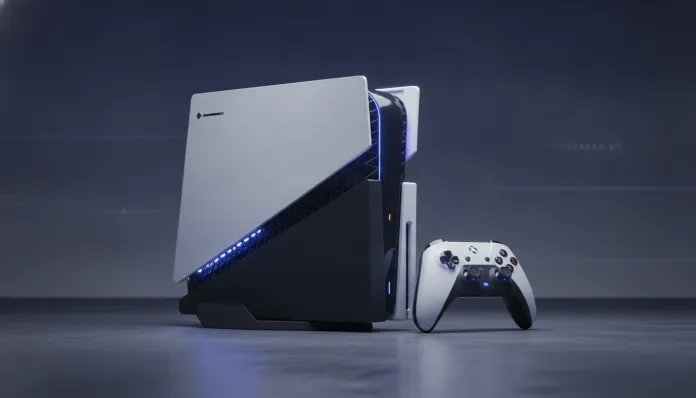

More than 47 million PlayStation 5 units have been sold globally by early 2026, according to Sony data, and the PS5 Pro — launched in November 2024 — already represents a growing share of that number, especially in premium markets. In Brazil, however, the equation is quite different: the console arrived here with a price that makes any wallet tremble, and the burning question is whether the upgrade really justifies the investment in Brazilian reais. The problem the PS5 Pro tries to solve is simple to state but complex to execute: deliver current-generation visual experiences without requiring you to buy a high-end gaming PC — and do it with the convenience of a living room console.
In this review, I spent three months with the PS5 Pro as my main machine, playing over 40 titles compatible with PS5 Pro Enhanced mode, testing performance on different TV configurations, measuring temperatures, load times, and comparing directly with standard PS5 and Xbox Series X. My methodology includes visual benchmarks with frame capture, Digital Foundry analysis as a cross-reference, and an honest perspective from someone who knows that in Brazil every real matters far more than in the USA or Europe.
If you’re undecided whether to upgrade now in 2026 — whether coming from PS4, original PS5, or even considering building a PC — this is the most complete guide you’ll find in Portuguese. And yes, I’ll talk about price with the frankness the subject deserves. For an analysis of the Brazilian market in international perspective, also check out the PS5 Pro in Brazil 2026: Complete Analysis Before Buying.
Technical Specifications
| Component | PS5 Pro | Standard PS5 (for comparison) |
|---|---|---|
| CPU | AMD Zen 2, 8 cores, up to 3.85 GHz | AMD Zen 2, 8 cores, up to 3.5 GHz |
| GPU | AMD RDNA 4 custom, ~33.5 TFLOPS | AMD RDNA 2 custom, ~10.3 TFLOPS |
| Ray Tracing | Hardware accelerated (up to 3x faster) | Software/hardware limited |
| RAM Memory | 16 GB GDDR6 | 16 GB GDDR6 |
| Bandwidth | 576 GB/s | 448 GB/s |
| SSD Storage | 2 TB NVMe custom | 825 GB NVMe custom |
| SSD Read Speed | ~9.2 GB/s (raw) | ~5.5 GB/s (raw) |
| Upscaling | PSSR (PlayStation Spectral Super Resolution) | None native |
| Maximum resolution | 8K (support), 4K native or upscaled | 4K native or upscaled |
| Target frame rate | 60 fps stable, 120 fps support | 30 or 60 fps as per game |
| Disc drive | Not included (sold separately) | Included in standard version |
| Dimensions | 358 x 96 x 216 mm | 390 x 92 x 260 mm (with disc) |
| Brazil Price (2026) | R$ 5,999 – R$ 6,499 (varies by store) | R$ 3,999 – R$ 4,299 (refurbished/outlet) |
Pros and Cons
Pros:
- The PSSR (PlayStation Spectral Super Resolution) is genuinely impressive — think of Nvidia’s DLSS but developed internally by Sony; it reconstructs details that native resolution wouldn’t deliver without the performance cost
- 60 fps performance is now a real standard, not a promise; games like Horizon Forbidden West, Ratchet & Clank: Rift Apart, and Spider-Man 2 that previously oscillated between 40-50 fps in fidelity mode now run smoothly
- Hardware-accelerated Ray Tracing visibly changes lighting quality in compatible titles — reflections in puddles, dynamic shadows, and environmental occlusion reach another level
- 2 TB SSD finally solves the chronic space problem — the original 825 GB PS5 would fill up in weeks
- More compact design and considerably quieter than PS5 Slim; the cooling system was completely redesigned
- Full backward compatibility with PS4 and PS5, including automatic performance improvements in many older titles via boost mode
- Firmware updates from 2025 and early 2026 fixed several stability bugs and added expanded VRR (Variable Refresh Rate) support
Cons:
- Price in Brazil is outrageous: R$ 6,000 equals over 5 minimum wages of 2026, while in the USA the console costs US$ 699 — Brazilian tax differential is abusive
- No disc drive in the box: paying R$ 6,000 and not getting a Blu-ray reader is a Sony decision that still annoys — the disc accessory costs another R$ 399
- Visual difference in games not optimized for PS5 Pro is practically zero; from the available catalog, only about 60-70 titles have the “PS5 Pro Enhanced” badge as of mid-2026
- No functional native 8K support in practice — it’s a marketing number; no game runs in true 8K
- Power consumption rose to ~350W under heavy load, versus ~200W on standard PS5
- Doesn’t come with new DualSense — the included controller is the same as always, with no hardware improvements
Cost-Benefit Analysis
Here lies the heart of the problem for the Brazilian consumer. Let’s be mathematical: the price difference between a standard PS5 (used, good condition, ~R$ 3,500) and a new PS5 Pro is around R$ 2,500 to R$ 3,000. With that value, you can easily buy 4 to 5 AAA games — which is exactly what feeds the console experience.
The math changes if you already own a PS5 and are considering a direct upgrade. In that case, resale of the original PS5 today hovers around R$ 2,800 to R$ 3,200 in good condition, meaning the net upgrade cost is R$ 2,800 to R$ 3,200 — still significant, but more palatable for those with a 4K TV with VRR and quality HDR who play titles like Gran Turismo 8 or upcoming 2026 releases.
If you have a Full HD (1080p) TV, my direct advice: don’t buy the PS5 Pro now. The PS5 Pro was built for 4K screens, and you’ll be paying for technology your TV can’t display. PSSR, hardware-accelerated ray tracing, 60 fps in fidelity mode — it all shines on a 4K panel with decent HDR. On 1080p, the practical difference is minimal.
For those coming straight from PS4 or PS4 Pro, the leap is huge and justifiable — but in that case a used standard PS5 would also deliver 80% of the experience for half the price.
Comparison with Competitors
| Criteria | PS5 Pro | Xbox Series X | Equivalent Gaming PC |
|---|---|---|---|
| Brazil Price (2026) | R$ 6,000 | R$ 4,500 | R$ 8,000 – R$ 12,000 |
| Raw performance (TFLOPS) | ~33.5 | ~12 | Varies (RTX 4070 ≈ 40 TFLOPS) |
| Upscaling | PSSR | FidelityFX Super Resolution | DLSS 4 / FSR 4 |
| Exclusives | Strong Sony catalog | Game Pass + Microsoft exclusives | Access to both via PC |
| Ease of use | Plug and play | Plug and play | Requires setup |
| Game cost (average) | R$ 250 – R$ 350 | R$ 0 (Game Pass) | R$ 80 – R$ 200 (Steam) |
| Ray Tracing quality | Excellent | Good | Excellent (GPU dependent) |
| Upgrade/expansion | Limited (M.2 SSD) | Limited | Highly flexible |
The Xbox Series X remains an interesting value proposition in Brazil thanks to Game Pass, which still functions as the best bang-for-buck in subscription gaming. However, in terms of pure image performance and quality exclusives, the PS5 Pro takes a clear advantage in 2026. PC is the most powerful and flexible option, but the entry cost for true equivalence with PS5 Pro is still considerably higher in the Brazilian market.
Usage and Setup Tips
- Always enable performance mode when available: in each game’s settings menu, prioritize 60 fps over native resolution. With PSSR, a 1440p image upscaled to 4K is often indistinguishable from native at normal viewing distance
- Configure VRR in video settings: go to Settings → Screen and Video → Video Output → VRR. Enable “Apply VRR to compatible games” — this eliminates screen tearing and makes the image smoother even when frame rate fluctuates
- HDR: calibrate properly: Sony included an HDR calibration assistant on the console. Spend 5 minutes on this process — the difference in contrast and colors is real and noticeable
- Common issue — overheating in enclosed spaces: PS5 Pro needs at least 10 cm of space in all directions. In closed racks, temperature can rise and the console activates automatic throttling (reduces clock to prevent hardware damage)
- M.2 SSD: the internal slot supports PCIe Gen 4 M.2 SSDs up to 4 TB. Brands tested with good performance: WD Black SN850X and Seagate FireCuda 530
- Firmware patch 3.1 (February 2026) fixed a bug where 120 Hz mode froze on certain Samsung TVs — if you haven’t updated yet, do it now
Technology Future
The PS5 Pro in 2026 represents something interesting in Sony’s hardware cycle: it’s the peak of a generation that still has runway. Rumors about PlayStation 6 point to 2027-2028 as launch window, meaning the PS5 Pro theoretically has two to three years of useful peak hardware life ahead.
PSSR is Sony’s most important long-term bet. With maturation of machine learning-based upscaling technology — similar to what Nvidia did with DLSS over multiple generations — firmware updates are expected to continue improving image reconstruction quality without requiring new hardware. Sony confirmed in January 2026 that at least two major PSSR updates are planned for the year.
In a broader ecosystem, it’s interesting to note that the race for accessible performance isn’t exclusive to consoles. Smartphones like those covered in reviews such as the Motorola Edge 70 Fusion 2026 Worth Buying? show that AI image processing is migrating to all segments — reinforcing that PSSR isn’t a whim, but an inevitable industry direction.
Final Verdict
The PS5 Pro is technically impressive — perhaps the best-built console Sony has ever launched in terms of performance per watt and visual quality delivered. PSSR works, hardware-accelerated ray tracing is visible, and 60 fps in fidelity mode genuinely changes how it feels to play cutting-edge titles. In an ideal world, it would be an immediate recommendation.
But we live in Brazil in 2026, and R$ 6,000 on a console without a disc reader is a huge barrier that Sony simply ignored when pricing the product for the local market. The recommendation needs to be honest and segmented.
Overall Rating: 8.2/10
Recommended for: Owners of 4K TVs with HDR and VRR who play AAA titles frequently; those coming from PS4/PS4 Pro who want the best possible jump; Sony exclusive gamers who see the console as a long-term investment
Best price range: Below R$ 5,500 (keep an eye on Amazon, Magazine Luiza, and Kabum promotions — seasonal coupons have brought the console to R$ 5,299 in March 2026)