

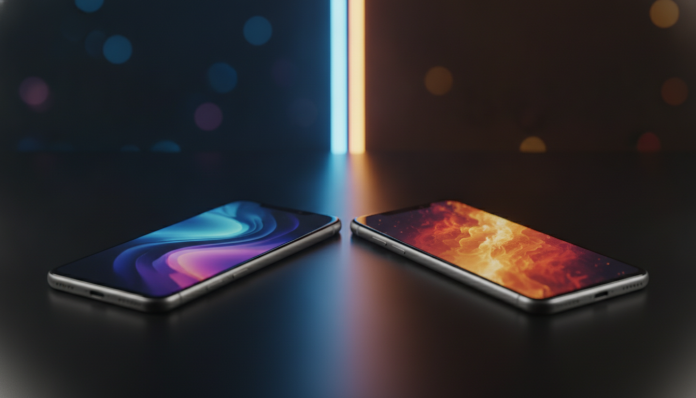

Snapdragon vs MediaTek: understanding what changes in everyday use
When you buy a smartphone, the chip name rarely appears prominently on the store shelf. What does appear is the camera with so many megapixels, the screen with so many inches, the battery that lasts two days. But behind all that is a processor that decides whether the phone will be smooth or stutter at the wrong moment, whether it will overheat during a video call or hold steady during a long gaming session. In 2026, the competition between Snapdragon (Qualcomm) and MediaTek (specifically the Dimensity line) became more heated than ever, because both manufacturers reached a level of maturity where neither is clearly inferior.
The problem is that “good on paper” and “good in real use” are different things. This comparison exists so you understand in which situation each platform performs better and, most importantly, which one makes more sense for your profile and what you’ll find available in Brazil.
The short answer: for general use and heavy gaming, Snapdragon still has an advantage in thermal efficiency and optimization ecosystem. For value for money and cameras in the mid-range segment, MediaTek Dimensity has delivered relevant improvements over the past two years and deserves serious consideration.
Comparison table: main chip families in 2026
| Criteria | Snapdragon 8 Elite / 8s Gen 3 | Dimensity 9400 / 9300+ |
|---|---|---|
| Manufacturer | Qualcomm | MediaTek |
| Manufacturing process | 3nm (TSMC) | 3nm (TSMC) |
| Main focus | Premium performance and efficiency | Performance, value for money |
| ISP (image processor) | Spectra | Imagiq |
| 5G connectivity | Integrated (X80 modem) | Integrated (M90 modem) |
| Wi-Fi support | Wi-Fi 7 | Wi-Fi 7 |
| Embedded AI | Hexagon NPU | APU 890 |
| Typical segment in Brazil | R$ 3,500 to R$ 9,000+ | R$ 2,200 to R$ 6,000 |
Prices refer to the price range of devices equipped with these chips, not the chip itself. Values vary by store, exchange rate, and time of purchase.
Daily performance: where the difference really shows
Specification on paper is one thing. What you feel when using the phone is another. In top-of-the-line chips from both families, the difference in raw performance in everyday tasks, such as opening apps, scrolling feeds, watching videos, and using multiple browser tabs, is barely noticeable for most people. Both the Snapdragon 8 Elite and Dimensity 9400 are 3-nanometer process processors (the smaller the number, the more efficient and powerful the chip, as if it were a factory that produces more parts in less space), which puts the two in a very similar power class.
The difference starts to appear in sustained load scenarios, that is, when the phone needs to work hard for a prolonged period. Demanding games like Genshin Impact or Call of Duty Mobile running for more than 30 minutes, video export on the phone, editing photos in RAW. In these scenarios, thermal management, which is how the chip distributes and dissipates heat to avoid having to reduce speed, tends to favor Snapdragon in devices that have a well-implemented vapor chamber design. This is not just the chip’s merit, but the ecosystem of optimizations between Qualcomm and partner manufacturers like Samsung, Xiaomi, and ASUS is more consolidated.
In the mid-range segment, the story changes a bit. The Dimensity 8300 and Dimensity 7300 deliver a value-for-money proposition that the equivalent Snapdragon (like the 7s Gen 3 or 6 Gen 3) cannot always surpass, especially in domestic devices from Motorola and Samsung that arrive in Brazil with Anatel certification and local warranty.
Camera and AI: where ISP makes a difference
The ISP, short for Image Signal Processor, is the component inside the chip that controls how photos are processed after the sensor captures light. Think of it as the digital darkroom that reveals the photo. The more capable the ISP, the better the performance in low-light conditions, the better the HDR (balance between light and dark areas in the same image), and the faster video processing.
The Spectra, Qualcomm’s ISP present in the Snapdragon 8 Elite, according to Qualcomm’s own information, supports simultaneous capture of multiple cameras with real-time processing and advanced 8K video features. The Imagiq, from MediaTek, also evolves cycle by cycle, and in the Dimensity 9400 the manufacturer claims support for 4K video at 60fps with native HDR and AI processing applied frame by frame.
In practice, camera quality depends much more on the physical sensor and the software the manufacturer implements than on the ISP alone. A Pixel 9 Pro with Tensor G4 can take better photos than a poorly calibrated Snapdragon 8 Elite device. What Snapdragon has an advantage in here is that more premium camera manufacturers choose the Qualcomm platform, so it’s easier to find devices with excellent cameras in this platform at the high end.
Connectivity, 5G, and the Brazilian context
Both top-of-the-line platforms in 2026 bring integrated 5G modems with support for frequencies used in Brazil, including the 3.5 GHz band which is the most common among national operators. To verify specific compatibility with the operator you use, consult the device’s technical sheet, which should list the supported frequency bands, and confirm with your operator which bands are active in your city.
A point that Brazilian readers need to consider is that Anatel certification is not automatically guaranteed by the chip: it is the responsibility of the device manufacturer. Buying a phone with Snapdragon or Dimensity imported without certification means operating irregularly and giving up local warranty and support. Devices sold officially in Brazil by Motorola, Samsung, Xiaomi, and others already come with this registration done, but imported versions of the same model may have different band configurations.
Support for Wi-Fi 7, present in both premium platforms, also won’t make much practical difference until Wi-Fi 7 routers become popular in Brazil. If you still use a Wi-Fi 5 router at home, this feature is irrelevant to your buying decision now.
Mid-range segment: where MediaTek shines in Brazil
Much of smartphone sales in Brazil happen in the R$ 1,500 to R$ 3,500 range. In this range, Motorola and Samsung dominate, and many of the best-selling models use MediaTek chips. The Dimensity 7300 and Dimensity 8300 appear in devices like intermediate lines from Motorola and Samsung Galaxy A, bringing 5G support, smooth performance for everyday use, and a final price that fits the budget of more people.
Snapdragon in this range still has a presence, especially in some Motorola Edge and Xiaomi Redmi Note models. But the proportion of devices with MediaTek in the Brazilian retail market grew over the past two years, according to market data from IDC Brasil and Counterpoint Research. This means that if you’re buying a domestic device with an invoice, warranty, and in the affordable price range, the chances of buying a device with MediaTek are greater than they were in 2023.
Just like when choosing PC components, as in the decision between SSD NVMe vs SATA: which to choose for your PC, the choice of smartphone processor is rarely the only variable that matters. The package, storage, RAM, software, and update support weigh as much as the chip itself.
Which to choose: recommendation by profile and budget
The choice between Snapdragon and MediaTek depends less on which is “the best chip” and more on which device makes sense for you.
Choose a device with Snapdragon if:
- You play heavy titles frequently and want long-term thermal consistency
- You use professional video or image editing on your phone a lot
- You want a premium device with guaranteed update support for several years (like Galaxy S or Xiaomi 15 Pro)
- You prefer a more consolidated ecosystem of accessories and integrations
Choose a device with MediaTek Dimensity if:
- You want good performance in the R$ 1,500 to R$ 3,500 range with 5G included
- You use your phone for general use, casual photography, social media, and streaming
- You buy from national stores with warranty and invoice and want value for money
- You’re between intermediate Motorola or Samsung devices and want to pay less without sacrificing smoothness
Price range:
- Snapdragon 8 Elite / premium: R$ 4,500 to R$ 9,000+
- Snapdragon mid-range: R$ 2,500 to R$ 4,500
- Dimensity 9400 / premium: R$ 3,500 to R$ 6,000
- Dimensity mid-range: R$ 1,500 to R$ 3,000
Frequently asked questions about Snapdragon and MediaTek
Is MediaTek inferior to Snapdragon?
Not absolutely. In the top-of-the-line chips of 2026, performance differences are small and depend very much on the device and use. The stigma that MediaTek is inferior comes from older generations, when Qualcomm had a larger advantage. Today the Dimensity 9400 competes head-to-head with the Snapdragon 8 Elite in many scenarios.
Does a phone with MediaTek heat up more?
Not necessarily. Heating depends on the device design, the vapor chamber used, and how the manufacturer calibrates thermal management, not just the chip. Premium devices with MediaTek and good cooling systems perform similarly to devices with Snapdragon in the same price range.
Which chip has better support in Brazil?
Both work normally in Brazil when the device comes with Anatel certification and is sold through official channels. The difference is in device availability: devices with MediaTek dominate the national retail market in the mid-range, while Snapdragon appears more in imported high-ends or in premium versions from brands like Samsung and Motorola.
Should I look at the chip before buying a phone?
Yes, but it’s not the only criterion. Also check the amount of RAM, storage type (UFS 3.1 or 4.0), software updates guaranteed by the manufacturer, and whether the device has Anatel certification. The chip matters, but the overall package decides the experience.
What to do with this information before buying
Before deciding, look at the complete technical sheet of the device, not just the chip name. Check which version of the chip is present (there are variants within each family), how much RAM comes with it, if storage is UFS 4.0, and for how many years the manufacturer guarantees system updates. These variables often differentiate two devices with the same chip more than the chip itself.
If you’re evaluating a device for heavier content editing, it’s worth reading specific comparisons of camera and video processing for the model that interests you, because just as when choosing a graphics card for editing: how to choose the right one, the right component depends on the task you’ll perform frequently. In 2026, both Snapdragon and MediaTek deliver capable chips. The right question is not “which is better”, but “which device, with which chip, does what I need at the price I can pay”.